Perennial Spacing Calculator
Estimate perennial plant counts, usable bed area, mature canopy fill, pot ordering, and access allowances for borders, island beds, pollinator strips, shade gardens, and long-lived mixed plantings.
Perennials often look open in year one and full by year three. Use this calculator to balance instant coverage, airflow, mature crown size, maintenance access, and nursery ordering.
Perennial Layout Results
Plant count is based on usable area after border offset and access allowance, then adjusted by spacing pattern, fill-year intent, and ordering buffer.
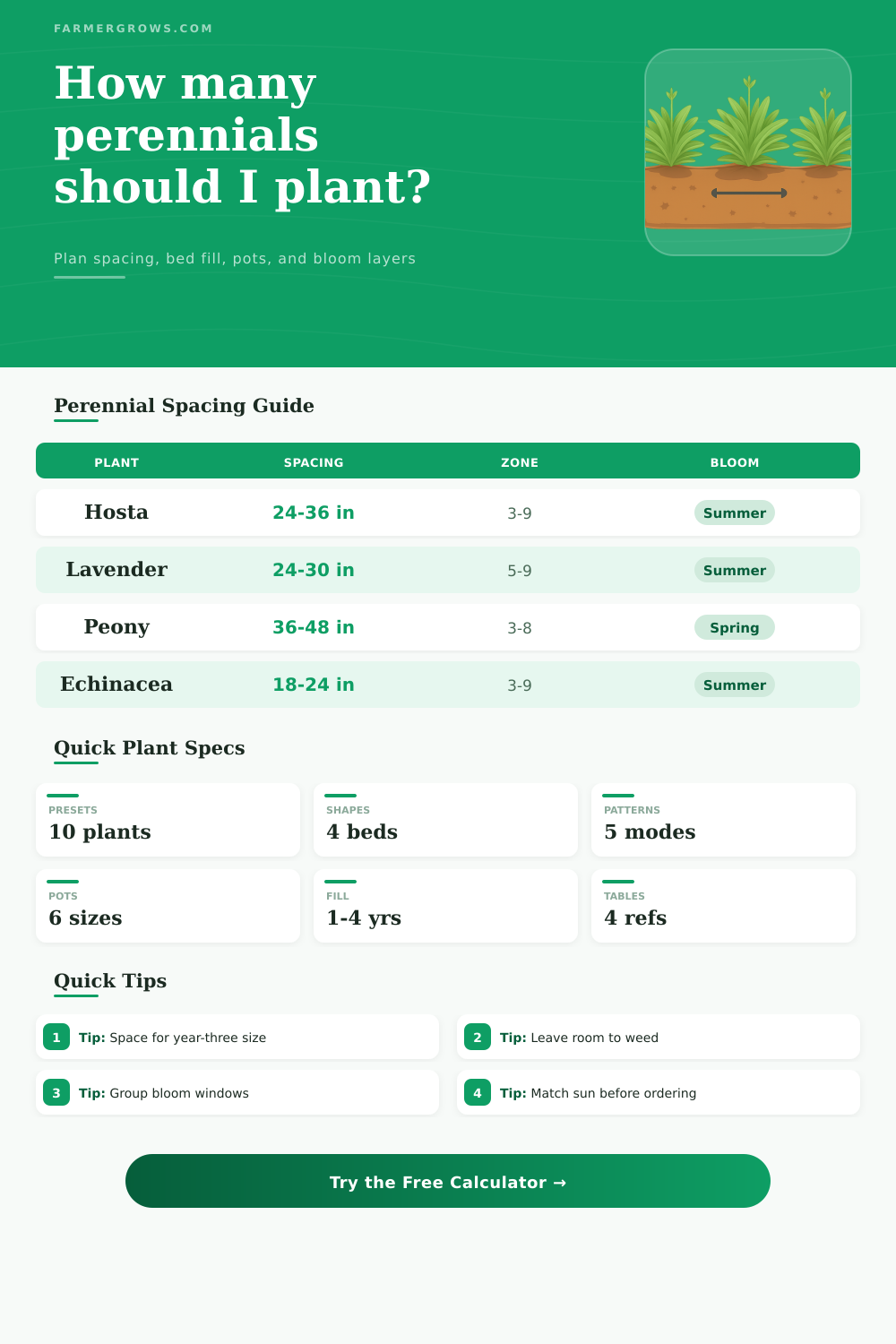
| Perennial | Recommended spacing | Best pattern | Use in bed | Spacing caution |
|---|---|---|---|---|
| Hosta | 24 to 42 in | Specimen or drift | Shade foliage masses and foundation beds | Large cultivars need far more room than minis |
| Lavender | 24 to 30 in | Grid or ribbon | Sunny edges, herb borders, low hedges | Crowding traps humidity around woody crowns |
| Echinacea | 18 to 24 in | Staggered or drift | Pollinator beds and prairie-style blocks | Leave space for self-sown seedlings if desired |
| Daylily | 18 to 30 in | Grid or ribbon | Driveway strips, slopes, and durable borders | Dense clumps eventually need division |
| Peony | 36 to 48 in | Specimen rows | Long-term cutting rows and focal points | Deep shade and tight spacing reduce bloom |
| Astilbe | 18 to 24 in | Drift clusters | Moist shade and woodland edges | Dry soil slows fill and browns leaf edges |
| USDA zone band | Reliable choices | Watch carefully | Planting window | Spacing note |
|---|---|---|---|---|
| Zones 3 to 4 | Hosta, peony, daylily, echinacea | Lavender in wet winter soil | Spring to early fall | Allow winter heave room around crowns |
| Zones 5 to 6 | Most listed perennials | Dry shade and summer drought | Spring or fall | Balanced spacing usually fills by year three |
| Zones 7 to 8 | Salvia, yarrow, rudbeckia, lavender | Peony chill needs in warm pockets | Fall is often easiest | Airflow matters in humid summers |
| Zone 9 | Lavender, salvia, yarrow in suitable soils | Hosta and peony heat stress | Fall to mild winter | Use looser spacing where heat traps moisture |
| Zone 10 | Climate-adapted substitutes may be needed | Cold-climate crowns | Cool season planting | Plan by local cultivar performance |
| Bloom timing | Perennial examples | Layer role | Spacing feel | Design use |
|---|---|---|---|---|
| Spring | Peony, salvia start, some daylily | Early focal color | Moderate to wide | Anchor beds before summer color arrives |
| Early summer | Lavender, astilbe, daylily | Mid border rhythm | Moderate spacing | Repeat in ribbons for a clean border line |
| Midsummer | Echinacea, rudbeckia, yarrow | Pollinator mass | Staggered or drift | Use larger groups for visible flower impact |
| Late summer | Rudbeckia, bluestem color, salvia rebloom | Season extension | Open enough for airflow | Mix with grasses to avoid gaps |
| Foliage season | Hosta, grasses, daylily foliage | Structure after bloom | Based on mature spread | Keep non-bloom texture in the spacing plan |
| Plant group | Mature height | Mature spread | Front or back | Maintenance access |
|---|---|---|---|---|
| Low mounds | 10 to 20 in | 12 to 24 in | Front edge | Hand-weeding access from path is enough |
| Medium clumps | 18 to 36 in | 18 to 30 in | Middle layer | Leave room for deadheading and division |
| Tall flowers | 36 to 60 in | 18 to 36 in | Back or center | Allow staking and stem cleanup access |
| Large foliage | 18 to 48 in | 30 to 60 in | Shade anchors | Do not place large crowns against hard edging |
| Ornamental grasses | 30 to 60 in | 24 to 42 in | Back or repeated rhythm | Leave room for spring cutback bundles |
For long-lived borders: Use the mature spread as the main spacing guide, then fill first-year gaps with annuals, mulch, or small bulbs instead of crowding permanent crowns.
For easier maintenance: Reserve small pockets for stepping, weeding, division, and drip repair. A dense perennial bed is only useful if you can still care for it.
Getting your spacing correct in a perennial bed is one of those decisions that will shape the garden for years. Planting too closely together mean fighting overcrowding and disease. Planting too far apart means having a thin-looking bed. The difference determines whether flowers look like separate clumps or part of a full planting. It also affects how much you weed each season.
First, know what you’re calculating: Is it mature spread (how far across they’ll go in time)? Or is it spacing on center, which is how much space you leave between them? Because you’re thinking about different moment in time here, these two figures usually don’t correspond. In one case the plants pushes up against each other; in the other, their crowns are tiny.
Why Garden Spacing Is Important
Enter those two figures into calculator, plus a figure for the bed’s shape and how soon you want the planting to appear full, and math happens for you. The size of the bed itself does matter (more than most realize). If it’s a long narrow border, it has less usable surface area on the sides different than a round island bed. Subtracting access paths and stepping pockets reduces space where you can actualy plant. And you have to get in there without squashing the stems! The tool accounts for that, so you won’t overestimate your plant count and find yourself unable to weed later.
The USDA zone and sun exposure is included as inputs because a plant that is fine in full sun in zone 5 will not behave the same way in part shade or zone 8. You’re never overriding your personal understanding of what happens where; instead, if you choose a species that tends to be out of its typical range, calculator flags this. So you know to adjust expectations, before ordering.
The same applies to fill-year selection: a one-year target means tighter spacing (so it will look like an intentional bed sooner). A four-year target mean looser spacing (because eventually it will get to full-size on its own). On the page, these are laid out as reference tables for various commonly grown species. At a glance, you see: Peonies needs more room than an echinacea does. Lavender hates being crowded if and when it grows its woody stems. Such information matters if you’re mixing up things that bloom at different times. It also matters if you’re trying to keep upkeep manageable in a bigger bed.
But you can’t know from the numbers how this planting will feel when it matures. What seems like just-right spacing on paper might feel too regimented in real life, yet a freer grouping might mean more weed-pulling in year two. That’s where the buffer percentage comes in. It provides some added plants for substitutions and curves. There are also always some losses between nursery and garden.
But that’s where running the numbers pays off: It makes you stop making guesses when your tendency is to overcorrect, you are very likely to do that. It helps you know how much you can fit onto a bed; it makes you plan for access even if the crowns aren’t filling in yet. And it lets you come to terms with the fact that this year won’t look like third year, or even second. That slight time adjustment turns a group of plants into a garden that continues to work.
You should of used this tool earlier.