House Garden Nutrient Calculator
Plan N-P-K for raised beds, vegetable plots, containers, herbs, berries, roses, and flower borders using crop demand, soil test credits, compost, fertilizer grade, source type, and application timing.
This garden calculator works in pounds of plant-available N, P2O5, and K2O. Use local soil-test guidance when available, especially where phosphorus is already high.
Fast leaves use steady nitrogen, but too much soluble feed can make soft growth.
Fruiting crops need potassium support after roots are established and bloom begins.
Carrots, beets, onions, and radishes prefer adequate P-K without excess nitrogen.
Annual flowers need even fertility for stems, buds, and repeated cutting cycles.
Culinary herbs usually need less fertilizer than vegetables and can lose flavor if pushed hard.
Strawberries and small berries like modest nitrogen and dependable potassium.
Roses use regular N-K during active growth, with phosphorus only when soil tests call for it.
Potting mixes hold fewer nutrients, so lower doses are often applied more often.
Garden Nutrient Plan
Calculated nutrient plan will appear here.
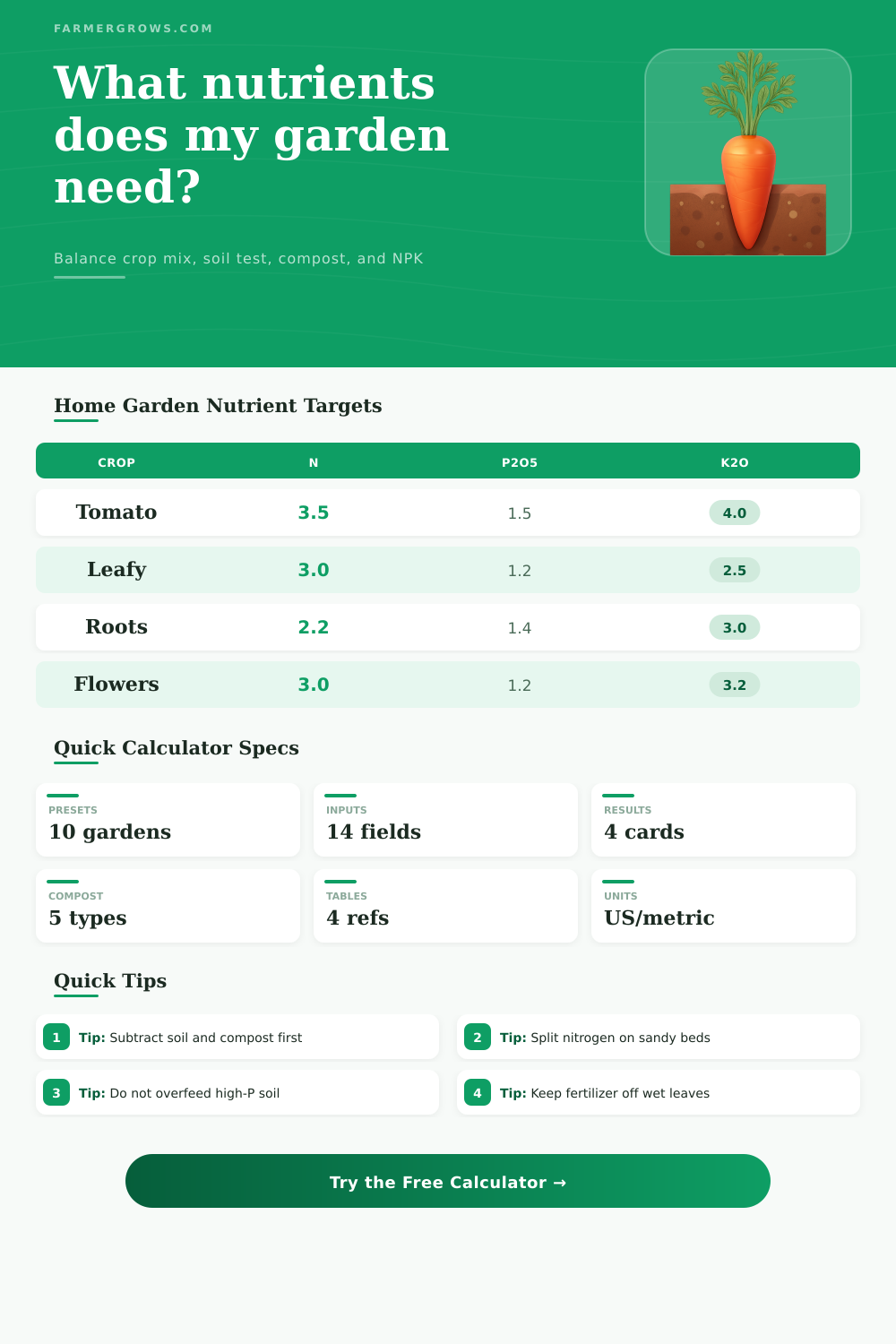
| Crop mix | N target | P2O5 target | K2O target | Garden note |
|---|---|---|---|---|
| Leafy greens | 3.0 lb/1000 ft² | 1.2 lb/1000 ft² | 2.5 lb/1000 ft² | Split nitrogen for lettuce, spinach, chard, and kale. |
| Tomato, pepper, eggplant | 3.5 lb/1000 ft² | 1.5 lb/1000 ft² | 4.0 lb/1000 ft² | Keep N moderate after bloom and do not short potassium. |
| Roots and onions | 2.2 lb/1000 ft² | 1.4 lb/1000 ft² | 3.0 lb/1000 ft² | Too much nitrogen can push tops instead of roots. |
| Annual cut flowers | 3.0 lb/1000 ft² | 1.2 lb/1000 ft² | 3.2 lb/1000 ft² | Balanced feeding supports stems, buds, and repeat harvest. |
| Berries and strawberries | 2.0 lb/1000 ft² | 0.8 lb/1000 ft² | 2.2 lb/1000 ft² | Use gentle rates and avoid late soft growth before winter. |
| NPK conversion | Formula | Example | What it means |
|---|---|---|---|
| Fertilizer grade | Percent / 100 | 5-10-10 gives 0.05 lb N per lb | Multiply product pounds by the grade fraction. |
| Product for nutrient | Need / grade fraction | 1 lb P2O5 / 0.10 = 10 lb product | The nutrient with the highest product rate limits the plan. |
| Metric rate | lb/1000 ft² x 0.488 | 2 lb/1000 ft² = 0.98 kg/100 m² | Useful for metric garden beds and allotments. |
| P to P2O5 | P x 2.29 | 1 lb P = 2.29 lb P2O5 | Fertilizer labels use phosphate, not elemental P. |
| K to K2O | K x 1.20 | 1 lb K = 1.20 lb K2O | Fertilizer labels use potash, not elemental K. |
| Compost source | Typical analysis | First-year N | P-K release | Use note |
|---|---|---|---|---|
| Finished yard compost | 1.2-0.6-1.0 | About 15% | Moderate P, good K | General vegetable bed conditioner. |
| Leaf mold compost | 0.6-0.2-0.4 | About 10% | Low nutrient credit | Excellent organic matter, light fertilizer value. |
| Composted manure blend | 1.8-1.2-1.8 | About 25% | Higher P and K | Watch phosphorus if soil already tests high. |
| Mushroom compost | 1.1-0.9-1.3 | About 18% | Moderate to high | Use cautiously around salt-sensitive seedlings. |
| Worm castings blend | 1.5-0.8-1.2 | About 20% | Moderate | Good for transplants and container mixes. |
| Application timing | Best nutrient focus | Typical share | Good for | Caution |
|---|---|---|---|---|
| Preplant incorporation | P2O5 and K2O, some N | 40% to 100% | Raised beds, roots, new flower beds | Do not bury hot fertilizer against seed. |
| Transplant band | Small N plus P | 20% to 35% | Tomatoes, peppers, annual flowers | Keep salts away from tender roots. |
| Sidedress | N with some K | 35% to 60% | Leafy crops, brassicas, tomatoes | Water in and keep granules off foliage. |
| Bloom or fruit feed | K2O and modest N | 25% to 50% | Tomatoes, squash, roses, cut flowers | Too much N can delay flowers or fruit. |
| Fall soil build | P2O5 and K2O | 50% to 100% | Perennials, berries, empty beds | N is easily lost before spring growth. |
Compost and soil test credits should reduce the fertilizer target before you calculate a bag rate. That keeps home beds from drifting high in phosphorus and salts.
Put immobile P and K in the root zone before planting, then use smaller sidedress or liquid feeds for nitrogen during fast growth.
Knowing what’s missing (what the plants require) and what’s there (what the soil provides), is key to getting nutrient balance correct in a home garden. Too often we purchase fertilizer because plants appears exhausted, but more commonly they are off-balance, not lacking one single thing.
The calculator makes you think about what was amended or credited last season by forcing you to tally those up. That way you won’t make the most frequent error: applying too much phosphorous over the years until your soil test show alarmingly high levels.
How to Get the Right Balance for Your Plants
What’s this? Your crop selection makes a difference (surprise, surprise). For example, leafy crops take off quickly pulling down nitrogen gradually as they develop. Once a tomato plant sets its fruit, however, it wants some potassium, too, but root crops can’t stand to have so much nitrogen. It will grow leaves instead of producing food for eating.
With the calculator, you select the main crop type, or mix it up; and it recalculates based off that. Still: Is it mostly tomatoes, or lettuce? That’s your call, but after that, arithmetic is simple.
Then there’s compost factor. Even seemingly rich finished yard-waste isn’t a big source of nitrogen in its first year. Compost made with manure as an ingredient has even higher levels of available nitrogen, but it also comes with some phosphorus. If your soil test indicates sufficient or high phosphorus levels, the additional phosphate credit from compost will cause calculator to advise against adding any additional phosphate fertilizer. At the very least, it will reduce how much you should of add.
This effect on the P-K balance is something many gardener don’t consider, and then find their foliage growing well and fruits not setting well. The outcome can vary depending on type of source and timing. For instance, if you use a slow-release product at planting time, it’s not the same as applying nutrients via fertigation every couple of weeks. It will include what percentage of each nutrient are available within your selected time frame.
Why does that matter? This matters if you’re dealing with containers that go dry between waterings, or a bed made off sand that rapidly loses nitrogen.
Soil test credits are the least-used input of all. A simple test will provide a baseline of what’s already present in soil for available forms of nitrogen, phosphorous and potassium. That way you don’t add more than needed when figuring out your fertilizer. This also protects nearby waterways from too many nutrients washing off after heavy downpour. Enter the figures into the calculator, and it subtracts them automatically for you.
It’s not about nailing down exact figures in pencil. It’s about providing enough nutrients to support the crop during its growing period without overfeeding it, which can trap micronutrients or cause salt buildup. Understand this, and know what the soil can hold and what you can safely add. This makes your decisions make more sense and your results more consistent year to year if you think of the calculator as an ongoing dialog.
What do the plants need? What will the soil hold? What can I safely add?