Plant Watering Calculator
Estimate weekly water, gallons per watering, drip run time, and root-zone moisture reserve for vegetables, herbs, berries, fruit trees, raised beds, and containers.
Choose a common crop setup to prefill plant type, bed size, soil, sun, mulch, stage, drip flow, and watering rhythm. Then adjust for your real garden conditions.
Your Watering Plan
Results update after calculation.
Needs steady water during blossom and fruit fill. Dry swings raise cracking and blossom-end rot risk.
Small roots dry quickly. Use lighter, more frequent watering and shade during heat.
Prefers even moisture without soggy roots. Stress can slow fruit set and size.
Keep the root zone moist while avoiding water packed around crowns and fruit.
Fine roots sit near the surface, so mulch and steady moisture matter more than deep soaking.
Water thoroughly, then allow the upper mix to breathe before the next deep event.
Consistent moisture helps carrots and beets size evenly and reduces splitting.
Large leaves and fruiting vines can move a lot of water on hot sunny days.
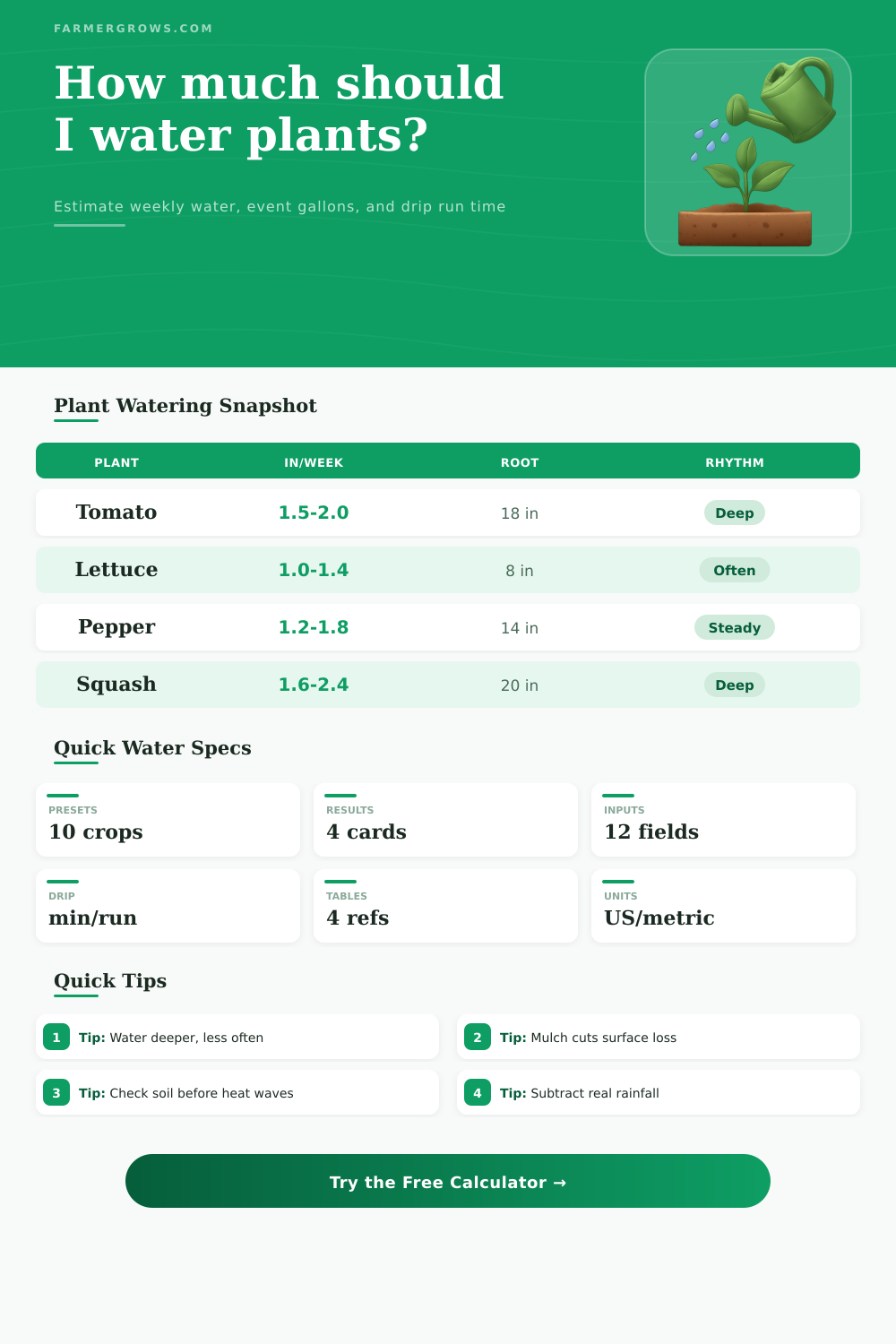
| Plant group | Typical inches per week | Root zone used | Best watering style | Watch point |
|---|---|---|---|---|
| Tomatoes | 1.5 to 2.0 in | 12 to 24 in | Deep drip or soaker, steady rhythm | Avoid dry-wet swings during fruit fill |
| Lettuce and leafy greens | 1.0 to 1.4 in | 6 to 10 in | Frequent light-to-moderate watering | Heat and shallow roots cause fast wilt |
| Peppers and eggplant | 1.2 to 1.8 in | 10 to 18 in | Moderate deep watering | Do not keep roots saturated |
| Strawberries | 1.0 to 1.5 in | 8 to 12 in | Drip under straw or leaf mulch | Keep crowns open and fruit dry |
| Squash, cucumber, melon | 1.6 to 2.4 in | 14 to 24 in | Deep events near root area | Large leaves wilt fast in hot wind |
| Container size | Approx surface area | 1 inch water equals | Common crop | Watering note |
|---|---|---|---|---|
| 5 gal / 19 L | 1.1 sq ft | 0.7 gal / 2.6 L | Herbs, lettuce, compact flowers | Often needs daily checks in heat |
| 10 gal / 38 L | 1.8 sq ft | 1.1 gal / 4.2 L | Peppers, eggplant, herbs | Mulch the top of dark pots |
| 20 gal / 76 L | 2.8 sq ft | 1.7 gal / 6.5 L | Tomato, blueberry, dwarf shrub | Deep water until mix is evenly moist |
| 30 gal / 114 L | 3.7 sq ft | 2.3 gal / 8.6 L | Citrus, potato, squash | Check drainage before adding volume |
| 45 gal / 170 L | 4.9 sq ft | 3.1 gal / 11.6 L | Dwarf fruit tree, large berry | Water in slow pulses to wet the profile |
| Soil or mix | Available water | Practical depletion | Best frequency | Field check |
|---|---|---|---|---|
| Sandy soil | 0.04 to 0.07 in/in | 35% to 45% | Smaller, more frequent events | Feels loose and dries quickly |
| Loam garden soil | 0.11 to 0.15 in/in | 45% to 55% | Deep events every few days | Forms crumbly ball when moist |
| Clay loam | 0.14 to 0.18 in/in | 40% to 50% | Slow watering, longer interval | Stop before puddling or sealing |
| Raised bed mix | 0.08 to 0.12 in/in | 40% to 55% | Moderate events under mulch | Top dries sooner than lower mix |
| Potting mix | 0.06 to 0.10 in/in | 35% to 50% | Frequent checks, thorough soak | Rewet slowly if mix turns hydrophobic |
| Growth stage | Water factor | Root depth behavior | Best practice | Stress sign |
|---|---|---|---|---|
| Seedling or transplant | 0.70 | Shallow active roots | Keep top zone evenly moist | Wilting after transplant shock |
| Vegetative growth | 0.90 | Roots expanding quickly | Encourage deeper roots with measured soaks | Soft growth from constant saturation |
| Flowering or fruit fill | 1.15 | High demand and sensitive timing | Prevent large dry swings | Blossom drop or fruit cracking |
| Mature maintenance | 1.00 | Full working root zone | Match watering to soil reserve | Midday wilt that does not recover |
| Late harvest or hardening | 0.80 | Demand easing for many crops | Reduce gradually, never abruptly | Leaf scorch or split roots |
Watering depth is not the same as hose time. Calibrate emitters with a bucket once, then use the calculator run time as a repeatable starting point.
After a new schedule, dig a small test hole near the root zone. Moist soil below a dry surface is often better than watering again too soon.
Containers need regular attention. Adjust your watering (above) to the conditions. If they’re baking in sun, do it more; if they’re shadier, less often. Match watering to how much water the soil can hold (whether soilless mix or potting soil) not to a calendar. When growing vegetables in the ground or in pots, match watering to what the plants need different than following a set schedule.
Get that balance right, and results happen fast: Too wet-dry-wet for tomatoes, and you get blossom end rot and cracking. Lettuce bolt or wilts when kept too long in heat. Think about what the root zone is getting, not merely “days since last watering.” That calculation take into account the weather, the mulch…and the fact that soil stores some water. It’s a complex equation, which takes into account several factor.
How to Water Your Garden Plants Correctly
The first factor is plant type. For example, squash and tomatoes is thirstier than root crops or herbs. Next is growth stage. Fruiting plants and those in flower need more water then young plants that just went in or older ones setting down their roots to harden off. Then there’s weather: Hot, breezy days increase the total, while a cool spell lowers it. Soil type and mulch affect how much water is held between watering times, because mulch stops water from evaporating from surface. Clay loam will hold more moisture than sandy soil, but you should of add it at a slower rate so it doesn’t run off.
What about containers? Oh, they affect the picture, too. Small pots dry faster and has less reserve than a raised bed of same footprint. When you plug in your data, the calculator (above) takes those factors into account. This includes your bed size, how much water is needed, what kind of soil it is, if there has been any rain lately, and what style of irrigation you use.
In return, it gives you a few important numbers: How many gallons are needed each week? How much will go onto things at each watering? How long should it runs on drip emitters to get everything? And about how long will the root zone retain moisture, in days? Those numbers let you know if you’re running out between waterings; if so, they’ll indicate how many days of usable moisture remain.
The other error is not adjusting the watering schedule based off the weather. Shallow-rooting plant may need a half inch in a few days. A few days of effective rain will provide that. However, many gardeners stick to their full schedule and saturate the soil which encourages disease. Another way to be inefficient is neglecting how efficient your irrigation system is. Mulched drip systems are far more efficient than overhead sprays, which waste much water to wind and evaporation. Applying the same volume has a very different effect down at the root zone. The tool takes that into account, based off the efficiency percentage that describes your set-up.
More root depth: Most people have no idea how deep their plants’ roots go. Squash and tomatoes will tap into twice as much soil when grown up as they did when seedlings, but lettuces (for instance) might only be using the first eight inches or so. Watering to the bottom of the bed (or not) is one thing; if you’re repeatedly skipping the lower part of the soil, the plant basically has a shallower container to livig in than the bed dimensions imply. A finger poke several inches down just before the next event will give you a fast reality check, and nothing replaces it for numbers.
We’re aiming to prevent droughts, not to have no water at all; we just want to make sure the tank never runs dry between refills. Even when it appears to be wet on top, when the time between refills is longer than what the soil can deliver each day, plants is stressed. Usually you can close that gap faster by adjusting the mulch thickness, emitter rate, or watering frequency then by simply adding more water.
Next, the calculator provides a repeatable starting point rather than a fixed prescription. There’s no exact prescription; it’s just a starting point you can use again and again. After you get an estimate of reserve and run time for your particular containers (or beds), some quick little checks in the field tell you if those figures hold true. All those tweaks over a growing season equate to less surprise in the heat wave, and steadier growth overall.