NPK Ratio Calculator
Compare a fertilizer label or custom product blend against a desired N-P-K ratio, crop stage, area, soil-test need, release type, and bag plan.
N-P-K labels report nitrogen as N, phosphorus as phosphate P2O5, and potassium as potash K2O. This calculator compares the label ratio and estimates product required from the entered soil-test need.
Grades such as 46-0-0, 32-0-0, and 21-0-0 fit corn, grass, wheat, and leafy growth when P and K already test adequate.
10-10-10 or 13-13-13 is simple for mixed gardens, but it can overfeed phosphate on soils that already have high P.
DAP, MAP, bone meal, and 5-10-10 support starter roots and flowering crops when placement and salt safety are managed.
0-0-60 or sulfate of potash fits hay, potatoes, legumes, fruiting vegetables, and low-K soil without adding extra nitrogen.
NPK Ratio Results
Calculated fertilizer ratio, soil-test rate, total product, and available nutrient delivery.
| Grade | Material example | Normalized ratio | Best fit | Watch-out |
|---|---|---|---|---|
| 46-0-0 | Urea | 1-0-0 | Corn, wheat, grass topdress | Volatilization if left on warm surface |
| 32-0-0 | UAN solution | 1-0-0 | Liquid side-dress and sprayer systems | Burn risk on foliage at high rates |
| 21-0-0 | Ammonium sulfate | 1-0-0 | N plus sulfur for pasture and brassicas | Acidifying over repeated use |
| 18-46-0 | DAP | 1-2.56-0 | Starter phosphate with some N | Keep seed-safe placement distance |
| 11-52-0 | MAP | 1-4.73-0 | High-P starter blends | Can oversupply P on high-test soil |
| 0-0-60 | Muriate of potash | 0-0-1 | Potassium build for hay and soybeans | Chloride sensitivity on some crops |
| 0-0-50 | Sulfate of potash | 0-0-1 | K and sulfur for chloride-sensitive crops | Usually costs more per unit K |
| 10-10-10 | Complete garden fertilizer | 1-1-1 | Mixed beds with balanced need | May apply too much P |
| 5-10-10 | Vegetable starter blend | 1-2-2 | Tomato, pepper, potato, root crops | Low N for heavy leaf demand |
| 5-3-3 | Organic vegetable fertilizer | 1-0.6-0.6 | Slow-release garden feeding | Needs warm soil for mineralization |
| Crop or stage | Useful ratio | Typical need pattern | Common fertilizer direction | Field note |
|---|---|---|---|---|
| Seedling establishment | 2-1-2 | Moderate N with enough K | Light complete starter | Avoid salty bands near seed |
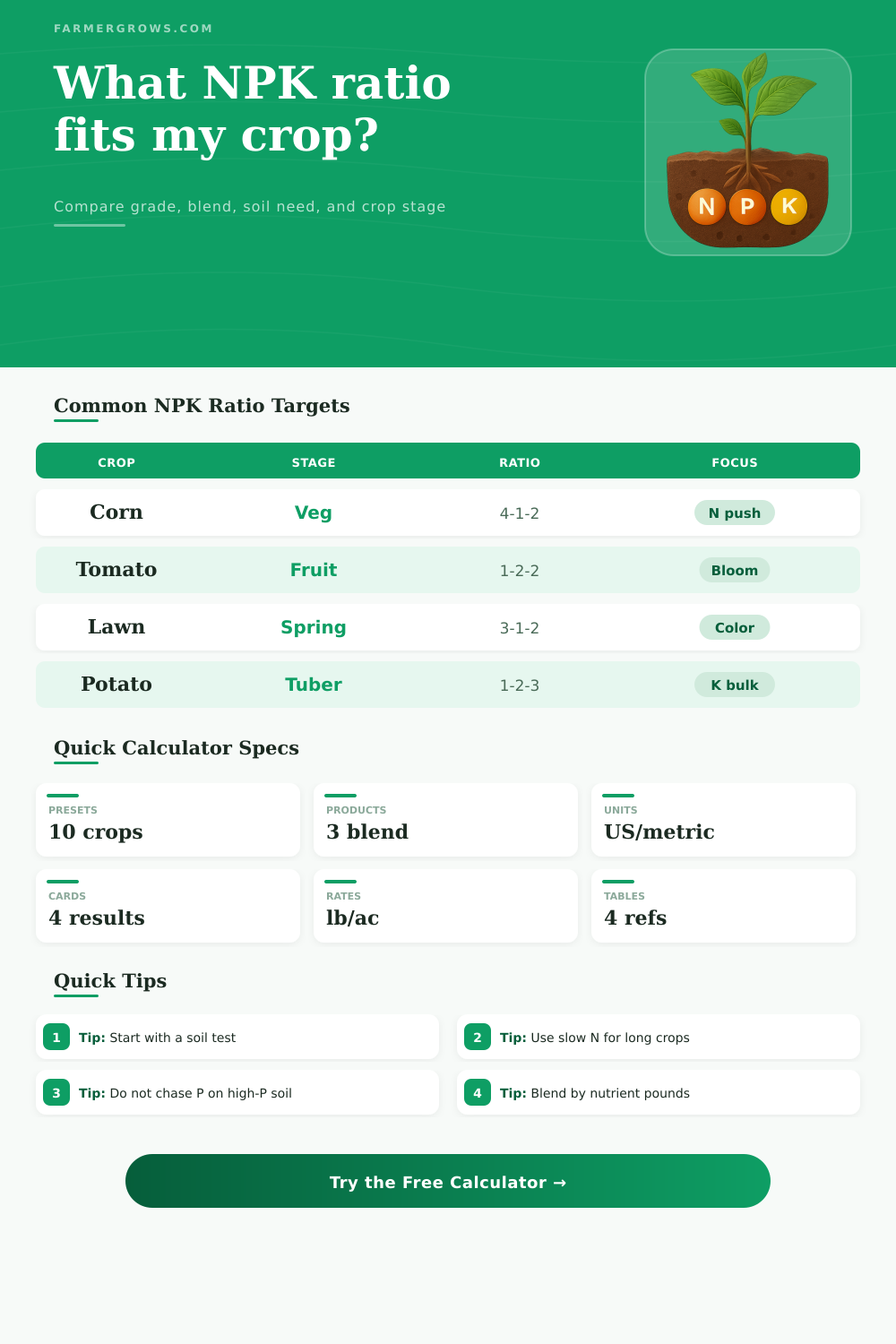
| Vegetative corn | 4-1-2 | Heavy nitrogen demand | Urea, UAN, ammonium sulfate plus K if needed | Split N on sandy or wet fields |
| Tomato fruiting | 1-2-2 | More P and K than N | 5-10-10, 4-8-8, or blended organic | Too much N can delay fruiting |
| Lawn spring growth | 3-1-2 | N drives color and density | 24-0-11 or similar with low P | Skip P unless soil test calls for it |
| Potato tuber bulking | 1-2-3 | Strong K and moderate P | 5-10-15, potash blend, sulfate of potash | Chloride-sensitive programs may prefer SOP |
| Soybean maintenance | 0-1-3 | P and K replacement | MAP plus potash, or potash alone if P is high | N fertilizer is rarely useful after nodulation |
| Alfalfa hay removal | 0-1-4 | High potassium removal | Potash plus phosphate as soil test indicates | K deficiency reduces stand persistence |
| Orchard maintenance | 2-1-2 | Balanced annual replacement | Slow-release N with K as needed | Band under drip or active root zone |
| Task | Formula | Example | Result |
|---|---|---|---|
| Grade to nutrient pounds | Product lb x grade percent / 100 | 50 lb of 10-10-10 | 5 lb each N, P2O5, K2O |
| Nutrient need to product rate | Need lb/ac / nutrient fraction | 80 lb N / 0.46 | 174 lb/ac urea |
| Weighted blend grade | Total nutrient lb / total product lb x 100 | 100 lb urea + 100 lb potash | 23-0-30 blend |
| Normalize ratio | Divide N, P2O5, K2O by smallest positive part | 5-10-10 | 1-2-2 |
| lb/ac to kg/ha | lb/ac x 1.12085 | 100 lb/ac | 112.1 kg/ha |
| kg/ha to lb/ac | kg/ha x 0.89218 | 100 kg/ha | 89.2 lb/ac |
| Acres to hectares | Acres x 0.404686 | 10 acres | 4.05 ha |
| Square feet to acres | Square feet / 43,560 | 5,000 ft2 | 0.115 acre |
| Blend example | Product weights | Calculated grade | Ratio | Crop fit |
|---|---|---|---|---|
| Corn N-K side-dress | 200 lb urea + 100 lb potash | 30.7-0-20.0 | 1.54-0-1 | Corn or grass where K is also low |
| Tomato fruiting bed | 100 lb 5-10-10 + 40 lb compost 3-2-3 | 4.4-7.7-8.0 | 1-1.77-1.83 | Fruit set with moderate N |
| Soybean P-K build | 100 lb MAP + 170 lb potash | 4.1-19.3-37.8 | 1-4.73-9.27 | Low P and K soil before planting |
| Organic vegetable base | 80 lb 5-3-3 + 50 lb bone meal 3-15-0 + 40 lb kelp 1-0-2 | 3.5-6.2-2.4 | 1.45-2.58-1 | Slow garden starter with extra P |
| Alfalfa maintenance | 120 lb MAP + 240 lb potash | 3.7-17.3-40.0 | 1-4.73-10.91 | Hay fields needing P and high K |
| Balanced garden blend | 100 lb 10-10-10 + 50 lb 5-3-3 | 8.3-7.7-7.7 | 1.09-1-1 | Mixed vegetables with balanced need |
Soil-test first: A pretty ratio is not always an agronomic fit. If phosphorus already tests high, choose a low-P grade even when the crop-stage ratio looks balanced.
Blend by nutrient pounds: Product weights only matter after each material's analysis is converted to pounds of N, P2O5, and K2O in the blend.
What are those numbers on fertilizer bags? Most bags of fertilizer is labeled with three numbers. Those are the percentages of nitrogen, phosphate, and potash in the mix, which is called NPK. But do you realy need that amount in this fertilizer now for this crop, this stage? You will if those figures matches the ratio calculator’s prescription, which is why the tool is useful.
It tells you how many times your current grade fits into the required ratio (according to your soil test), which then tell you how much product you must apply to reach the correct level. Each of these inputs influences the answer in a real-world fashion. The size of your area (entered at “enter”) affect the rate that’s calculated. It is not just a theoretical number; it is based off actual square feet or acres you enter.
How to Use the Fertilizer Calculator Correctly
Soil-test needs reflect what’s really missing, as opposed to simply choosing a trendy mix and crossing your fingers; this is why many grower prefer starting here rather then with a popular mix-and-hope-it-matches formula. Another critical input is release type. Coated or organic material won’t behave like a fast-acting mineral fertilizer would, nor vice versa, and the calculator take this into account in adjusting its first-season estimate. This adjustment helps determine if one application will do the trick, or whether splitting up treatments makes more sense.
One recipe does not suit them throughout their entire life. For example, early on when they are stretching out leaves, they may prefer more nitrogen; later, during the tuber or fruiting phases, they may need more potassium and phosphorous. You can change crop stage and calculator updates accordingly (no retyping everything). And if you want to mix your own ingredients? There’s a place for the blend weights too.
Enter exact number of pounds for each ingredient. It will recalculate the blended grade so the final recommendation is based on what you will actualy spread, not just one package label. The biggest error is not mathematical, though: People buy a “balanced” ratio because it appears so on paper, regardless of what their soil test says. Adding more phosphorous as part of a “complete” fertilizer if your phosphorus level is already high just creates a surplus that might go unused forever. Conversely, you get too little (if potassium is low) and choose a grade with near-zero percent K.
The calculator flags these differences by matching supplied nutrients to the ones you enter. Ultimately, the grower must decide if an oversupply are okay or if another product would of make more sense. There are also some practical considerations to think about. Timing, for instance, and placement can all ruin even the most perfect ratio.
This could happen if soluble phosphorus is put in an area that seedlings might not reach safely, or if nitrogen turns into gas on a hot surface. The release-type setting does provide a general idea of when something will become available, but actual circumstances like how it’s incorporated in the soil, its moisture status, and soil temperature will all come into play. This is one reason to treat this type of tool more as a planning aid than a final prescription.
The page’s reference tables shows a pattern (though not a rule) to familiarize you with common grades and the crops they are usually used for. If a field has adequate phosphate and potash, a high-nitrogen material would suit grass or corn; a low-nitrogen, high-potash mix would be good for potatoes, or for growing hay where reserve-building is most important. The calculator just makes those patterns concrete, enabling you to calculate exactly how much of what to apply before heading out into the yard with your spreader.
When used together, both the context and the numbers stays fixed in that same way. The tool does the math. You provide what you know about the crop and the growing conditions. It shows you where your choice of grade lie relative to the rest of the range. Is the difference close-enough? Or might another approach get the goods to you more efficienty? That’s the kind of clarity that transforms a bag label from a mystery to a working plan.