Garden Arch Calculator
Estimate trellis arch length, rib count, frame material, post embedment, vine load, path clearance, and plant spacing for edible and ornamental garden arches.
Choose a real trellis situation, then adjust the span, run length, vine, or post depth for your garden path.
Garden Arch Results
Your arch estimate will appear here.
Good for narrow spring tunnels when ribs are close and wind exposure is modest.
A panel tunnel carries foliage evenly and gives harvest access from both sides.
Use stronger posts, deeper embedment, and a wide path for pruning and picking.
Plan for woody growth and twisting stems; light seasonal arches are not enough.
| Arch geometry | Length basis | Best fit | Planning note |
|---|---|---|---|
| Round hoop or tunnel | Half ellipse using span and height | Cattle panel, rebar, PVC, flexible rods | Efficient material path and good shoulder clearance. |
| Gothic pointed arch | Round arc with extra peak allowance | Roses, ornamentals, narrow paths | Sheds foliage outward and gives a taller center. |
| Flat-top arbor frame | Two uprights plus top span | Cedar, treated wood, steel tube | Simple cuts; add diagonal bracing for heavy vines. |
| Lean-in A-frame trellis | Two sloped legs meeting at ridge | Beans, cucumbers, seasonal crops | Fast to build but narrows at shoulder height. |
| Box arbor | Square shoulders with top crosspiece | Permanent walkway or entry arch | Needs posts and side rails more than bent ribs. |
| Material | Comfortable spacing | Practical vine load | Use case |
|---|---|---|---|
| Bamboo poles | 12 to 18 in | Light, 2 psf or less | Peas, sweet peas, small annual flowers |
| Cedar 2x2 rails | 18 to 24 in | Moderate, about 4 psf | Beans, cucumbers, light roses with pruning |
| Treated 2x4 frame | 24 in with bracing | Heavy, about 7 psf | Permanent arbors and mixed vines |
| Galvanized steel tube | 24 to 30 in | Very heavy, about 12 psf | Grapes, kiwi, mature woody vines |
| Cattle panel with T-posts | Panel ribs at 24 to 36 in | Moderate, about 5 psf | Beans, squash, cucumbers, annual tunnels |
| PVC seasonal hoop | 12 to 18 in | Light, about 1.5 psf | Netting and young vines in sheltered beds |
| Vine type | Design load | Plant spacing | Structure note |
|---|---|---|---|
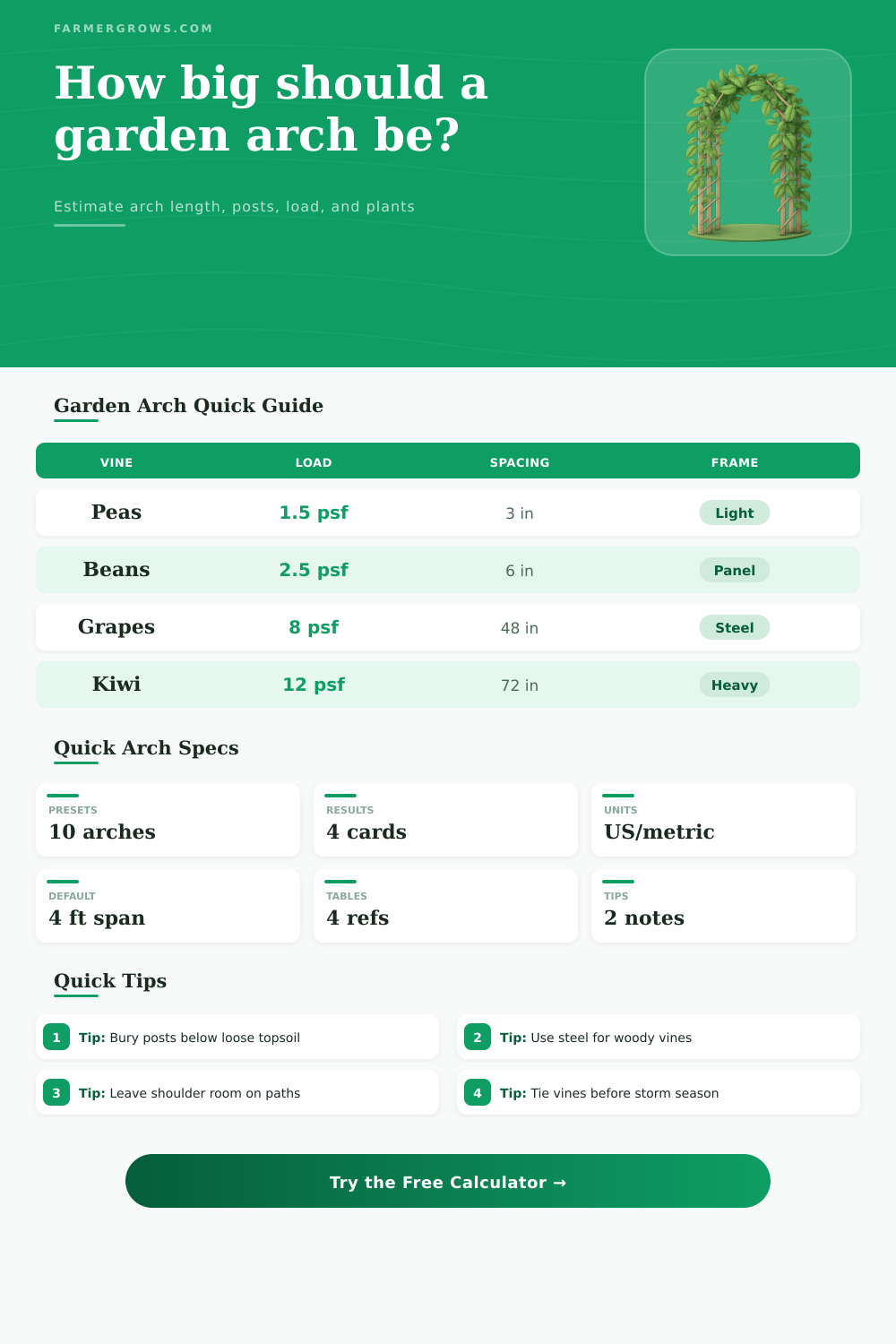
| Peas | 1.5 lb per sq ft | 2 to 3 in | Light mesh or twiggy support is usually enough. |
| Pole beans | 2.5 lb per sq ft | 4 to 6 in | Needs continuous ties or panel openings. |
| Cucumbers | 5 lb per sq ft | 12 to 18 in | Fruit weight climbs quickly after rain. |
| Climbing roses | 6 lb per sq ft | 36 to 48 in | Count mature canes and wet foliage. |
| Grapes | 8 lb per sq ft | 48 to 72 in | Use permanent posts and pruning access. |
| Hardy kiwi | 12 lb per sq ft | 72 to 96 in | Heavy woody vine; build like a small arbor. |
| Plant spacing plan | Typical spacing | Sides planted | Path guidance |
|---|---|---|---|
| Dense annual screen | 3 to 6 in | Both sides | Works for peas and beans on open mesh. |
| Harvesting cucumbers | 12 to 18 in | Both sides | Keep at least 30 in of clear path. |
| Flowering entry arch | 24 to 48 in | One or both sides | Leave room to tie canes without blocking entry. |
| Permanent grape arbor | 48 to 72 in | Usually one side | Wider paths help pruning, picking, and airflow. |
| Woody kiwi or wisteria | 72 to 96 in | One side | Limit plant count and prioritize the frame. |
For a permanent arch, compare the recommended embedment with actual soil conditions. Loose fill, raised beds, and windy gaps usually need deeper posts or wider footings.
Do not size a trellis only for the empty frame. Wet foliage, fruit, pruning neglect, and winter dieback can double the stress on a light arch.
Making an arch in the garden sounds like such an easy concept, but then you have to choose what to build it from, and that’s when things get complicated. You imagine your completed arbor or tunnel…but how deep should the posts be? How many feet of material will you need? Most important is how you ensure it stands up after a few years of weathering and a lot of vines fills it in.
More important than many realize is that scale: How wide? When it’s smallish with only greenery, an inch will seem plenty, but once the vines fill out, that tiny space seems puny. Likewise with height: Seven feet of clearance create enough headroom for people to walk through without touching the dripping leaves; anything less is a hassle and requiring constant pruning.
How to Build a Strong Garden Arch
The calculator (above) does that math for you after you input the width, height and run-length. No need for you to guess what those numbers mean in terms of actual frame.
And then there are tradeoffs. For example, bamboo or lightweight cedar make sense for more modest loads of annual flowers or peas; they could even be pulled out at season’s end. Heavier treated lumber or steel is required for kiwis or grapes… Whose woody stems coil around the frame as years go by, adding to their weight. To see what is possible, look at reference table on this page. It shows that different materials has different load ratings and rib spacings. You’ll get an idea of why wisteria won’t hold up to the same spacing than beans.
One other thing that doesn’t get noticed is post depth. That is calculation used to compare your intended embedment to potential weight of vines and the arch height. Will you have to dig deeper? It’s also a check on how well your structure might hold up to heavy rains. In loose soils or even raised beds, a couple of inches can make the difference between staying upright and leaning over.
The tool will also confirm if your rib spacing are within the limits of the materials you plan to use. Fewer pieces is good, but with wider spacing comes less distribution off the load (and therefore a weaker frame). Spacing plants is no different: Close planting can create an instant screen with annuals, but permanent vines that bear fruit require space for their care (access to prune, plus air circulation). The calculator uses your desired vine and run length to determine plant number, then factors in path width to show which side or sides of the arch you should plan to plant. That avoids buying more starts than necessary for a slender shoulder.
Running these numbers is good for two reasons. First, the actual numbers themselves are not always what is useful. It’s the process of forcing yourself to consider the whole thing as a system. Span + load + material + embedment = how they all play together. So your next arch isn’t quite so much a guess any more, but something you chose. You should of picked one based off these numbers.