Lawn Leveling Sand Calculator
Estimate cubic yards, cubic feet, bag counts, delivery loads, mix split, and finished weight for filling low spots or topdressing a lawn.
Use measured low-area coverage and average fill depth for the most useful estimate. The maximum depth field flags smothering risk, while compaction and overage account for settling, dragging, spills, and uneven screening.
Leveling Sand Estimate
Volume is based on treated lawn area, average fill depth, selected mix, compaction allowance, and handling overage.
| Topdressing depth | Cu ft per 1,000 sq ft | Cu yd per 1,000 sq ft | Sq ft per cubic yard | Typical use |
|---|---|---|---|---|
| 1/16 in | 5.2 | 0.19 | 5,184 | Light smoothing after mowing low |
| 1/8 in | 10.4 | 0.39 | 2,592 | Routine topdress on tolerant turf |
| 1/4 in | 20.8 | 0.77 | 1,296 | Small low spots and bumpy lawns |
| 1/2 in | 41.7 | 1.54 | 648 | Heavy leveling in separate passes |
| 1 in | 83.3 | 3.09 | 324 | Deep repair, usually staged |
| Material or mix | Typical density | Drainage behavior | Best lawn fit | Calculator cue |
|---|---|---|---|---|
| Mason sand | 2,600 to 2,800 lb/yd³ | Fast draining, fine screened | Bermuda, sports turf | Use clean sand density |
| Concrete sand | 2,750 to 3,000 lb/yd³ | Coarser, drains very fast | Warm-season leveling | Increase bulk density |
| 80/20 sand blend | 2,300 to 2,500 lb/yd³ | Still sandy, slight nutrient hold | Zoysia, Bermuda, St Augustine | Good default mix |
| 70/30 topdress | 2,100 to 2,350 lb/yd³ | Balanced structure and moisture | General lawn topdressing | Moderate density |
| 50/50 organic blend | 1,750 to 2,050 lb/yd³ | More water and nutrient holding | Cool-season lawns | Lower density estimate |
| Grass type | Safe pass depth | Recovery speed | Mix preference | Field caution |
|---|---|---|---|---|
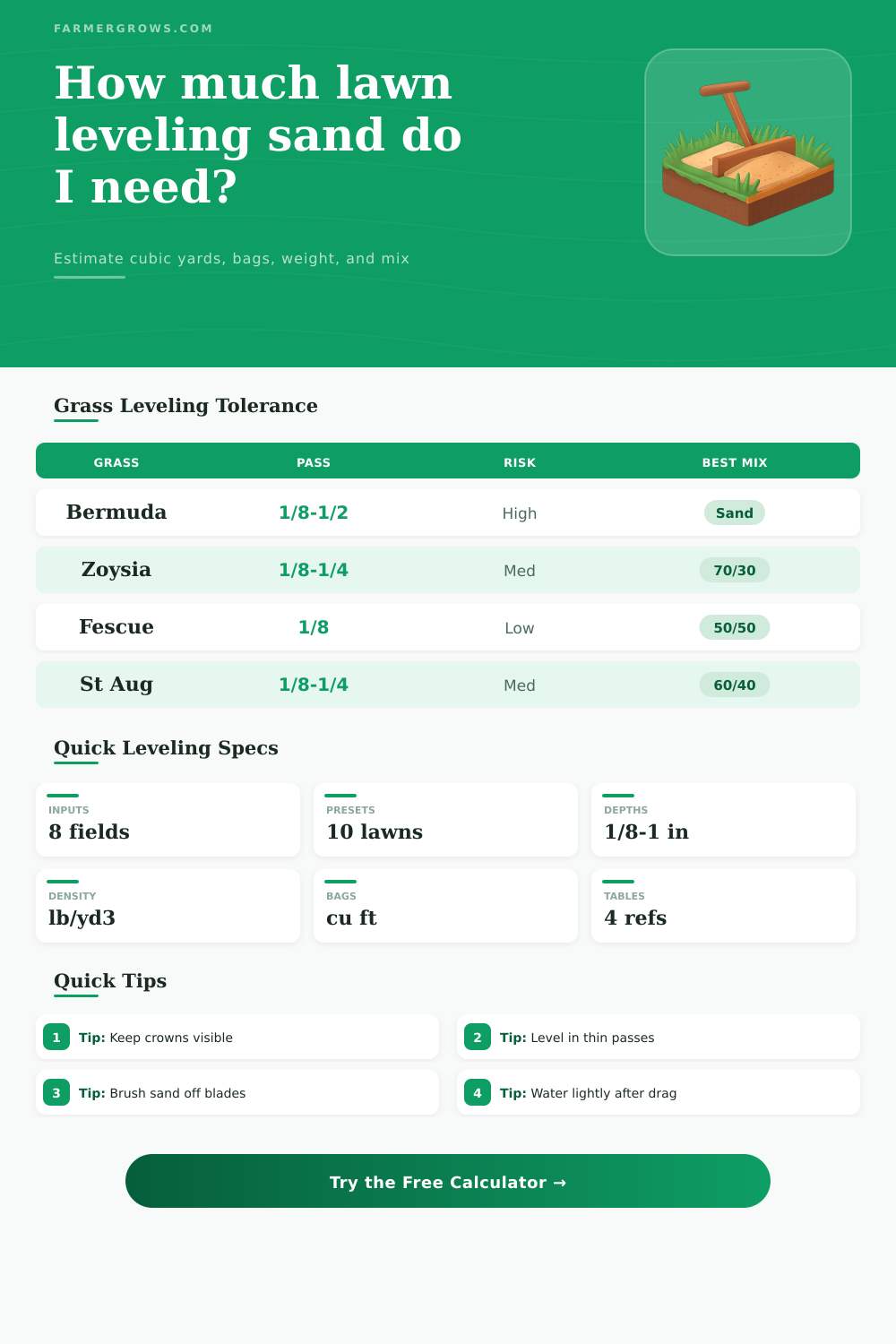
| Bermuda grass | 1/8 to 1/2 in | Fast in warm growth | Clean sand or 90/10 | Scalp and collect clippings first |
| Zoysia grass | 1/8 to 1/4 in | Moderate | 70/30 or 80/20 blend | Brush crowns clear after dragging |
| St Augustine | 1/8 to 1/4 in | Moderate | 60/40 sandy topdress | Avoid burying stolons and broad blades |
| Tall fescue | Dusting to 1/8 in | Slow fill-in | 50/50 or soil-heavy blend | Overseed thin areas instead of burying |
| Kentucky bluegrass | 1/8 to 1/4 in | Moderate to fast | 50/50 or 60/40 blend | Match soil texture to reduce layering |
| Delivery unit | Volume each | Units per cubic yard | Coverage at 1/4 in | Best use |
|---|---|---|---|---|
| Bulk cubic yard | 27 cu ft | 1 | 1,296 sq ft | Large lawns, driveway stockpile |
| 2 cu ft bag | 2 cu ft | 13.5 | 96 sq ft | Small low spots and patch repair |
| 1 cu ft bag | 1 cu ft | 27 | 48 sq ft | Spot filling and test passes |
| 0.75 cu ft bag | 0.75 cu ft | 36 | 36 sq ft | Retail topsoil or leveling mix bags |
| 40 lb sand bag | About 0.4 cu ft | 65 to 70 | 19 sq ft | Tiny repairs where weight is sold per bag |
Depth control: If the max low spot is deeper than the grass tolerance table, split the job into separate passes and allow the canopy to recover between applications.
Material check: Keep screened sand or mix dry before measuring. Wet stockpiles weigh more, drag poorly, and can make bag-to-bulk estimates look inconsistent.
I’m never realy sure when I’ve leveled my lawn until I mow over the area. If there’s not enough, the mower will hop around. It’s tempting then just to pour on more sand and hope for the best.
But you don’t want too little (it will wash away in the rain) and too much (you’ll kill off the crowns and slow the recovery). Fill to a depth that matches size of the area and amount of material.
How to Calculate How Much Sand You Need
How Do You Know How Much to Buy? Enter some basic information. Lawn size, percent low ground, depth, and mix type, and it convert these variables into a total volume. This is helpful because each factor affects how much you will need.
If you’re treating just a third of your lawn rather than all of it (say), that’s going to dramatically reduce the amount you need to buy. And if half your mix are not pure sand but includes an equal amount of organic material, mixture will be less dense and require less total weight.
Plus, add ten percent for handling losses; and another ten for compaction so you don’t run out after dragging around. You should also note the depth options: Most grass types can tolerates up to one-eighth-inch deep without issue. If you push it beyond halfway on one pass, you risk burying growing points and killing the lawn; the max-depth field flags that danger and advise staging the work.
That’s the kind of mistake people make when they order one big load and kill what was meant to be rescued. Those depths are translated into actual coverage amounts on the page with reference tables for help. It takes over twenty cubic feet of material to cover a thousand square feet of surface area a quarter inch thick. Scale that up to an entire acre, and it’s easy to see the volume required for a light topdress compared to a heavier repair.
The calculator does the math; you just need to decide how much your lawn will tolerate. One choice where the number doesn’t help: what combination to use. For example, pure sand is good for an aggressive Bermuda lawn (and fast-draining), but might be too lean for a cool-season lawn which prefers some additional organic material to hold onto moisture and nutrients.
To make up for this, you can dial in the density factor to reflect whatever mix you’re purchasing; a bag of masonry sand will weigh less by the cubic yard compared to one made up of more soil. Knowing the correct density keeps your weight estimate honest, and avoids being surprised by a heavy truck when it arrives.
The second part of that equation is compaction plus overage percentage. When we take the material out of the pile it settles down, especially the sand as it is moved and wetted down. Some also spills while being screened and transported. Those little allowances add up. Many folks forget to include them and are baffled as to why they can’t seem to ever fill their last low spot. Once you enter your percentages into the calculator they’re built right in.
Few real lawns is as neat as those drawn on plans. Trees, beds, and irrigation heads reduce the actual area that needs material. Some areas might require another pass (such as where it’s realy hard-packed from heavy use). And sloped areas lose sand to gravity downhill. All these variables don’t fit into one input box; and therefore the tool presents you with a starting volume (not a final purchase order).
Measure your lawn with a tape measure and take notes with a pad while walking around first; then dial down the percentage of treated area based off your on-the-ground reality. First of all: We’re not shooting for a specific number of cubic yards here. Ideally, we’re ordering just enough material to complete the project with one delivery and no return trips. We also don’t want to overdo things and harm the turf in the process.
So after punching those numbers into the calculator, glance first at how many passes is recommended (and then look at the split between sand and amendment). That’s where you learn something about what actualy lies ahead. One big dump is never better than several thin ones applied at just the right time. And that’s where the math comes in.
I have made the mental math problem go away by using this calculator. Now I’m only dealing with the weather, the timing, and the kind of grass. I don’t have to worry about whether I should of add half or double what I’ve got there. Settle the numbers, then grab your mat and start dragging.
Next, apply a gentle soaking and wait for each layer to soak in before applying another one.