Spray Volume Calculator
Estimate carrier volume, tank loads, refill count, per-nozzle output, product amount, adjuvant volume, and field coverage for crop spray applications.
Use this tool for planning water or carrier volume before mixing. It handles broadcast, banded, orchard, vineyard, vegetable, pasture, and drone-style spray scenarios.
Label and calibration caveat: The product label, local regulations, buffer requirements, re-entry intervals, and crop stage always override calculator output. Calibrate the sprayer with clean water, verify nozzle flow against the nozzle chart, and replace worn nozzles before mixing crop protection products.
Spray Plan Results
Results use treated acres, selected carrier rate, usable tank volume, ground speed, spray width, active nozzle count, and nozzle chart pressure.
| Field area | At 10 GPA | At 15 GPA | At 20 GPA | At 30 GPA |
|---|---|---|---|---|
| 10 acres / 4.05 ha | 100 gal / 379 L | 150 gal / 568 L | 200 gal / 757 L | 300 gal / 1,136 L |
| 40 acres / 16.19 ha | 400 gal / 1,514 L | 600 gal / 2,271 L | 800 gal / 3,028 L | 1,200 gal / 4,542 L |
| 80 acres / 32.37 ha | 800 gal / 3,028 L | 1,200 gal / 4,542 L | 1,600 gal / 6,057 L | 2,400 gal / 9,085 L |
| 160 acres / 64.75 ha | 1,600 gal / 6,057 L | 2,400 gal / 9,085 L | 3,200 gal / 12,113 L | 4,800 gal / 18,170 L |
| 240 acres / 97.12 ha | 2,400 gal / 9,085 L | 3,600 gal / 13,627 L | 4,800 gal / 18,170 L | 7,200 gal / 27,255 L |
| Target carrier | Metric equivalent | Coverage class | Typical use | Calibration note |
|---|---|---|---|---|
| 2 to 5 GPA | 18.7 to 46.8 L/ha | Very low | Drone or special low-volume labels | Use only when label allows low carrier |
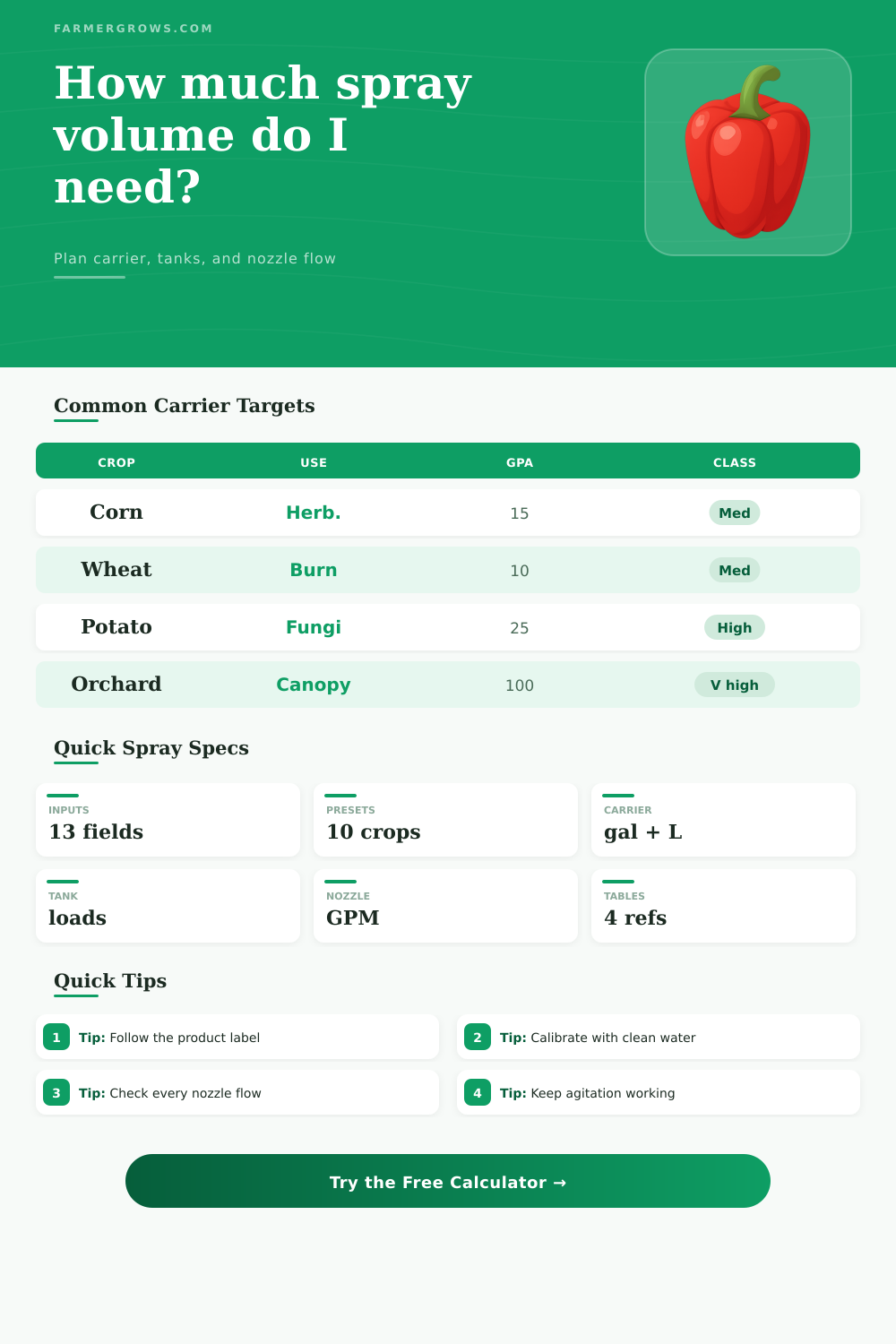
| 8 to 12 GPA | 74.8 to 112.2 L/ha | Low to medium | Burndown, pasture, light canopy | Watch drift and coverage at higher speed |
| 15 to 20 GPA | 140.3 to 187.1 L/ha | Medium | Row-crop herbicide and many fungicides | Common ground-rig planning range |
| 25 to 40 GPA | 233.8 to 374.2 L/ha | High | Vegetables, potatoes, dense crop foliage | Confirm tank agitation and canopy penetration |
| 60 to 150 GPA | 561.2 to 1,403.1 L/ha | Very high | Vineyard, orchard, high-volume canopy | Match tree row volume and reduce runoff |
| Usable tank volume | Coverage at 10 GPA | Coverage at 15 GPA | Coverage at 20 GPA | Refills for 160 ac at 15 GPA |
|---|---|---|---|---|
| 300 gal / 1,136 L | 30.0 ac | 20.0 ac | 15.0 ac | 7 refills / 8 loads |
| 500 gal / 1,893 L | 50.0 ac | 33.3 ac | 25.0 ac | 4 refills / 5 loads |
| 800 gal / 3,028 L | 80.0 ac | 53.3 ac | 40.0 ac | 2 refills / 3 loads |
| 1,000 gal / 3,785 L | 100.0 ac | 66.7 ac | 50.0 ac | 2 refills / 3 loads |
| 1,200 gal / 4,542 L | 120.0 ac | 80.0 ac | 60.0 ac | 1 refill / 2 loads |
| Nozzle spacing and speed | 10 GPA | 15 GPA | 20 GPA | Formula |
|---|---|---|---|---|
| 20 in at 8 mph | 0.269 GPM | 0.404 GPM | 0.539 GPM | GPA x mph x spacing / 5940 |
| 20 in at 10 mph | 0.337 GPM | 0.505 GPM | 0.673 GPM | Broadcast boom check |
| 20 in at 12 mph | 0.404 GPM | 0.606 GPM | 0.808 GPM | Per nozzle target |
| 15 in at 12 mph | 0.303 GPM | 0.455 GPM | 0.606 GPM | Narrow spacing needs less per nozzle |
| 30 in at 6 mph | 0.303 GPM | 0.455 GPM | 0.606 GPM | Common directed row check |
Calibrate before mixing: Catch clean water from several nozzles for one minute at operating pressure. If a nozzle is more than about 10% off the average or chart flow, clean or replace it before using the result.
Plan the last load: Use the full-load and last-load values to avoid leftover spray mix. Keep agitation running and follow label instructions for mixing order, tank cleanout, and water quality.
When making spray volume decisions, more is involve than just water volume that gets hauled around. It also involves how often you need to refill and how evenly the product are applied to target. Will your existing nozzles apply the needed application rate or will you need to change tips mid-season? Factors like row spacing, tank size, and canopy density all influence what looks like an easy decision on map when you are in the field.
This is not the rate for last year; it’s the rate for the job, and you have to match the rate to the carrier. Droplet-size doesn’t matter for bare-ground burndown applications at 8 to 12 gallons an acre; they only has to reach the soil and smother tiny weed. But when there are thicker layers of foliage involved, that changes the dynamic. Using the same low rate will wet the top layer of leaves but miss those below. That is why insecticide and fungicide labels sometimes suggest rates of 15 or 20 gallons.
How to Choose the Right Spray Amount
Try increasing in real time with the calculator here. How much bigger does a final load get before you add anything to your tank? And how much does it change your tank loads and last-load size? The seemingly straightforward numbers of tank capacity and usable percentage gets complicated when you add in field slope, agitation paddles, and foam. That 10 percent headroom might sound conservative… But it’s your clean-out volume, too, that you can’t spray.
When you run the numbers with varying usable percentages, this one adjustment will tell you if you need to refill an extra time in small tank. Or if you really should of gone big, because now you have to drive all that way to the nurse truck. In day-to-day terms, this is more important then getting precisely to the gallon-per-acre target.
The rate of output from your nozzles will be determined by their spacing, width and speed. All nozzle charts print this conversion formula for the three inputs to gallons per minute per tip; however many operators skip cross-check. If the nozzle’s flow is far outside its rated range, knowing the calculator’s predicted flow at chart pressure tell you how much to adjust the pressure before you go out with it. That way, you won’t apply low amounts on the initial pass or push the pressure so hard on the final pass that you drift.
The banded/drone application complicates things because it’s the fraction treated that’s relevant when calculating total volume. The same 8-inch band on 30-inch row treatment cuts treated acres by over two-thirds. It impacts everything, including adjuvant totals. Full-load requirements. A job might look like it needs 1,200 gallons in the field. However, once you apply the fraction used with the band, it becomes a 400-gallon job.
The tool does all the math, so let it work while you decide if the lower volume is enough to meet the label minimums for coverage. The label determines the legal rate, not the mixing instructions. Knowing how many liters or ounces are needed to treat the entire field allows you to purchase only as many jugs of product and adjuvant as necessary. And it tells you whether there is enough in the adjuvant tote to last all day.
You make the same type of calculation when figuring out the last load. Then you won’t be embarrassed by running out of 40 gallons of product at the end of a field when you cannot use it anywhere else.
The calculator is not a definitive answer. It’s a tool for planning. Use it by running the numbers at the label rate first and seeing what the cost is in terms of refills and time. Then do it again with a bit more carrier volume and get the true cost. See how the nozzle flow requirement shifts when you adjust width or speed within safe ranges. Look for what patterns form and they’ll reveal whether you’re set up efficienty. It also shows whether a small tweak in one of those inputs will save a whole refill tomorrow.