
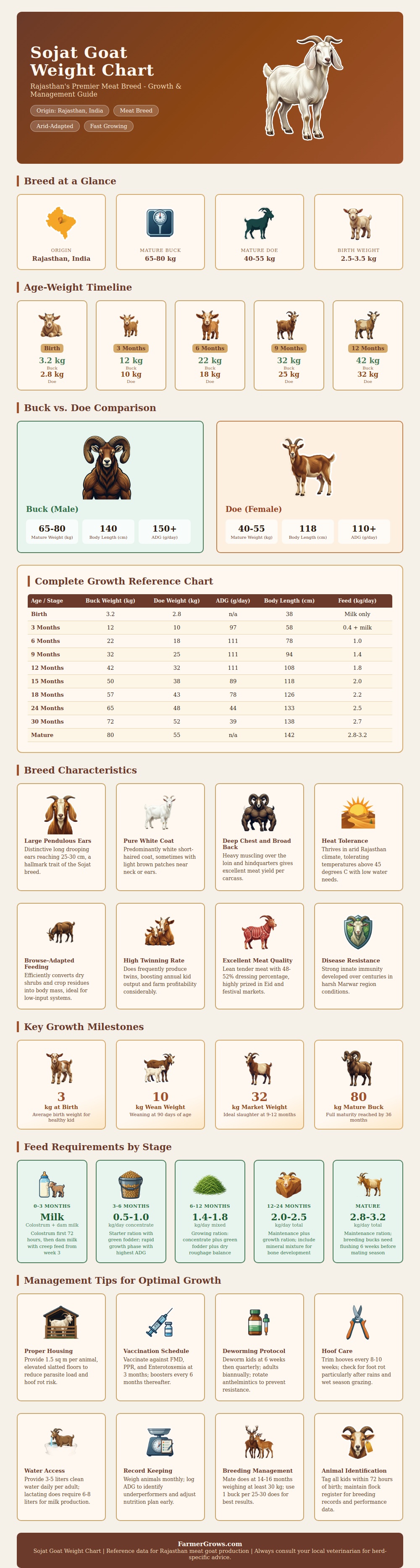
In the dry climate of Rajasthan, raising meat goats are all about a single practical question. Are my animals growing as fast as they should be? Or, have they reached their maximum size? Knowing the answer determines your daily breeding and feeding decisions, budget, and when you’ll finally load up animals and take them to market. The answer come from weight chart which shows you what’s normal at every age. You won’t have to guess anymore. You won’t waste feed on animal that have stopped growing fast, and you won’t have underfed kids.
In particular, the Sojat breed developed in the Marwar region specifically for this climate. You can tell them apart from rest of the herd because they are all pure white, with those long, droopy ears. But the beauty is underneath. They is wide across the loin and deep through the chest, which means more meat on each animal. Because they are so well adapted to sparse forage and hot temperatures, their input costs is low. In fact, farmers working with other breeds frequently report how there Sojat kids continue to gain even as their pastures dry out. No wonder the breed has expanded outside of it home villages.
Why Weight Charts Are Important for Raising Goats
It’s not a straight line of growth. It come in distinct periods. You’re nearly all milk for first three months and if you’re lacking in that area, it shows itself with lower weaning weights later on. From three to six months, the kids begin eating solids. That’s when they will gain most each day. Then from six months through nine months, rate drops off. After nine months, the rate slows as the animal builds frame rather than just filling out.
So there are distinct periods and the chart plots them out for you so you don’t have to learn by memory what each period is like. You’ll know where yours fall into those time periods. The same is true with sex. In all these growth stages, bucks will has greater overall size and greater daily gains. If you are culling out some males for finishing and others to retain for breeding, this is important. Does will be slightly smaller but also has to deal with lactation and pregnancy, so their feed program must includes those additional needs. It’s easy enough to look at them visually and establish separate goals rather than try to average them all together.
As the goat gets bigger, they eat more (duh), but not linearally. Mature goats will hold body condition well on coarser forages; young ones should of get more protein than you’d expect from their body size. This means most of us screw up our feeding one way or another, either too soon or to late. This happens either by underfeeding during the critical growth spurt phase, or by continuing to force-feed high-cost concentrates when natural gains is slowing down. Following this chart and matching your feed to the stage will avoid both extremes.
Those stages of development also closely match health routines. Vaccinations/deworming at young age will put a kid on the right track but if missed he’ll never really get back on the curve, no matter what. Monthly weighings (or regular) will catch a setback when it’s small enough to help correct. You can tell in the record how much heavier the twins are from one set of does than another. That informs your selection for breeding multiple season.
But really, any weight chart should be useful by translating observation into action. Stop saying, “That animal’s small for its age.” Instead, ask, “What did I change about their health? What did I change about their feed? That leap from endless guesswork to actual measurement is the line between consistent production and annual margin-eating surprises.