Corn Harvest Loss Calculator
Estimate loose kernel loss, dropped ear loss, head loss, gathering loss, separator loss, moisture-adjusted bushels, acres affected, and optional grain value.
Load a realistic harvest-loss pattern, then replace the counts with your own field averages.
Harvest Loss Estimate
Your corn harvest loss estimate will appear here after calculation.
| Kernels per sq ft | Approx bu/ac | 80-acre field | Field meaning |
|---|---|---|---|
| 1 | 0.5 bu/ac | 40 bu | Minor visible grain if uniform. |
| 2 | 1.0 bu/ac | 80 bu | Standard quick-check benchmark. |
| 5 | 2.5 bu/ac | 200 bu | Worth separating by machine source. |
| 10 | 5.0 bu/ac | 400 bu | High enough to stop and adjust. |
| Row width | 1 row length | 2 rows length | 4 rows length |
|---|---|---|---|
| 20 in | 261.4 ft | 130.7 ft | 65.3 ft |
| 22 in | 237.6 ft | 118.8 ft | 59.4 ft |
| 30 in | 174.2 ft | 87.1 ft | 43.6 ft |
| 36 in | 145.2 ft | 72.6 ft | 36.3 ft |
| 38 in | 137.6 ft | 68.8 ft | 34.4 ft |
| Loss source | Measure as | Likely cause | First check |
|---|---|---|---|
| Head loss | Kernels/sq ft | Butt shelling, ear bounce, low header | Deck plates and header speed |
| Gathering loss | Kernels/sq ft | Snapping rolls too aggressive or fast | Roll gap and ground speed |
| Separator loss | Kernels/sq ft | Grain on cob or blown out rear | Rotor, concave, fan, sieve |
| Dropped ears | Ears per strip | Ear shank, lodging, header angle | Snout height and gathering chains |
| Field moisture | Dry-bushel factor | 1 raw bu/ac becomes | Use note |
|---|---|---|---|
| 15.5% | 1.000 | 1.00 bu/ac | Standard market corn basis. |
| 18% | 0.970 | 0.97 bu/ac | Typical early harvest adjustment. |
| 22% | 0.923 | 0.92 bu/ac | Wet kernels have more water weight. |
| 28% | 0.852 | 0.85 bu/ac | Use with caution in very wet fields. |
Corn harvest loss occur when the kernels or ears of corn fall to the ground during the harvesting process. There are several different way that corn harvest loss can occur, and there are different part of the combine that can lead to corn harvest loss. Using the calculator, you can determine the amount of corn harvest loss that occurs in your field.
The calculator will allow you to determine if you should adjust the combine. To use the calculator, you must enter specific counts into the calculator. You will need to enter the amount of loose kernels that fall per square foot.
How to Measure Corn Harvest Loss
You will also need to enter the number of kernels that is tied to the corn head. Additionally, you may also need to enter the number of kernels that are lost from the gathering chains or the separator. Lastly, you will also need to enter the number of whole ears of corn that is found in a measured strip within the field.
The calculator will adjust for the moisture content of the corn, as corn weigh more when it is wet. This adjustment will allow you to compare the corn loss with the moisture percentage that the elevator uses. The calculator will provide you with an output of the total loss of corn that fell from the field per acre, as well as the total number of bushels of corn that were lost from the field.
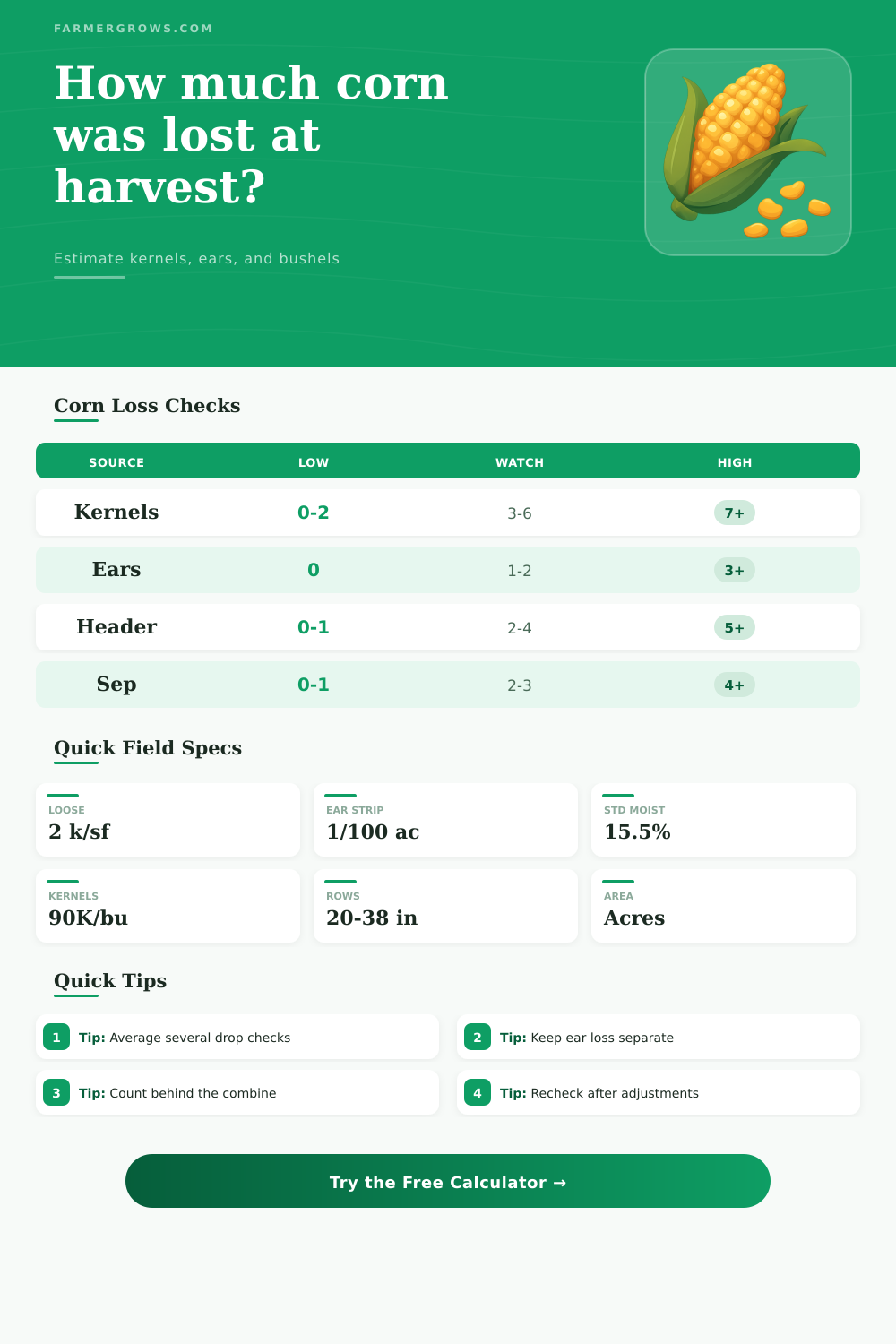
One of the most common form of corn harvest loss is the loss of kernels. The loss of kernels is the easiest form of corn harvest loss to visually identify. For instance, if you find two kernels per square foot within a thirty-inch row, you will lose one bushel of corn per acre.
If you have a field of several acres, the loss of even a few bushels per acre will result in a high total number of lost bushels. Additionally, the location of the kernels will help you to find the cause of the corn harvest loss. If the kernels are located right behind the combine head, then the cause of the harvest loss may be the deck plate spacing or the speed with which the header moved forward.
However, if the kernels are located further along in the harvested swath, the cause of the corn harvest loss may be the separator or the cleaning fan. Another form of corn harvest loss is the loss of ears of corn that is dropped to the ground. This type of corn harvest loss can represent a significant amount of the corn that was planted.
If one ear of corn is dropped to the ground, it can represent the loss of five to six hundred kernels of corn. To measure the dropped ears, you must count the number of ears that are dropped within a one hundredth-acre strip. The calculator will convert the dropped ears to bushels, which you will then add to the total number of loose kernels that were counted.
This total will provide you with your total corn harvest loss. The moisture content of the corn can impact how you calculate the corn harvest loss. If the corn is wet, it will weigh more than dry corn.
The high moisture percentage will mean that the number of kernels that you count will weigh less dry bushels. The calculator will account for this by using a dry matter factor. This will allow the calculator to determine your corn harvest loss in a way that is not overstated due to the high moisture content of the corn.
For instance, the calculator will account for moisture percentages like twenty-two percent. The size of the field in which you plant your corn will impact the importance of corn harvest loss. If you have a small field, losing corn will have a more greater impact on your yield than if you have a large field.
A small amount of corn harvest loss in a large field can result in the loss of thousands of kernels of corn. Additionally, you can use the yield goal to determine the percentage of your corn harvest loss. If you know the percentage of your corn harvest loss, you can determine if your combine is performing within the limits of normal corn harvest loss within your field for that yield goal.
It is also possible to enter the price of corn into the calculator. By entering the price, the calculator will provide you with the monetary value of your corn harvest loss. This information will help to determine if it is cost effective to repair the combine to reduce the amount of corn that is lost during harvest.
To obtain the most accurate measurements with the calculator, you should take more than one sample of the corn that is lost during harvest. If you take only one sample of corn, it may not be representative of the total amount of corn that is lost per acre. You should walk the field for a distance of a few hundred feet, and take three or four samples of the corn that fell to the ground during harvest.
Averaging these samples will provide a more accurate measurement of the total corn harvest loss that occurs within the field. Depending upon the time of year in which the corn is harvested, there will be seasonal impacts upon the type of corn harvest loss that is observed in the field. For instance, if the corn is harvested during the early portion of the harvest, the stalks may be especially tough, and lead to the loss of kernels at the head of the corn.
If the harvest takes place after a freeze, the corn may be brittle, leading to more dropped ears. If the corn that is harvested is dry, there will be a higher loss of kernels that pass through the separator. These seasonal impacts will change the type of inputs that must be placed into the calculator, but will not impact the way in which the calculator is used.
The goal for corn harvest loss should not be to work to reach a zero count. If you attempt to reach a zero count of corn harvest loss, you may slow the combine too much, or you may raise the header too high. These changes may result in additional costs to the farmer due to the increased time and fuel requirements to harvest the corn.
Instead, use the combine and the calculator to determine a target count for corn harvest loss that will make the combine efficient in its harvesting of corn from the fields. To obtain accurate counts from the calculator, provide accurate counts of the corn that is lost during harvest to the calculator itself.