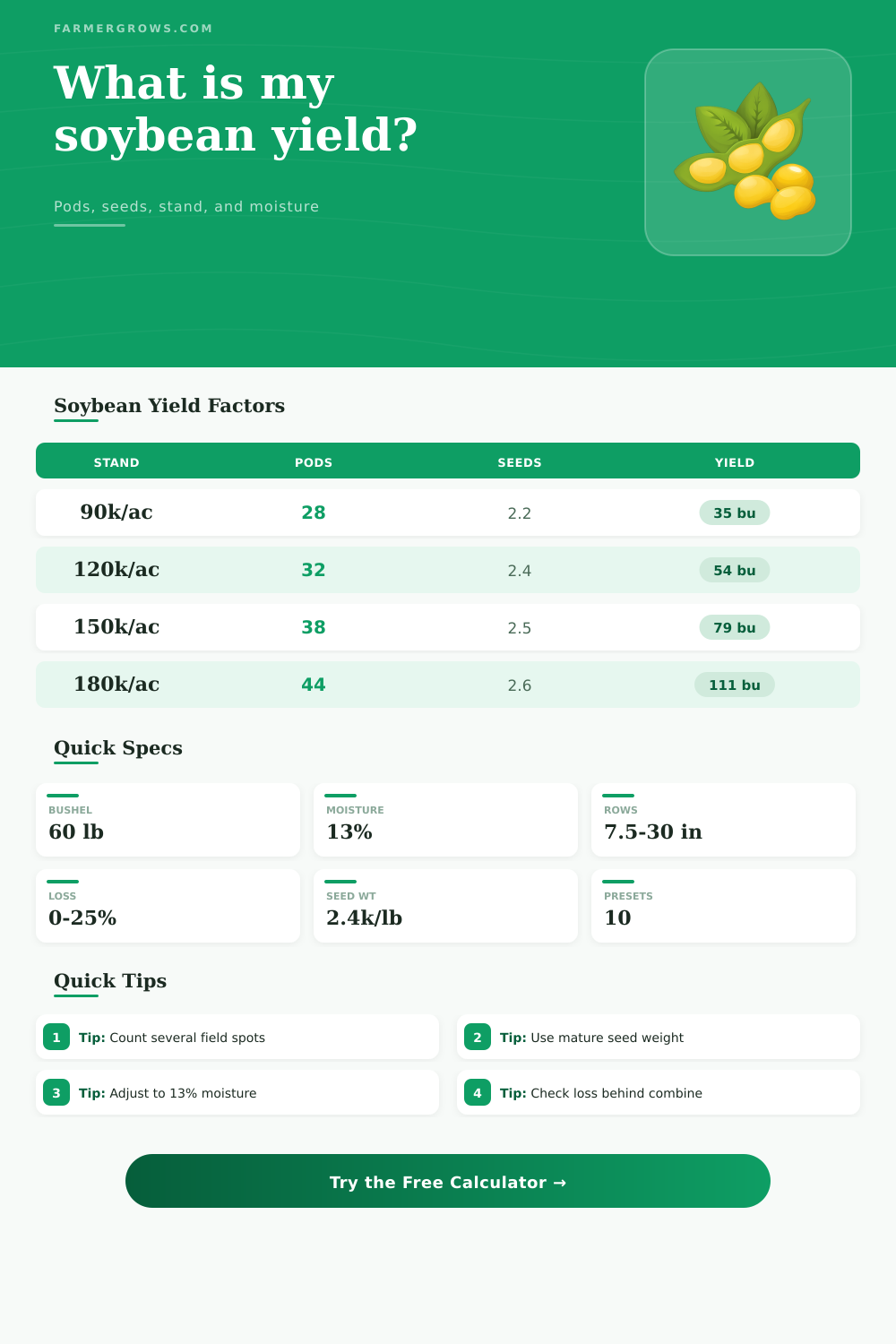
Soybean Yield Calculator
Estimate soybean bushels per acre from plants per acre, counted stand, pods per plant, seeds per pod, seed weight, harvest loss, grain moisture, and row spacing.
Use representative spots from the same management zone. The calculator can use an entered plants-per-acre value, derive population from a row stand count, or choose the lower of the two for a conservative field estimate.
Soybean Yield Estimate
Results update as you edit the field inputs.
| Row spacing | Count length | Plants counted | Approx stand | Use note |
|---|---|---|---|---|
| 7.5 in | 17.5 ft | 35 | 139,000/ac | Narrow drilled rows need several samples. |
| 15 in | 17.5 ft | 70 | 139,000/ac | Common quick check for narrow soybeans. |
| 20 in | 17.5 ft | 93 | 139,000/ac | Useful for split-row or twin-row systems. |
| 30 in | 17.5 ft | 139 | 139,000/ac | Count two rows when stands are variable. |
| 30 in | 10 ft | 80 | 139,000/ac | Shorter count works for a fast field check. |
| Seeds per pound | Seed size | 1000 seed wt | Effect on yield | Sampling note |
|---|---|---|---|---|
| 3,400 | Small seed | 133 g | Fewer pounds per seed count | Common after stress or dry finish. |
| 3,000 | Medium small | 151 g | Moderate seed weight | Use if seeds are filled but not large. |
| 2,800 | Average | 162 g | Balanced default | Good starting estimate when unsure. |
| 2,500 | Large seed | 181 g | More pounds per seed count | Often from strong late-season fill. |
| 2,200 | Very large | 206 g | High weight per seed | Confirm with harvested sample if possible. |
| Moisture | 13% factor | If field bu is 60 | Meaning | Action |
|---|---|---|---|---|
| 10% | 1.034 | 62.1 bu/ac | Below standard moisture | Seed is drier than market basis. |
| 13% | 1.000 | 60.0 bu/ac | Standard soybean basis | No moisture change applied. |
| 15% | 0.977 | 58.6 bu/ac | Slightly wet sample | Dry matter adjustment lowers bushels. |
| 18% | 0.943 | 56.6 bu/ac | Wet harvest estimate | Use after field moisture testing. |
| 22% | 0.897 | 53.8 bu/ac | Very wet estimate | Expect a larger moisture correction. |
| Field condition | Harvest loss | Pods per plant | Seeds per pod | Planning note |
|---|---|---|---|---|
| Clean harvest | 2 to 4% | 30 to 40 | 2.3 to 2.6 | Good combine setup and even maturity. |
| Normal field | 4 to 7% | 28 to 38 | 2.2 to 2.5 | Useful default before harvest checks. |
| Green stems | 6 to 10% | 30 to 42 | 2.3 to 2.6 | Watch shatter, cutterbar, and rotor loss. |
| Lodged crop | 8 to 18% | 25 to 38 | 2.1 to 2.5 | Loss can exceed the stand estimate risk. |
| Stress finish | 7 to 15% | 20 to 32 | 1.8 to 2.3 | Seed size and seed count both matter. |
Count more than one spot: Pull stand, pod, and seed counts from several representative areas, then average them before making field-level decisions.
Separate biology from harvest: Estimate gross seed yield first, then apply moisture and combine loss so you can see which factor moved the final bushels.
Estimating the soybean yield that will be harvested is an important process for a soybean farmer. There is a variety of different methods for estimating the soybean yield, including counting the number of soybean plants, pods, and soybean seeds within the field. However, each of these counts isnt enough to create an accurate soybean yield estimate; additional factor that must be accounted for include the weight of the soybean seeds, the moisture content of the soybeans, and the potential loss of soybeans during the harvest.
The first step in creating an estimate for the soybean yield from the fields is to determine the plant population within those fields. The population count could be based upon the count that was recorded when planting the soybeans, or it could be based upon a count that was performed within the fields during the growing season. The lower of the two count is typically used to provide a conservative yield estimate for the soybeans that will be harvested.
How to Estimate Soybean Yield
Furthermore, the farmer must also account for the row spacing for the fields in this calculation; a 17.5-foot count within fields with 30-inch rows will produce a different count than 17.5-foot count within fields with 15-inch rows, for instance. Following the determination of the plant population, it is important to count the number of pods and seeds within those plants. You should count the soybeans at either the R4 or R5 growth stages, or it is better to count the soybeans at the R6 growth stage, which indicate the number of seeds within each soybean plant.
It is also necessary to count the number of seeds within each soybean pod, as well as to measure the weight of the soybean seeds. The weight of the soybean seeds will influence the calculation of the total pound of soybeans that will be harvested from the fields. Following the count of the soybeans, adjustments must be made for the moisture content of the soybeans, as well as for potential loss during the harvesting process.
Soybean yields are typically sold at a moisture content of 13%. Therefore, if the moisture content is determined to be higher or lower than that percentage, you should make adjustments to the yield estimate. Additionally, some soybeans will be lost during the harvest process due to the soybean plants becoming lodged in the fields, or due to the soybean stems being still green during harvest.
The yield estimate should account for potential loss during the harvest. The timing of the counts of the soybeans will impact the accuracy of the yield estimate. If you count the soybeans too early, there may be underestimation of the number of seeds that will mature.
If the soybeans are counted too late, there may be underestimation of the total soybean yield due to shatter loss of the soybeans that are still standing within the field. The period between the R5 and R6 growth stages is typically the best period to perform the counts of the soybeans within each field. Furthermore, the farmer should perform soybean counts within three or four different area within the field rather than just one area to provide a more trustworthy estimate of the soybean yield.
The weather within the fields can impact the soybean yield estimate. For instance, drought conditions may lead to a decrease in the weight of the soybean seeds. Conversely, overly wet conditions within the fields may result in the soybean seeds becoming heavier, but it may also lead to green stems, which would indicate a potential loss of those soybeans during the harvest process.
A calculator can be used to determine how different scenarios of soybean seed weight and soybean loss during harvest may impact the total soybean yield estimate. The soybean yield estimate can help the soybean farmer to make business decisions regarding the soybeans that are currently stored within the farm. For instance, the soybean farmer can use the soybean yield estimate to decide whether to sell the soybeans that are stored from the previous year, or to decide to hold those soybeans for sale at a later date.
If the yield estimate for the newly grown soybeans is high, it may be better to sell the stored soybeans from the previous year. In contrast, if the soybean yield estimate for the newly grown soybeans is low, it may be better to hold the stored soybeans from the previous year for a longer period of time. Thus, the soybean yield estimate can help the soybean farmer to make more better business decisions.
Finally, it is important to compare the soybean yield estimate to the actual weigh tickets for the soybeans that were harvested. The soybean yield estimate is an estimate of the soybean yield within the fields, and the weigh tickets are the actual soybean yield that was harvested from those fields during the growing season. By comparing the soybean yield estimate to the weigh tickets, the soybean farmer can determine the accuracy of the counts that were made within the fields.
Furthermore, by comparing these two value, the soybean farmer will understand how to create better yield estimates in the future.