Drainage Pipe Calculator
Size farm drain pipe from rainfall or field drainage demand, check Manning full-flow capacity, compare slope and material roughness, and estimate bedding stone for the trench.
Use this for planning farm laterals, mains, roof drains, swales, and yard inlets. Final layout should still be checked against outlet elevation, local drainage rules, soil conditions, inlet losses, and tailwater.
Drainage Pipe Results
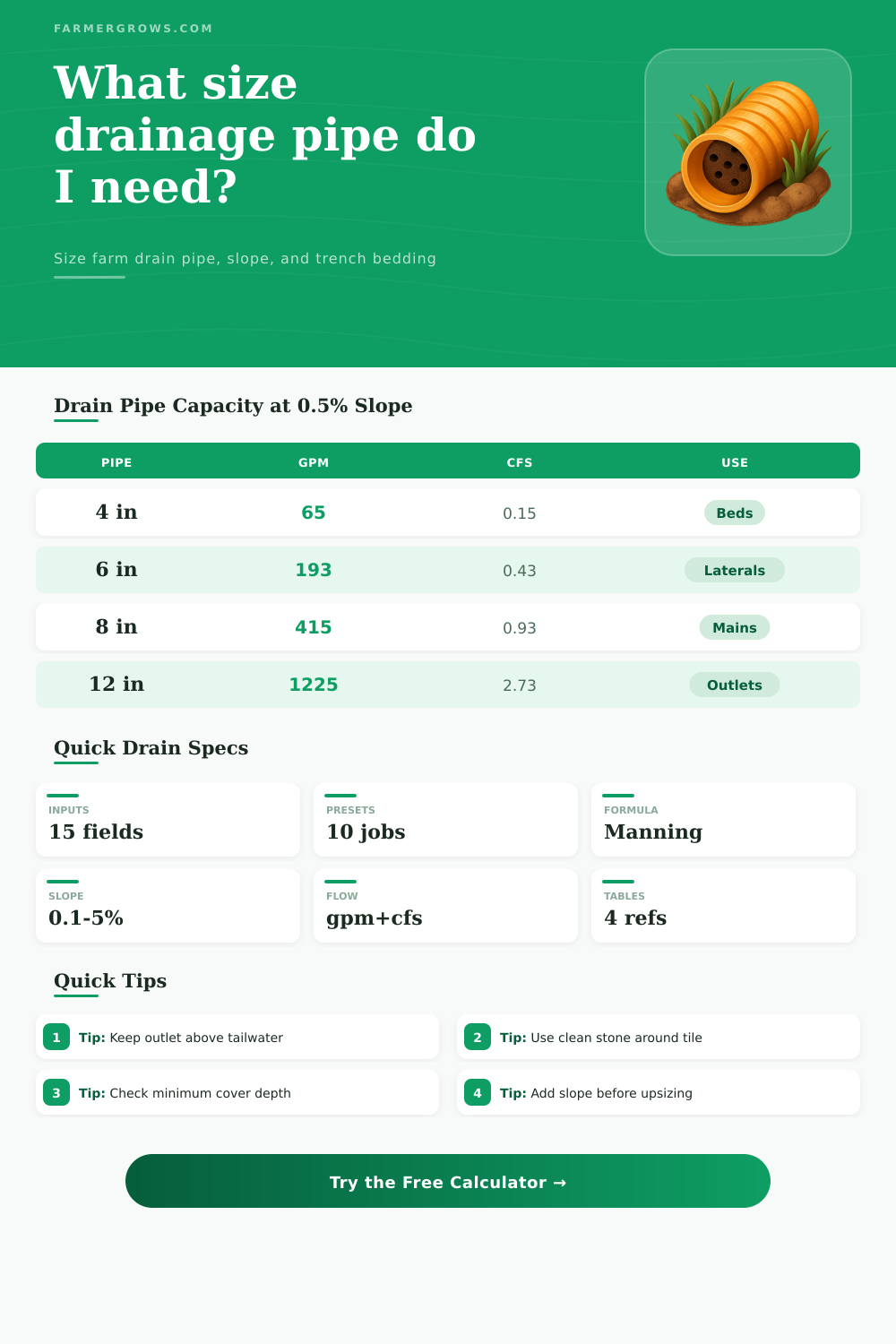
Capacity assumes the selected circular pipe is flowing full and steady at the entered slope using Manning's equation.
| Inside diameter | Capacity at 0.5% slope | Flow in cfs | Flow in L/s | Full-flow velocity |
|---|---|---|---|---|
| 3 in | 30 gpm | 0.07 cfs | 1.9 L/s | 1.38 ft/s |
| 4 in | 65 gpm | 0.15 cfs | 4.1 L/s | 1.67 ft/s |
| 6 in | 193 gpm | 0.43 cfs | 12.2 L/s | 2.19 ft/s |
| 8 in | 415 gpm | 0.93 cfs | 26.2 L/s | 2.65 ft/s |
| 10 in | 753 gpm | 1.68 cfs | 47.5 L/s | 3.08 ft/s |
| 12 in | 1,225 gpm | 2.73 cfs | 77.3 L/s | 3.47 ft/s |
| 15 in | 2,221 gpm | 4.95 cfs | 140.1 L/s | 4.03 ft/s |
| 18 in | 3,612 gpm | 8.05 cfs | 227.9 L/s | 4.55 ft/s |
| 24 in | 7,778 gpm | 17.33 cfs | 490.7 L/s | 5.52 ft/s |
| Pipe slope | Grade equivalent | Capacity factor | Field guidance |
|---|---|---|---|
| 0.10% | 0.10 ft per 100 ft | 0.45 of 0.5% flow | Very flat; protect from sediment and outlet submergence |
| 0.25% | 0.25 ft per 100 ft | 0.71 of 0.5% flow | Common lower limit for careful farm tile layouts |
| 0.50% | 0.50 ft per 100 ft | 1.00 reference | Good practical slope for laterals and small mains |
| 1.00% | 1.00 ft per 100 ft | 1.41 of 0.5% flow | Higher velocity helps keep fine sediment moving |
| 2.00% | 2.00 ft per 100 ft | 2.00 of 0.5% flow | Check erosion at the outlet and protect the discharge |
| Pipe or channel surface | Manning n | Use in calculator | Capacity effect |
|---|---|---|---|
| Smooth PVC or smooth HDPE | 0.010 | Roof leaders, solid outlets, clean mains | About 20% more flow than n 0.012 |
| Clay, concrete, clean older tile | 0.012 | Neutral reference for many drainage checks | Reference roughness for the table above |
| Dual-wall HDPE, smooth inside | 0.013 | Farm mains, culvert-style drain runs | About 8% less flow than n 0.012 |
| Corrugated metal pipe | 0.015 | Lane crossings and shallow culverts | About 20% less flow than n 0.012 |
| Single-wall corrugated plastic | 0.018 | Flexible French drains and bed edges | About 33% less flow than n 0.012 |
| Rough tile with sediment risk | 0.024 | Conservative check for aging or dirty pipe | About half the flow of n 0.012 |
| Trench detail | Typical farm range | Calculator input | Practical note |
|---|---|---|---|
| Trench width | Pipe OD plus 8 to 16 in | Width around pipe and stone | Enough room improves stone placement and compaction |
| Bedding below pipe | 3 to 6 in | Bedding under pipe | Use more under uneven soil, rock pockets, or crossings |
| Stone above perforated pipe | 4 to 12 in | Stone cover above pipe | More envelope area helps water enter tile without fines |
| Minimum cover in fields | 24 to 36 in | Trench depth check | Deeper cover protects tile from traffic and freeze damage |
| Outlet protection | Rodent guard and splash pad | Not a volume input | Keep tailwater below outlet whenever possible |
Slope before size: A small increase in grade can add meaningful capacity because Manning flow rises with the square root of slope. Confirm outlet elevation before choosing a larger pipe.
Stone envelope: Perforated pipe needs clean, open bedding around the slots. If native soil is silty, use fabric or a graded envelope to keep fines out of the stone.
Drainage system design require an understanding that simply moving water from the field or structure require more than just a pipe. Using the wrong size pipe will either cause water to back up along the pipe (if too small) or will require spend money on construction materials that is not needed (if too large). Thus, an understanding of the volume of water that will flow through the pipe is required, as is an understanding of the conditions under which that water flow.
Pipes can be sized according to the flow basis; the type of drainage conditions that will exist along that pipe. For instance, some drains is constructed to handle the rapid rainfall that can land on a roof or field lane, while other drains is constructed to manage the slower seepage of water from the soil after periods of rainfall. Thus, understanding whether the drainage system will be used in one situation or the other is essential to properly size the pipe.
Choose the Right Pipe, Slope and Stone for Farm Drainage
The slope on which the pipe will be constructed and the roughness of the material of the pipe will also impact how much water can move along the pipe. For instance, a gentle slope may allow for the movement of a great deal of water along the pipe if the inside of the pipe is smooth. However, the same gentle slope with a rough corrugated pipe will move less water due to the friction between the water and the pipe walls.
Thus, using a rough pipe will require the diameter of the pipe to be made larger to handle the reduced movement of water along the pipe, or the pipe may need to be of a diameter that it will be full of water when rainfall occur. In contrast, using a smooth pipe material will allow for more water to pass through the pipe, especially if it will be constructed on a relatively flat slope. The drainage calculator performs the mathematical calculations necessary to determine the size of pipe of stone that will be required for the trench once the area, drainage and rainfall coefficient, the slope of the land, and the type of material for the pipe are entered into the calculator.
The calculator will provide information regarding the smallest standard pipe size that will handle the water that will fall within the farm according to the parameters that were entered. Furthermore, the calculator will also calculate the volume of the stone that will be required for the trench once the trench width, depth, and bedding thickness are entered. These calculations allow for the understanding of how each decision may impact the other decisions that are to be made in the building of the drainage system.
The calculator does not account for the various complications that can exist on the site in which the drainage system is to be constructed. For instance, the type of soil that will exist along the drainage system will impact the rate at which water can move to the pipe, as well as whether the fines in that soil will move into the stone envelope. The outlet can become submerged in periods of high water flows, turning the pipe into a tank rather than a free flowing system.
Finally, the amount of traffic that is to use the field can impact the amount of cover that will need to be placed over the pipe. Each of these factors must be accounted for in relation to the assumptions made by the calculator. People often make mistakes using the calculator due to a consideration of only one of the factors within the system.
For instance, many individuals will choose a pipe size due to the availability of that pipe, and then determine the slope and area necessary to allow for the water to properly enter that pipe. This approach will fail during periods of large rainfall amounts or long periods of wet weather on the farm. Thus, individuals should of begin with determining the volume of water that will enter the pipe and the slope that can be constructed on the land to allow for proper drainage of that volume of water.
The decisions that are made regarding the bedding of stone along the trench will also impact the remainder of the farm. For instance, if there is too little stone, the pipe may shift in relation to the trench or become clogged with the entering water. If there is too much stone, the construction costs will increase due to the increased amount of stone that must be ordered for the project.
Thus, the calculation of the volume of stone required will help determine the amount of stone that is required to be ordered for the drainage system. Decisions regarding the drainage system will impact the remainder of the farm. For instance, the main drainage pipe that is constructed for the farm may not be able to handle the increased volume of water from the addition of a new high tunnel or lane.
Thus, decisions regarding the size of main drainage pipe should be made with consideration of future changes to the farm. Finally, the location of the outlet for the drainage system will impact the drainage system itself. If the outlet of the pipe is placed below the tailwater level of the field, the drainage system will act as a slow leak throughout the wet seasons of the year.
Finally, it is important to remember that the pipe is only one part of the complete drainage system. The grade of the slope along which the pipe will be constructed, the material of the pipe, the volume of stone that will be utilized in the bedding of the pipe, and the protection of the outlet of the pipe are all components of the drainage system. Each of these components is essential to the proper function of the drainage system.
If any of these components do not function together in the way that they are intended to function, even if the size of the pipe is set at the correct amount, the drainage system will not effectively manage the amount of water that may fall within the field during any given year. Thus, each of these components must be made visible to the design of the drainage system prior to beginning to backfill the trench for which the drainage system will be constructed.