Rainwater Runoff Calculator
Estimate storm runoff volume, Rational Method peak flow, storage demand, and overflow rate for roofs, yards, driveways, lanes, fields, and mixed farm surfaces.
Use connected drainage area only: the part of the roof, field, lane, or yard that actually drains toward the ditch, barrel, swale, inlet, pond, or problem low spot you are checking.
Runoff Estimate
Results use runoff volume V = C x rainfall depth x area and Rational Method peak flow Q = C x intensity x area.
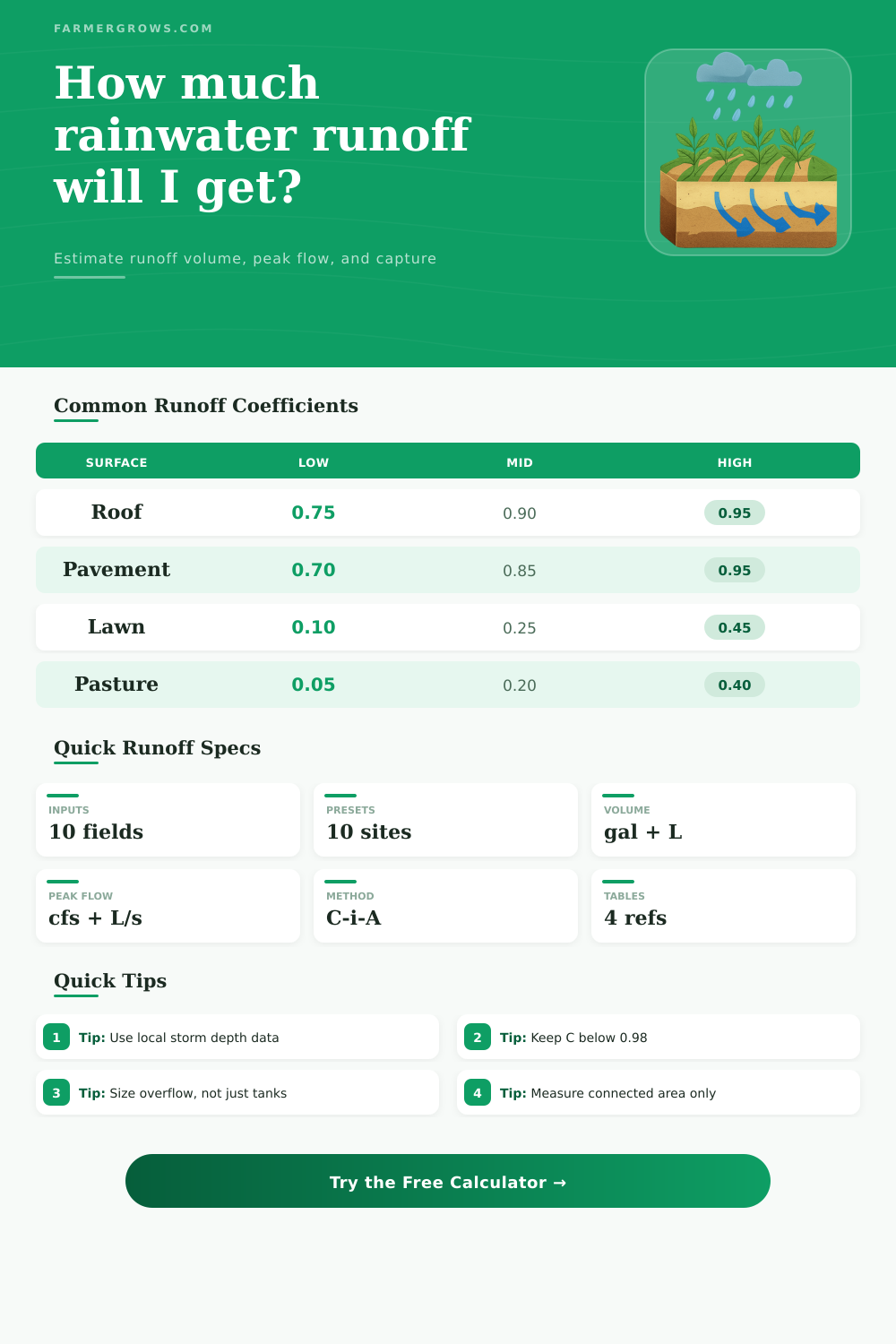
| Surface or cover | Common C range | Use in calculator | Field interpretation |
|---|---|---|---|
| Metal, tile, or steep roof | 0.75 to 0.95 | 0.95 for connected gutters | Nearly all rainfall becomes runoff after minor wetting losses. |
| Asphalt shingle roof | 0.70 to 0.95 | 0.90 for most roofs | Texture and roof age hold a little water, but runoff remains high. |
| Concrete or asphalt surface | 0.70 to 0.95 | 0.85 for pads and lanes | Cracks, joints, and surface storage lower the value slightly. |
| Compacted gravel | 0.35 to 0.70 | 0.60 for driven lanes | Fresh open gravel runs lower; sealed or silty gravel runs higher. |
| Bare cultivated soil | 0.30 to 0.60 | 0.45 for exposed beds | Crusting, slope, and saturation can push runoff upward fast. |
| Lawns, pasture, meadow | 0.05 to 0.45 | 0.18 to 0.35 | Dense roots and roughness reduce runoff unless soil is saturated. |
| Rain depth | Gallons on 1,000 sq ft | Liters on 100 m² | How to use it |
|---|---|---|---|
| 0.25 in / 6.4 mm | 156 gal before C | 635 L before C | Light shower, useful for first flush checks. |
| 0.50 in / 12.7 mm | 312 gal before C | 1,270 L before C | Small storm, often fills barrels from roof area. |
| 1.00 in / 25.4 mm | 623 gal before C | 2,540 L before C | Common planning depth for roof harvesting. |
| 2.00 in / 50.8 mm | 1,247 gal before C | 5,080 L before C | Strong storm, good stress test for overflow paths. |
| 4.00 in / 101.6 mm | 2,493 gal before C | 10,160 L before C | Large event; verify with local design rainfall data. |
| Average slope | Coefficient factor | Runoff behavior | Planning note |
|---|---|---|---|
| 0% to 2% | 0.95 | Slow sheet flow with more surface storage | Watch for ponding near crops or foundations. |
| 2% to 5% | 1.00 | Typical yard, roof edge, lane, or field drainage | Good default when slope is known only roughly. |
| 5% to 10% | 1.07 | Faster concentration and less time to soak in | Use vegetation, rock, or level spreaders where flow gathers. |
| 10% to 20% | 1.14 | Runoff becomes more erosive on exposed soil | Check outlets and ditch lining before large storms. |
| Over 20% | 1.20 | Rapid runoff with high erosion risk | Use conservative storage and protected spillways. |
| Example project | Area | Runoff C | Runoff from 1 inch | Runoff from 2 inches |
|---|---|---|---|---|
| 30 x 48 ft barn roof | 1,440 sq ft | 0.90 | 808 gal | 1,616 gal |
| 20 x 96 ft greenhouse roof | 1,920 sq ft | 0.95 | 1,137 gal | 2,274 gal |
| 12 x 300 ft gravel lane | 3,600 sq ft | 0.60 | 1,347 gal | 2,694 gal |
| 100 x 100 ft compacted yard | 10,000 sq ft | 0.70 | 4,364 gal | 8,728 gal |
| 0.25 acre pasture outlet | 10,890 sq ft | 0.18 | 1,222 gal | 2,443 gal |
For roof collection: Calculate each roof plane that drains to the gutter. A small first flush depth can remove dirty initial runoff but it also reduces stored water.
For erosion control: Peak flow matters as much as total gallons. Short intense storms can damage an outlet even when the total volume seems manageable.
When it rains, the water will either soak into the ground, evaporate into the air, or move to a different location. On farms and on yards, the different location for the rainwater often moves to a ditch, a low spot in the field, a tank, or to the property of a neighbor. Understanding how much water will move, and how fast that rainwater will move to that different location on the property, allows individuals to decide what action to take in response to that movement of rainwater, such as whether to store that water, slow the movement of that water, or send the water away from the property altogether.
The calculator will provide the mathematical calculations based off the user’s entry of the connected drainage area, the rainfall depth, and the type of surface that is being consider for that amount of rain falling. These three pieces of information will determine the majority of the calculator’s results. For instance, metal roofs tend to shed almost all of the rainwater that fall upon them, while pastures often hold large amounts of rainwater.
Rainwater Runoff Calculator for Farms
These differences are represented by the runoff coefficient; a roof may have a runoff coefficient of 90%, meaning it will send 90% of the rainwater moving onward from the property, but the same amount of rain falling on healthy grass may have a runoff coefficient of only 18%. Each of these coefficients will impact the amount of water that runs off of each type of property; two properties may experience the same amount of rainfall, but experience different problems caused by the different types of surfaces from which the rain falls. The storm duration allow for the consideration of the rate at which the water will move during the storm.
For instance, two inches of rain over a period of six hours will result in the rain falling at a more slower rate than the same two inches of rain falling within one hour. The calculator will calculate both the total number of gallons of rainwater that will fall within the area, as well as the peak rate of the movement of that water. These two calculations will help the farmers to decide if the outlet for that area can handle the rush of that rainwater.
The first flush settings allow for diversion of the initial portion of rainwater that falls onto the property. This initial portion of rain often contains substances like dust, pollen, and bird droppings that collects upon the surfaces of the property. By diverting the first portion of rainwater, the water that is later diverted and collected will be cleaner; however, the amount of water that is collected will be less.
The depth of that initial portion of diverted rain can be tested with the tool; for instance, if the area is a barn roof, setting the depth of the initial portion of diverted rain may result in the loss of only a few hundred gallons of rainwater, but the remainder of the rainwater will be usable for longer periods of time due to the reduction of the need to filter that water. Many individuals may underestimate the amount of water that must be stored. A water storage tank that is sized according to the average number of gallons of rainwater that returns to the farm during the months of the year will often either begin to receive an overflow of rainwater during storms of significant rainfall, or will become dry during dry spells.
These calculations consider the available storage for the farm relative to the amount of run off that will occur during rainfall; the results will reveal the amount of overflow that will occur from the farms storage tank. This value will allow the farmers to determine whether the tank should be enlarged, whether a second barrel should be installed, or whether an overflow path that will not erode the structure should be created. The slope and the soil condition of the land within which the rainfall is to occur can alter the base coefficient value; both the slope of the land and the soil condition will impact the rate at which the rainwater leave the lands surfaces.
The tool automatically calculates these values; the user simply needs to enter the slope and the soil condition values for the land. The reference tables provides coefficients for different types of surfaces. These tables are not rules, but they can provide examples of coefficients for different types of surfaces; for instance, coefficients for a compacted equipment yard can be found between the coefficients for a gravel lane and a concrete pad.
A mulched garden bed will have a coefficient similar to that of a lawn, rather than bare soil. These coefficients can prevent the owner of the farm from needing to consult a soil scientist to determine the correct coefficient for any particular area of the farm. Many farms may not contain only one type of surface; for instance, a farm may contain a greenhouse that includes a metal roof, a gravel path, and a mulched bed.
The tool accounts for these different types of surfaces; it will calculate the runoff coefficient based upon the average of the coefficients for each of the different surfaces. The area of each of these surfaces will need to be accounted for in the calculation; the user should not count the area for any type of surface if that area does not contribute to the water that drains to the point of interest. It is common for individuals to treat each rain event the same.
For instance, the amount of rainfall that fills a few barrels may be very different than the amount of rainfall expected during a design storm, which may be used to calculate the size of a ditch. Each of these types of rain can be tested with the calculator. By entering the rainfall depth and the duration of the intended storm, the user can determine how much rain will fall during these periods.
The real value of this calculator is in the decision that can be made based upon the calculations. For instance, if the peak flow of the run off from the farm is determined to potentially overwhelm the swale that drains that land, then check dams or vegetation can be added to control the amount of run off that reaches that swale. Similarly, if the overflow of water from the storage tank is determined, farmers can make a plan for a spillway that will safely contain that overflow without causing erosion.
These decisions will protect the land, the crops, and the structures of the farm. Rain does not negotiate. Rain will fall from the clouds, the rain will move from the areas of high elevation to low elevations, and the rain will find the lowest point on the land.
The calculator makes visible the movement of the rain, allowing the farmers to decide where the rain should fall instead of discovering where the rain will end up when it falls.