Corn Yield Estimate Calculator
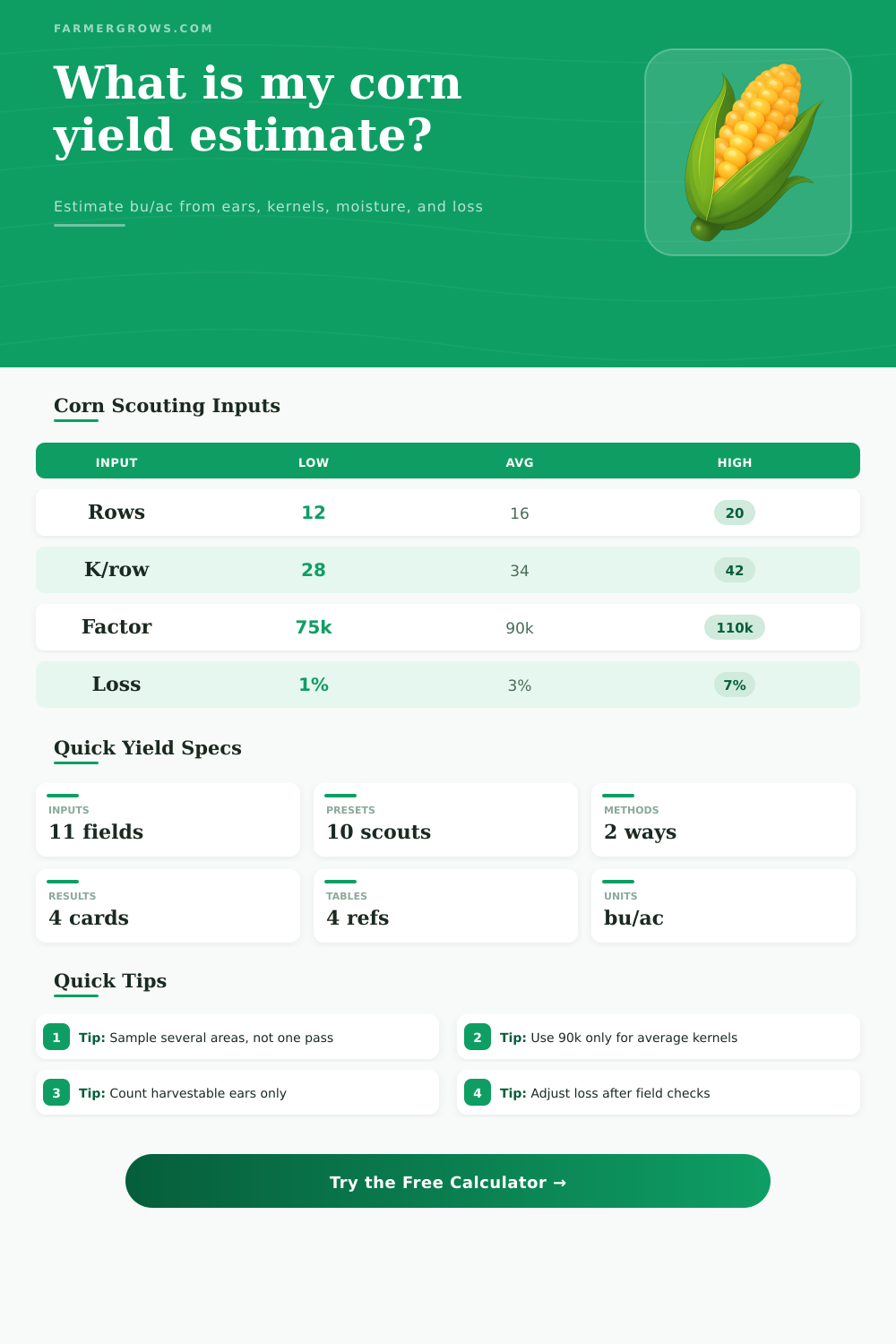
Estimate field corn yield from ear counts, kernel rows, kernels per row, kernel weight factor, harvest moisture, stand count, and expected harvest loss.
Use this as a scouting estimate before harvest. Count only harvestable ears, sample more than one management zone, and update the kernel weight factor as grain fill becomes clearer.
Corn Yield Estimate
Results combine ear population, kernels per ear, kernel weight factor, harvest moisture adjustment, and expected harvest loss.
| Row spacing | 1/1000 acre row length | 1/2000 acre row length | Use in field |
|---|---|---|---|
| 15 in | 34.8 ft | 17.4 ft | Narrow-row corn or twin-row conversion checks |
| 20 in | 26.1 ft | 13.1 ft | Common narrow-row scouting length |
| 22 in | 23.8 ft | 11.9 ft | Use when planter spacing is between common widths |
| 30 in | 17.4 ft | 8.7 ft | Classic quick count length for 30-inch corn |
| 36 in | 14.5 ft | 7.3 ft | Wider-row fields or older equipment systems |
| Kernel weight factor | Kernel size signal | Typical scouting use | Yield effect |
|---|---|---|---|
| 75,000 to 80,000 | Large kernels | Excellent grain fill, long season, low stress | Raises bu/ac versus 90,000 factor |
| 85,000 to 90,000 | Average kernels | Most midseason field estimates before black layer | Good default when kernel weight is unknown |
| 95,000 to 100,000 | Light kernels | Heat, dry finish, nutrient stress, or late planting | Lowers bu/ac versus 90,000 factor |
| 105,000 to 115,000 | Small kernels | Severe late-season stress or poor grain fill | Use cautiously and resample near maturity |
| Harvest moisture | Dry matter factor to 15.5% | Example from 200 bu/ac | Field note |
|---|---|---|---|
| 18% | 0.970 | 194 bu/ac | Small correction, still useful for comparison |
| 20% | 0.947 | 189 bu/ac | Common early harvest adjustment |
| 24% | 0.899 | 180 bu/ac | High moisture estimate needs careful dry basis |
| 28% | 0.852 | 170 bu/ac | Wet harvest estimates can look inflated |
| Harvest loss level | What it may represent | Deduction from 200 bu/ac | Scouting response |
|---|---|---|---|
| 1% to 2% | Clean harvest and upright crop | 2 to 4 bu/ac | Use for calm, even fields after combine setup |
| 3% to 5% | Normal field loss or light lodging | 6 to 10 bu/ac | Check behind the combine with a loss count |
| 6% to 10% | Heavy lodging, down corn, or ear drop | 12 to 20 bu/ac | Separate zones instead of averaging the whole field |
| Over 10% | Severe storm, wildlife, or harvest delay | 20+ bu/ac | Use conservative planning and field-specific counts |
For cleaner sampling: Walk past field edges, drowned-out pockets, and obvious headlands unless you are estimating that zone separately. A few extra stops usually improve the estimate more than changing the formula.
For kernel counts: Skip butt and tip kernels that will not finish as harvestable grain. If kernel depth or grain fill changes sharply across the field, run separate presets for each zone.
A yield estimate determine how many bushel of corn will be harvested from a field. Using this figure, farmers can plan for the harvest of the corn. Many farmer walk the rows of their fields with a notebook and an corn counter to gather the information necessary to calculate the corn yield estimate.
Based off the calculated yield estimate, farmers must decide when to harvest their corn, as well. To calculate the yield estimate of a fields corn, there are specific data components that must be gathered. These data components include the number of ear of corn that can be harvested from a field, the number of kernels contained in each ear of corn, and the weight of the kernels at a specific moisture level.
How to Estimate Corn Yield
A calculator can calculate these components for the farmer, but it is the farmer who must decide which ears of corn will be counted as harvestable ears. The row spacing in which the corn is planted can affect the calculation of the yield estimate. The row spacing affect the number of feet of corn row that can be planted into one acre of land.
Many farmers find it easier to plant corn at thirty-inch spacing rows to aid in counting the number of corn plant in the acre. A field that appears to have sparse rows of corn may actualy yield a high amount of corn if the ears of corn are long and well-filled with kernels. Standings of corn that are very thick may contain fewer kernels than a farmer expects from such a thick stand of corn plants.
The calculator will manage any conversions created by the corn fields different row spacings. The weight of the kernels, or the number of kernels per pound of corn, can change from field to field. The number ninety thousand is used as a reference point for the number of kernels per bushel of corn, but the weight of the kernels can range from heavier with excellent grain fill to lighter with stress on the corn that is planted late in the season.
If five thousand or ten thousand kernels change the number of kernels per pound of corn, the yield estimate will change by ten or fifteen bushels of corn. Reference tables can help the farmer decide if the factor that is used for the weight of the corn kernels is an accurrate representation of the corn that will be harvested. The moisture levels of the corn at the time of harvest impacts the corn yield estimate.
The amount of moisture content in the corn that is sold requires more drying than corn that contains less moisture. The dry matter of corn at harvest adjusts the reported yield of corn. The calculator will account for the dry matter of corn at the time of harvest, but the farmer should understand the reasons for dry matter adjustment in the yield estimate.
If dry matter is not accounted for, fields of corn that are harvested early may appear to contain a higher yield than they actualy do. The same is true for fields of corn that are harvested later in the season. Stand counts for corn fields can also aid in calculating the yield estimate.
By counting the number of productive ear of corn to the total number of corn plants in the field, farmers can determine if anything in the field have reduced the yield of corn from that field. If the total number of productive ears is below eighty percent of the total number of corn plants in the field, the farmer should investigate the field to determine what may have caused this reduced yield of corn. If the total number of productive ears is above one hundred percent of the total number of corn plants in the field, the farmer may be counting tillers or corn plants that have produced two ears of corn.
By calculating the ratio of productive ears to total number of corn plants in the field, the farmer can find another way to verify the ear count in the field. One last calculation for the yield estimate is the harvest loss of the corn field. Fields that are harvested in a clean manner may lose only two or three percent of the corn to the combine that will harvest the corn.
However, areas of the field where the corn has lodged may lose more than the percentage of corn that can be lost in a clean field. The percentage of corn that is lost during harvest accounts for the adjusted yield of corn from the field. As with other calculations for yield estimate, the farmer can program the calculator for these percentages into the calculator to help the farmer envision the impact that different percentages of harvest loss will have upon the final yield estimate of the field.
A yield estimate can be most accurate when observing the field in different pieces. Different sections of a field may contain different levels of moisture content in the corn plants. Additionally, the corn kernels in different sections of the same field may contain different amounts of corn kernels.
By observing the field in these different areas, a farmer can account for the differences in the corn in that field. The calculator can be programmed to account for observation of different areas of the same field. A yield estimate can help farmers make decisions regarding the harvest of the corn before the combine that will harvest the corn.
Based on the yield estimate, farmers may determine whether they need to use more drying capacity to dry the corn to the moisture level that will be sold or if they need to move the grain to another location sooner. Additionally, if the yield estimate calculations reveal that a field will contain a high yield of corn, farmers can use that time to search for suitable storage area or to market the corn. A yield estimate turns the process of harvesting corn into a well-planned process that farmers can use.