Food Plot Seed Calculator
Estimate food plot seed pounds, pure live seed adjustment, species blend rates, overseeding buffer, and rounded bag count for deer, turkey, pollinator, and cover-style wildlife plots.
Use local extension guidance and seed-tag values when available. This planner combines common drilled seed rates with season, method, PLS, and buffer adjustments so small wildlife plots are easier to order and plant.
Small seed, high forage quality, and strong spring use when soil pH and seedbed contact are right.
Fast tonnage and cold-weather attraction, but tiny seed can be over-planted quickly.
Forgiving fall grain that germinates in cooler soils and helps protect bare plot ground.
Palatable, quick growth for fall plots; winter survival depends on variety and climate.
Large seed adds forage and attraction, often paired with oats or rye for support.
Useful brassica component where roots and tops can extend attraction after frost.
Food Plot Seed Estimate
Seed estimate based on your acres, blend, season, method, PLS, buffer, and bag size.
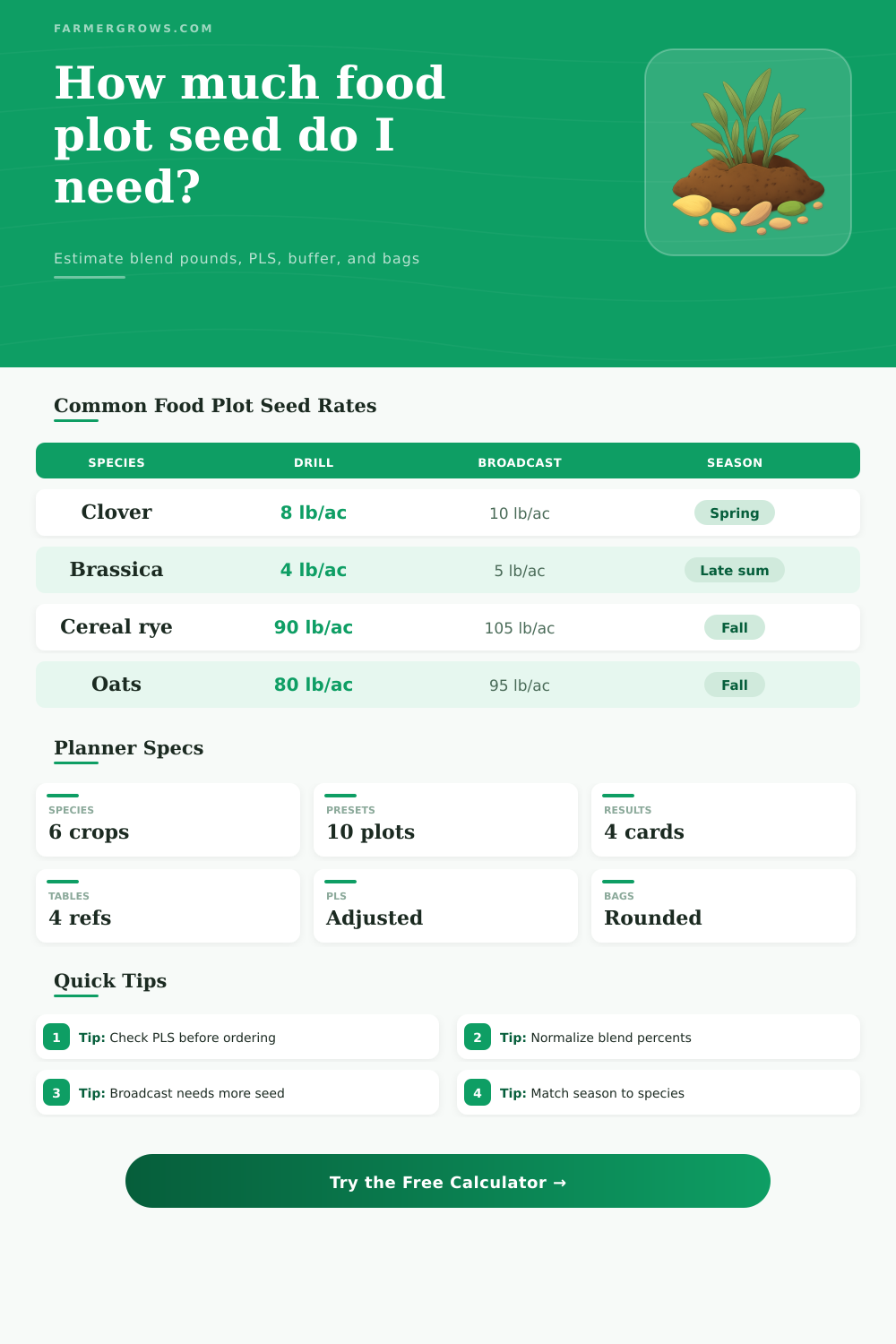
| Species | Common drilled rate | Common broadcast rate | Best fit | Planning note |
|---|---|---|---|---|
| Clover | 6 to 10 lb/acre | 8 to 12 lb/acre | Spring, frost, perennial mix | Needs shallow placement and firm seedbed contact. |
| Brassica mix | 3 to 5 lb/acre | 4 to 6 lb/acre | Late summer or fall draw | Tiny seed; too much can crowd bulbs and leaves. |
| Cereal rye | 75 to 100 lb/acre | 90 to 120 lb/acre | Fall grain, cover, nurse crop | Reliable in cool soils and useful in mixed plots. |
| Oats | 60 to 100 lb/acre | 80 to 120 lb/acre | Early fall forage | Quick attraction, but winter hardiness varies. |
| Peas | 40 to 80 lb/acre | 55 to 100 lb/acre | Protein forage, bow-season mix | Large seed works well with cereal support crops. |
| Turnip | 2 to 4 lb/acre | 3 to 5 lb/acre | Brassica bulb component | Often a small percentage of a broader brassica mix. |
| Planting season | Clover | Brassica | Cereal grains | Peas and turnip |
|---|---|---|---|---|
| Spring green-up | Strong fit | Light rate only | Oats fit better than rye | Peas can work in cool soil |
| Late summer | Good in moisture | Prime window | Use rye or oats as nurse crops | Turnip and peas both fit |
| Fall grain window | Lower share | Moderate share | Best rye and oats window | Peas depend on frost timing |
| Frost seeding | Best use case | Limited use | Not a primary method | Turnip only as a small test |
| Seeding method | Calculator factor | When to use | Seedbed note |
|---|---|---|---|
| No-till drill or grain drill | 1.00x | Best seed placement and least waste | Watch small-seed depth and calibrate boxes. |
| Broadcast and cultipack | 1.12x | Good for small plots with prepared soil | Pack before and after for small seed contact. |
| Broadcast and light drag | 1.20x | Works when packing is not available | Do not bury clover or brassicas too deep. |
| Overseed into standing plot | 1.35x | Use before rain or into thin thatch | Competition and contact are the main risks. |
| Frost seed on firm soil | 1.18x | Best for clover in freeze-thaw cycles | Works on exposed soil, not heavy residue. |
| Bag size | Best use | Exact bag formula | Rounding rule |
|---|---|---|---|
| 5 lb bag | Small clover or brassica plots | Total bulk lb / 5 | Round up to the next whole bag. |
| 10 lb bag | Small mixed plots and tests | Total bulk lb / 10 | Keep unopened extras dry for touch-up. |
| 25 lb bag | Mid-size food plot blends | Total bulk lb / 25 | Round up; allow for drill cleanout. |
| 50 lb bag | Cereal rye, oats, peas, large blends | Total bulk lb / 50 | Common bulk planning size for grains. |
Blend tip: The calculator normalizes species percentages when they do not total 100%. That keeps the blend usable, but a clean 100% mix is easier to communicate when ordering seed.
Planting tip: Small seeds need shallow placement, while peas and cereal grains can handle deeper coverage. For mixed seed sizes, plant large seed first or use separate passes.
Determining the proper rate to seed a food plot is another necesary step in managing a food plot effective. Using to little seed will result in thin stand of plants. Using too much seed will waste the money invested in establishing the food plot.
Many individual will attempt to calculate the proper rate by guessing, but the guesswork will not provide a best outcome when the weather is dry or the land suffers a frost. The behavior of plant species differ based on the planting window and the soil conditions it will encounter. Clover will only grow in soil that is cool and moist and with a firm seedbed.
How Much Seed to Use in a Food Plot
Brassica species require the ground to be able to grow before encountering hard freezes in the ground. Cereal rye and oats will germinate in soil that is exposed to cool temperature. However, how the seed is plant (drilled or broadcasted), will change the growth of cereal rye and oats.
To determine the proper rate to seed a food plot, individuals can use a seed calculator. These calculators asks the individual the number of acres of the food plot, the current season, and the planting method. If using a drill to plant the seed, the rate will be closer to one.
If broadcasting and dragging the seed, the rate will be higher because of the potential loss of seed. If overseeding an existing stand of plants, the rate will be even higher. Using a seed calculator allow an individual to avoid memorizing the coefficient for these scenarios.
Another factor to consider in calculating the proper rate for seeding a food plot is the pure live seed percentage for the seed species. If the percentage is 80, for instance, it will take more bulk pound of seed to reach the target for live seeds. Using a buffer percentage for the calculation will help create a successful food plot.
Depending on the number of acres to be seeded, a ten percent buffer will provide enough room for the individual to account for the loss of seed in the ground by birds before it germinate. The blend percentage for the seed mix will create certain outcomes in the food plot. The percentage for cereal rye will provide rapid cover for the food plot and help control erosion.
However, if there is a heavy component of cereal rye, it will potentially shade the other species in the blend. A blend with many brassica species will attract game species later in the growing season. However, the seeds in brassica species are small, so the individual can easy overapply these seed to the food plot.
The percentage for each species can be normalized, but that will require an individual to decide on the purpose of the food plot. A food plot for a bow stand will attract different species during specific time frame different than a food plot for a brood plot. Another tool that can assist with calculating the proper rate for seeding a food plot are the reference tables.
These tables include the drilled and broadcast rates for each species, as well as the best time to plant each species. These tables are helpful in that they can account for the lands condition other than the variables asked of the seed calculator. These tables will provide the starting point for an individual setting up a food plot.
An individual may encounter difficulties if attempting to use the same rate for every acre of food plot. Depending on the location of the acre within the food plot, the soil will remain wetter and shade by trees. Additionally, the center of a large food plot may have different soil condition than the edges.
By dividing the food plot into zones, it is easier to create a successful food plot that dont require purchasing one large bag of seed. The seed calculator can round up the bag count to the nearest bag of seed. Any extra bag of seed is rarely wasted in that any extra quantity will cover calibration passes on the drill and any thin spot in the field.
Additionally, a bag of seed may tear during transport, so there will be extra to account for that possibility. While it may be possible to order the exact amount of seed calculated by the seed calculator, that might not work out in the field. Planning a food plot based off the actual condition will ensure that the calculated rate for the seed is accurate to the food plot situation.