Cotton Seed Calculator
Plan cotton seed drop, final stand, seed spacing, seed units, bag weight, and replant-risk allowance from acres, row spacing, seed size, germination, and expected field emergence.
Use local extension and seed-company guidance for variety-specific targets. Cool soils, crusting, thrips pressure, planter speed, seed treatment, and irrigation timing can all shift the final stand.
Cotton Seed Results
Results use row feet per acre, planted seed drop, seed germination, expected field emergence, seed size, seed-unit count, and your replant-risk reserve.
| Cotton system | Common rows | Typical final stand | Seeding note |
|---|---|---|---|
| Irrigated picker cotton | 30 to 40 in | 36,000 to 52,000 plants/ac | Moderate to high stand target where moisture is reliable. |
| Dryland picker cotton | 36 to 40 in | 28,000 to 42,000 plants/ac | Lower targets are common when moisture is limiting. |
| High Plains cotton | 30 to 40 in | 25,000 to 45,000 plants/ac | Adjust for short season, irrigation, and storm risk. |
| Pima cotton | 38 to 40 in | 32,000 to 48,000 plants/ac | Variety and local production system matter. |
| Ultra-narrow cotton | 7.5 to 15 in | 45,000 to 70,000 plants/ac | Lower seeds per foot can still produce high acre populations. |
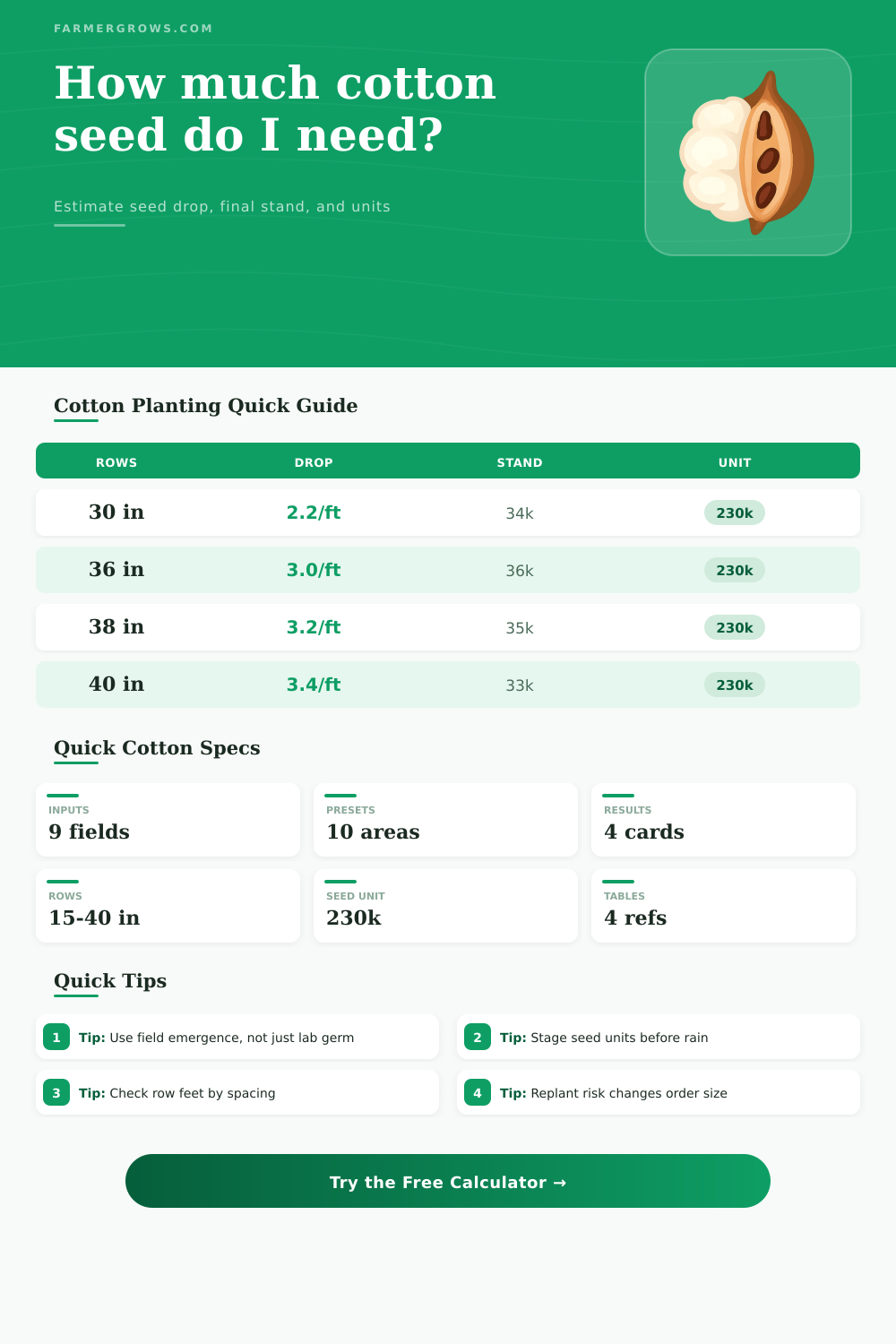
| Row spacing | Row feet per acre | Seeds/ac at 2.5/ft | Seeds/ac at 3.2/ft | Seeds/ac at 3.8/ft |
|---|---|---|---|---|
| 15 in | 34,848 ft | 87,120 | 111,514 | 132,422 |
| 30 in | 17,424 ft | 43,560 | 55,757 | 66,211 |
| 36 in | 14,520 ft | 36,300 | 46,464 | 55,176 |
| 38 in | 13,756 ft | 34,389 | 44,018 | 52,272 |
| 40 in | 13,068 ft | 32,670 | 41,818 | 49,658 |
| Seed size | Weight per 230k unit | Seed weight at 40k/ac | Planning note |
|---|---|---|---|
| 4,000 seeds/lb | 57.5 lb/unit | 10.0 lb/ac | Larger seed; check planter plates and singulation. |
| 4,400 seeds/lb | 52.3 lb/unit | 9.1 lb/ac | Common planning range for many treated lots. |
| 4,800 seeds/lb | 47.9 lb/unit | 8.3 lb/ac | Smaller seed lowers pounds but not seed count. |
| 5,200 seeds/lb | 44.2 lb/unit | 7.7 lb/ac | Confirm meter setup because seed count changes fast. |
| Field condition | Emergence range | Replant reserve | Decision note |
|---|---|---|---|
| Warm, firm bed | 80% to 90% | 0% to 5% | Best planting window with good moisture and closure. |
| Cool early planting | 65% to 80% | 5% to 12% | Watch forecast, seed vigor, and thrips pressure. |
| Crusting risk | 55% to 75% | 10% to 20% | Rain after planting can reduce stand unevenly. |
| Partial replant field | Variable | 15% to 35% | Reserve should match the likely affected acreage. |
Use field emergence: Lab germination is useful, but cotton stand planning should reflect soil temperature, seedbed firmness, moisture, insects, disease, and planter performance.
Stage replant seed carefully: A reserve can keep a tight planting window moving, but large buffers tie up treated seed. Match the reserve to real field risk.
A successful cotton stand begin with the decisions made regarding the selection of cotton seed. The selection of cotton seed determine the number of plants that will successfully reach the harvest stage. Cotton seed decisions determine the total amount of cotton seeds that a person will have to purchase.
Additionally, cotton seed decisions will determine if that person will need to replant there crops if the weather condition are not favorable for the crops to mature. Cotton seed drop should be matched to the conditions of the field in which the crops will be planted. This is more favorable than using the data from previous year or the estimates of other individuals.
Choose Cotton Seed and Plan Your Planting
Several specific inputs is required to calculate the drop of cotton seeds. One of these is the row spacing. Row spacing will determine the number of linear feet of cotton that will be covered by each acre.
The second of these specific inputs is the number of seeds to be dropped per linear foot. Germination rates are one of the determinations for cotton plans. However, field emergence is the more accurate determination of the germination of the cotton seed.
Field emergence accounts for the soil temperature during the emergence of the cotton seed, the moisture content of the soil at the time of planting, and the number of insect that may have impacted the seed prior to emergence. The calculator that was provided can calculate all of these, so the individual dont have to remember these variables. Another factor that must be considered is the size of the cotton seed.
Cotton seed lots contain different amount of weight. If the seeds are large, then there will be fewer weights of cotton seed per pound of cotton. The weight of the cotton seed is important in determining the number of seed unit that can be staged, or the number of bags of seed that may be loaded on a trailer.
The number of acres that are to be planted with a replant reserve is another important planting calculation. Using this calculation, there will be a buffer for situations where the soil may crust after it rains, or for crops that require a second pass to be planted. Using too small of a replant reserve will result in insufficient cotton seed for those unfavorable condition.
Using too large of a replant reserve will result in the holding of treated cotton seed that may be killed during storage. The reference tables that are provided demonstrate the interaction between row spacing, seed size, and emergence rates. These tables are not a replacement for the recommendations of the local agronomist, but they do provide information regarding the changes in one of these variables that will impact the other.
For instance, if emergence rates are low, the number of cotton seeds per linear foot can be increased. Additionally, factors like seedbed preparation or the planting date could be changed to increase the survival rate of the cotton seeds. This is one alternative to purchasing additional cotton seed.
Many mistake can be made with the use of the cotton planting rate that was established the previous growing season. Fields that experienced excellent yields with the use of irrigation may require different planting rates to dryland acres. Additionally, the lots of cotton seed that are available may contain different amount of cotton seed due to the availability of different varieties of cotton seed.
Factors like planter speed and planting depth affect the emergence rates of the cotton plants, but these factors are rarely list on the tag of the cotton seed. The calculator did not account for all possible factor in the establishment of a good cotton plan, but it does require that the cotton farmer to consider these factors. Row spacing is one of the factors that may significantly change with changes to the number of seeds per linear foot.
If a certain row spacing is established for dryland acres that will allow for the development of a high stand of cotton, the same spacing could lead to the plants competing for moisture before the development of cotton bolls. The calculator will establish the row spacing that will result from the number of cotton seeds that are to be planted per linear foot. This calculation will allow a planter to determine if that row spacing is appropriate based off the availability of water to the fields.
The use of these specific inputs will allow an individual to create a plan for the planting of cotton that will provide for the yield that is desired from that farm. The plan should include a balance between the cost of the cotton seed that is planted, and the risk of having to establish a replant reserve for those acres. By adjusting each of these variables to the actual condition of the fields in which the cotton will be planted, the planter will have a clear idea of the number of plants that will be established in each acre.
By creating such a plan, an individual will enter the planting season with fewer problems than would of otherwise occur.