Cow Breeding Calculator
Build an individual cow breeding calendar from heat detection, AI or natural service date, breed gestation, preg-check timing, dry-off target, postpartum interval, and body condition readiness.
Use this as a planning calendar with herd records and veterinary guidance. Actual pregnancy status, calving date, and breeding readiness depend on health, nutrition, semen quality, bull fertility, heat detection accuracy, and your farm protocol.
Breeding Calendar Results
Dates are estimated from service date, gestation length, heat cycle, preg-check interval, dry period, postpartum interval, and BCS readiness.
| Breed or type | Planning gestation | Common window | Calendar note |
|---|---|---|---|
| Holstein | 279 days | 272 to 286 days | Useful default for dairy cow due-date calendars |
| Jersey | 278 days | 271 to 285 days | Often planned slightly shorter than large dairy breeds |
| Brown Swiss | 290 days | 283 to 297 days | Longer dairy gestation, useful for dry-off planning |
| Angus | 283 days | 276 to 290 days | Common beef cow breeding calendar default |
| Hereford or Simmental | 285 days | 278 to 292 days | Balanced beef calendar estimate |
| Brahman influence | 292 days | 285 to 299 days | Heat-adapted cattle often need longer gestation plans |
| Heat or service situation | Calendar anchor | Recommended action | Watch point |
|---|---|---|---|
| Morning standing heat | Heat date | Breed the same evening or by farm AI protocol | Record time and cow ID |
| Afternoon or evening standing heat | Heat date | Breed the next morning or use set farm timing | Confirm standing behavior |
| Activity monitor alert | Alert date | Confirm with visual signs before AI if possible | False alerts can shift timing |
| Natural service | First observed service | Use service date for due date and return heat watch | Confirm bull soundness |
| Uncertain signs | Observation date | Recheck, chalk, tail paint, or consult protocol | Avoid breeding too early |
| Follow-up event | Typical timing | Purpose | Calculator use |
|---|---|---|---|
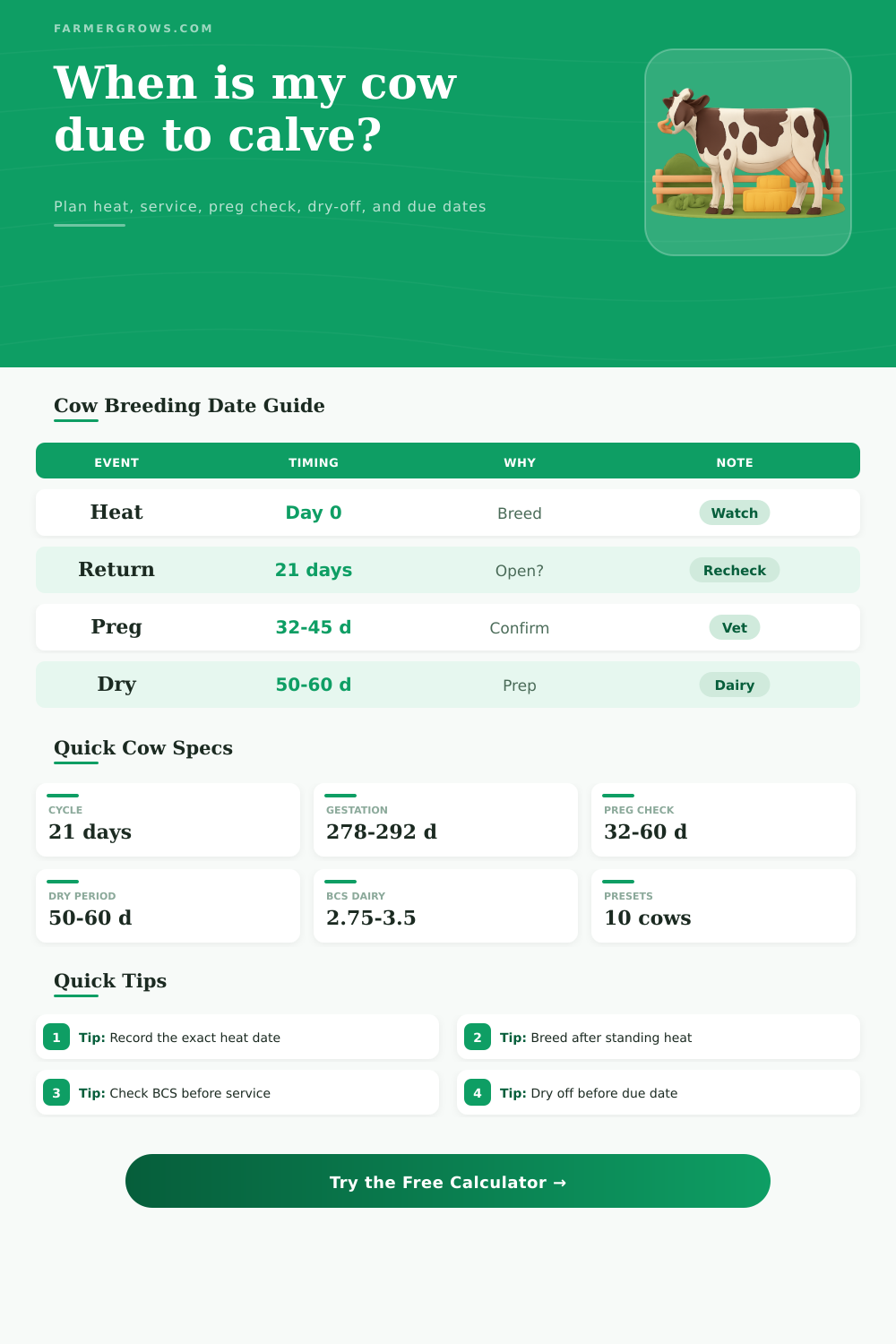
| Return heat watch | 18 to 24 days after service | Find open cows early | Shown from selected cycle length |
| Early ultrasound | 32 to 35 days after service | Confirm pregnancy and twins where used | Enter your farm's check day |
| Palpation or later check | 45 to 60 days after service | Confirm pregnancy status with vet | Common beef and dairy field window |
| Dry-off target | 50 to 60 days before due date | Prepare mammary tissue and close-up cow | Applies mainly to dairy cows |
| Close-up watch | 21 days before due date | Move to close-up ration or pen | Listed in breakdown calendar |
| Readiness check | Dairy cow target | Beef cow target | Management meaning |
|---|---|---|---|
| Postpartum interval | 50 to 70 days | 45 to 80 days | Allows recovery before breeding pressure |
| Body condition | 2.75 to 3.5 BCS | 5 to 6 BCS | Thin cows often cycle later and settle poorer |
| Heat detection | Standing heat or strong alert | Standing heat or observed service | Weak signs deserve another check |
| Health screen | Clean discharge, no fever | Sound feet, good appetite | Problem cows may need vet review first |
| Nutrition trend | Rising intake and stable milk | Maintaining or gaining condition | Energy balance supports conception |
For heat breeding: Write down the first standing heat time, not just the day someone noticed activity. That note makes AI timing and return-heat checks much cleaner.
For readiness: A cow can show heat before she is a good breeding candidate. Match postpartum days, BCS, uterine health, and farm protocol before service.
Timing a cows breeding calendar require precise data. To determine the breeding schedule for a cow, a person must determine when to breed the cow, when to check the cow for pregnancy, when to begin the dry-off period for the cow, and when the calf will arrive. The choices a person make in the breeding process regarding detecting the cows heat will affect the breeding calendar.
If a person misses a heat cycle for the cow, the breeding calendar will shift several week as a result. A breeding calculator will perform mathematical calculation to determine the due date for the cows calf, the dry-off date for the cow, and the pregnancy-check dates for the cow. The breeding calculator will calculate these dates when a person enters the specific dates and settings into the calculator.
Using a Cow Breeding Calendar
The calculator will determine the due date by using the length of pregnancy for that specific breed of cow. Additionally, the calculator will work both forward and backward from the due date to show the pregnancy-check and dry-off dates for the cow. These dates are only accurate if the inputs a person enter into the calculator are accurate.
Detecting when a cow is in heat will impact the timing of artificial insemination of the cow. Standing heat last for approximately half a day. Additionally, the timing of artificial insemination will depend on when a person spots the cow in heat.
If a cow is spotted in heat in the morning, the person will perform breeding in the evening of the same day. However, if a cow is spotted in heat in the afternoon, breeding will be performed the following morning. A person can use activity monitor to detect when a cow is in heat before the cow is spotted in heat.
However, the person must still confirm that the cow is in heat when the activity monitor beeps. The breeding calendar can help to determine the specific time that a cow display heat and the level of confidence that the person has in the detection of the cow in heat. The body condition of the cow is one of the variable that will impact the breeding calendar for that cow.
A person must enter the body condition score of the cow into the breeding calculator to account for this variable. Dairy cows with a body condition score of less than 2.75 on a five-point scale have a higher risk of losing their embryos. Additionally, beef cows with a body condition score of less than five on a nine-point scale will also have higher breeding risk.
The breeding calculator allow a person to enter both the current and target body condition score of the cow to determine if the cow is ready for breeding. However, the readiness label that the breeding calculator provides is not a substitute for physically inspecting the cow. For dairy farm, dry-off timing is a crucial component of the breeding and calving cycle.
If a person sets the dry-off period for the cow too early, the cow will waste its production days. Additionally, if dry-off is started too late for the cow, the udder will have health problem. A person can enter the length of the dry period for the cow in the breeding calculator.
This will allow the farm to determine when the dry-off period will begin in relation to the due date for the calf. Beef breeding operations will have different requirements for breeding the cows in their pasture. Beef operations may experience uncertainty regarding the service dates for the cows.
This is because a bull may run with the herd for several month. It may be difficult to pinpoint the exact date on which each cow was bred with the bull. Breeding calculators will produce a due date when a person enters the service anchor date for the cow.
However, the pregnancy-check window for beef cows may need to be different than dairy cows. A person can reference the tables in the breeding calendar to find the pregnancy length for different breeds of cows. Another factor to consider for the breeding of cows is the postpartum interval.
This will determine the age of the cow before it is ready for breeding. Many dairy farm will wait sixty days after calving before breeding the cow. However, some farm may extend the period to allow the cow more time to recover after giving birth.
A breeding calculator will use the number of days set by the farmer for the postpartum interval. Additionally, the breeding calculator will compare the days in which the cow produce milk with the body condition score of the cow. This will allow the farmer to determine whether or not the breeding dates for the cow are within the safe interval.
Many people make mistake while breeding cows. These mistakes occur in three specific areas while breeding cows. The first mistake is not treating every heat cycle for a cow the same.
Additionally, another mistake is to treat the due date for a cows calf as if it is a fixed date rather than a time window during which breeding should occur. Finally, a third mistake is to enter the dates into the breeding calendar without checking if the cow meet the health and body condition requirements to become pregnant. The value of the breeding calendar for cows forces a person to have an organized breeding plan for the cows in the farms pasture.
All of the components of the breeding calendar must be accounted for when determining the breeding schedule for the cows. The dates will function as a plan for breeding that can be followed for the season. Additionally, if there are discrepancies in these components, the farmer will spot these discrepancies early in the breeding cycle to allow the farmer to make adjustments prior to the changing of the season.