Feed Rate Calculator
Estimate livestock feed delivery rate, daily pounds, per-window run time, batch totals, waste allowance, and refill frequency for auger, belt, gravity, or hand feeding.
Use this as a planning and calibration worksheet. Always verify feeder output with an actual timed catch test, and adjust feeding programs gradually for the animal class and ration.
Feed Rate Results
Results use the measured delivery rate when provided; otherwise they estimate rate from feeder type, density, auger rpm, belt speed, and gate opening.
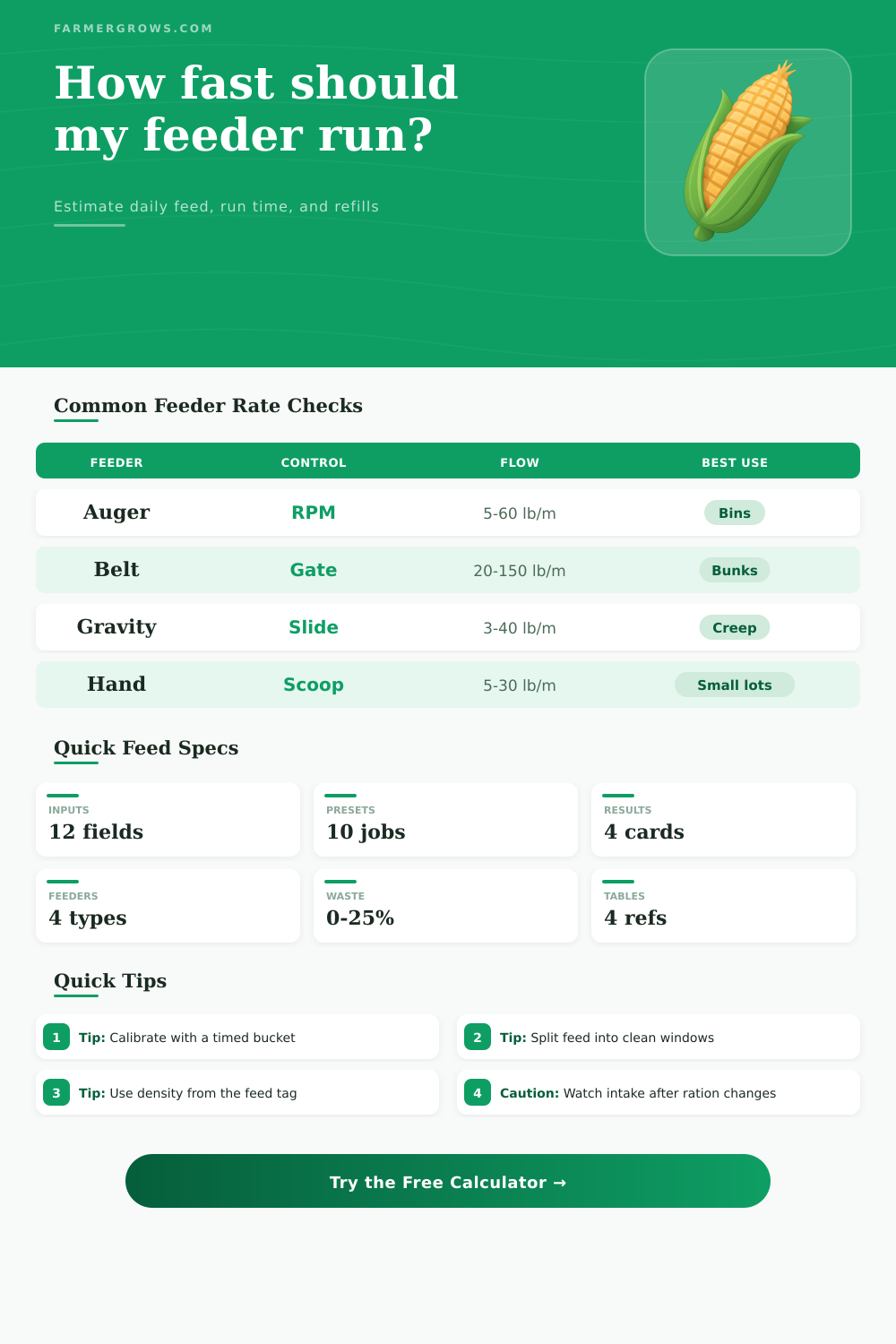
| Feeder type | Main control | Typical delivery | Calibration method |
|---|---|---|---|
| Small auger feed line | Motor rpm and screw fill | 5 to 35 lb/min | Catch feed for 60 seconds, weigh it, then repeat after changing rpm. |
| Large auger or bin unload | RPM, inlet gate, and density | 30 to 180 lb/min | Use a wagon, tote, or scale platform for a timed run. |
| Belt or chain bunk feeder | Gate opening and belt speed | 20 to 150 lb/min | Mark a short run, catch the discharge, and check bunk coverage. |
| Gravity drop feeder | Slide opening and feed head | 3 to 40 lb/min | Open the gate for a fixed time and weigh each drop. |
| Hand feeding | Scoop size and labor pace | 5 to 30 lb/min | Weigh several scoops or a cart load, then time the route. |
| Feed material | Density range | Flow behavior | Rate note |
|---|---|---|---|
| Pelleted complete feed | 38 to 45 lb/cu ft | Usually steady | Good for auger and gravity calibration. |
| Mash or meal feed | 28 to 38 lb/cu ft | Can bridge or pack | Watch humidity, fines, and vibration. |
| Cracked corn | 42 to 48 lb/cu ft | Free flowing | Often runs faster than fluffy rations. |
| Grain and protein mix | 36 to 44 lb/cu ft | Moderate | Recheck after changing ingredients. |
| Calf starter | 32 to 42 lb/cu ft | Moderate | Small amounts need careful weighing. |
| TMR or chopped ration | 16 to 30 lb/cu ft | Bulky | Use measured lb/min whenever possible. |
| Windows per day | Share per window | Typical use | Management note |
|---|---|---|---|
| 1 window | 100% each run | Simple dry cow, horse, or hand feeding | Works best when animals have enough bunk space. |
| 2 windows | 50% each run | Beef bunks, dairy groups, small ruminants | Common balance of labor and fresher feed. |
| 3 windows | 33% each run | High intake or hot weather groups | Can reduce slug feeding and stale refusals. |
| 4 windows | 25% each run | Poultry, nursery pigs, automated lines | Check that short runs still distribute evenly. |
| Usable capacity | Daily use | Refill interval | Planning note |
|---|---|---|---|
| 1,000 lb | 250 lb/day | 4.0 days | Small tote or gravity feeder. |
| 3,000 lb | 900 lb/day | 3.3 days | Common small herd bulk bin rhythm. |
| 8,000 lb | 1,600 lb/day | 5.0 days | Leave reserve before storms or weekends. |
| 18,000 lb | 2,500 lb/day | 7.2 days | Weekly delivery target if intake is stable. |
Calibration tip: Run the feeder long enough to reach steady flow, catch a known time sample, weigh it, and enter that measured lb/min instead of relying on the estimate.
Management tip: Recheck rate after changing pellet size, moisture, fines, auger wear, gate setting, or ration ingredients. Small flow changes compound across every feeding window.
Effectively feed delivery require planning in creating an effective feed delivery system. Effective feed delivery requires that the settings for the feeding equipment is matched to the type of feed that must be delivered to the animals, as well as the number of animal that must be fed. If the feeder delivers feed to the animals to quickly, there will be waste of that feed and sorting of the feed by the animals at the bunk.
If the feeder delivers feed to the animals too slowly, some animals will compete for the feed, and some animals may stop eating altogether because they are waiting for the feeding to begin. The rate at which feed is delivered can change based on a variety of factors. The factors that influence the feed delivery system includes the density of the feed, the length of time during which the feed is delivered, the allowance for waste of feed from the feeding area, and the frequency at which the feed are replenished in the feed bins.
How to Plan Feed Delivery for Animals
The density of the feed is one of the primary factor that influence the feeding system. The density of feed is the weight of the feed within a specific volume of the feed. Pellets contain more feed density than total mixed ration (TMR) that is fed in a loose manner to the animals.
Therefore, the number of pounds of pellets that are delivered at a specific gate is more than the number of pounds of loose TMR that can be delivered through the same gate. Thus, if the feed that is delivered to the animals change from one type to another, the rate at which feed is delivered will change even if the settings of the feeding equipment do not change. A calculator that determine feed delivery rates can account for the type of feed and the density of that feed to calculate the volume of feed that will allow the desired pounds of feed to be delivered to each animal.
Run time per feeding window is another critical component of the feed delivery system. The run time for each feeding window must be calculated based on the total amount of feed that must be consumed by the animals each day. The feed that is produced by many farming operations is split into two or three feeding portions to keep the feed fresh for the animals.
Additionally, it helps to ensure that all of the animals has an opportunity to consume the feed. The total number of animals and the total daily target for the feed can be entered into a feed delivery rate calculator to determine the number of minutes that each feeding window must last to provide the total feed that is required each day. This duration of each feeding window can be used to determine if the feeding equipment is able to evenly distribute the feed during that time period.
Waste allowance is a factor that is often neglected when calculating the rate at which feed will be delivered to the animals. Waste allowance must be accounted for in the calculation of feed delivery rates. The waste of feed can include feed that is not eaten by the animal, fines that is blown away from the animals, and feed that the animals step on.
Five percent is often the waste allowance that is used to produce clean feeding bunk areas. A higher waste allowance may be required with changes to the type of feed or weather condition. The allowance for waste can be entered into the feed delivery rate calculator.
By entering a waste allowance for feed, the remaining feed calculations will scale according to this allowance so that the schedule for replenishing feed will not lead to a shortage of feed. Refill frequency for the feed bins is another essential component of feed delivery management. The frequency with which the feed bins are replenished is based off the capacity of the bins and the number of animals being fed.
The feed bins may appear to be full, but they will be emptied once the reserve amount of feed is accounted for. A feed delivery rate calculator allows the farmer to input the usable capacity of the bins and the daily demand for feed from the number of animals to calculate the number of days between refills of each feed bin. By calculating the number of days between feed refills, the farmer can ensure that feed deliveries are scheduled according to weather or labor availability.
The calculator will alert the farmer if the usable space in the bins contains less than enough space for one day of feed. If there is not enough space in the bins to provide enough feed for the animals for one day, feed must be provided more frequently then at the current rate. Calibration of the feed delivery system is one of the last steps in the feed delivery planning process.
Calibration ensures that the calculations made for the feed delivery system are the correct numbers. One way of calibrating the feed system is to measure the amount of feed that is delivered during a timed period. Factors that impact the feed delivery system include feed density, gate height, and the revolutions per minute (RPM) that the feeders move at.
The only true calibration of the system is through the use of a scale to determine the actual amount of feed that is delivered. Reference tables exist that contain the feed delivery rates for different types of feeders. Using these reference tables will allow the feeders to understand if the feed delivery rate calculated for the feeding system is outside of normal limits for the type of feeder that is in use.
Additionally, the number of animals that are fed and the seasons in which the animals is feeding change the requirements for the feed delivery system. Animals of different types have different targets of feed that should be delivered to each animal. For instance, nursery pigs require a different amount of feed to be delivered to each animal than finishing cattle.
Therefore, the controls of the feeders may have to be adjusted if the feed system changes from nursery pigs to finishing cattle. Another example is that gravity gates work well for feeding pellets to the animals during cooler months of the year. However, the gates may become a disadvantage to feeding the same type of pellets during months with high humidity levels in the environment because the feed fines may begin to bridge the gates.
The feed delivery rate should be checked after every change in the type of feed. Checking the feed delivery rate after every change in the type of feed will ensure that the feeding schedule is accurate.