
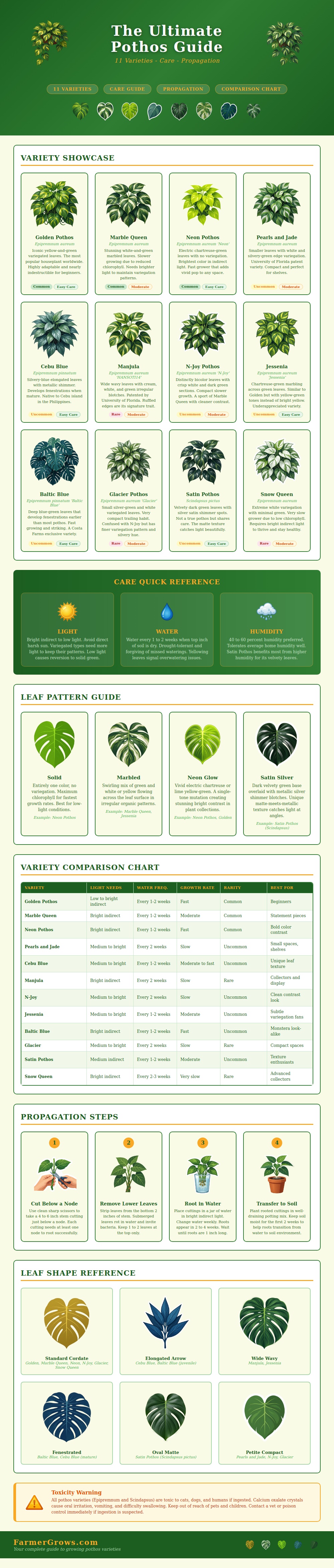
If you purchased your first houseplant, you paid not much, but it was probly a creature of the rain forest: a tropical-looking thing that had leaves like foliage. Chances are, it was a Golden Pothos, versatile, foolproof (it will live even when you’re an absent-minded gardener who doesn’t water regulary). It’s such an approachable houseplant; once you have the hang of it, why not branch out? There are version of this familiar vine in other leaf shapes, patterns, sizes and colors. Meet 11 variations on the theme.
The other thing about understanding your plants is knowing how fast they grow (manage your expectations) and being aware of what makes some varieties rare (or common). For instance, variegated patterns (such as on a ‘Marble’ variety above or the Snow Queen and the Marble Queen) are beautiful, but there’s a trade off: The portion of the leaf that’s not green (white or cream, for example) doesn’t contain any chlorophyll. It can’t photosynthesize very wellly. So plants with more variegation than green (like the Snow Queen and Marble Queen) will be slower growing than plain green ones. They also requires higher levels of indirect bright light to maintain their patterns without burning out. Put one of these in a really dark spot, and it’ll revert to plain green (the plant figure out it needs to make more chlorophyll-rich tissue to survive).
11 Different Types of Pothos Plants
The way you dress up your space is also influenced by structure. With most pothos types, the leaves is broad, heart-shaped, and dangle from their containers or hanging baskets. The Neon Pothos fills out in those dimensions and makes a nice pop of color against all those neutral colors. Some varieties throw those parameters for a loop. They aren’t part of common pothos (aureum) species, but are instead part of the pinnatum species: the Baltic Blue and Cebu Blue. These are long and arrow-like, and their leaves is a silvery blue that makes them appear artificial, until you feel the soft texture. As mature specimens, they begins to form fenestrations: those naturaly-looking splittings along the edge of each leaf. It’s a fancy appearance, well-suited to a floor stand.
All these kinds require the same basic care. This makes them common houseplants, like this one in a living room: Treat it all the same: Water when the top inch of soil is dry, place in medium to bright indirect light, and don’t worry if your average home humidity isn’t ideal; they take it. The infograph says to only make a few changes to your routine for more delicate ones like Glacier or Manjula, and those changes are just about how much light they get. They’re actualy rather tough guys that die most often from overwatering, not lack of attention. In their natural habitat, they’re drought-tolerant vines that store water in their thick leaves. Yellowing of the lower leaves indicate too much moisture, not too little.
Pothos are also easy to grow from cuttings. That’s because they is great houseplants for sharing, each cutting will easily form a new plant, requiring only one node. Whether you want to keep them for yourself or create more to share, a single node is all each cutting needs to take root. Simply cut beneath a node, strip off the bottom leaves, and submerge the stem in water until roots emerge. It doesn’t take long; within weeks of being placed underwater, the nodes will start producing roots, and soon those roots will hold fast when buried in potting mix. Easy, and a low-risk method for testing various types, since you can easily share cuttings with friends or make clones of your favorite vine instead of buying full-sized plants. Try the variegated Manjula with her lacy ruffles, or the bicolor N-Joy, and you’ll end up with another happy houseplant to help you fill some empty spots, proving again that humble vines does make good companions.