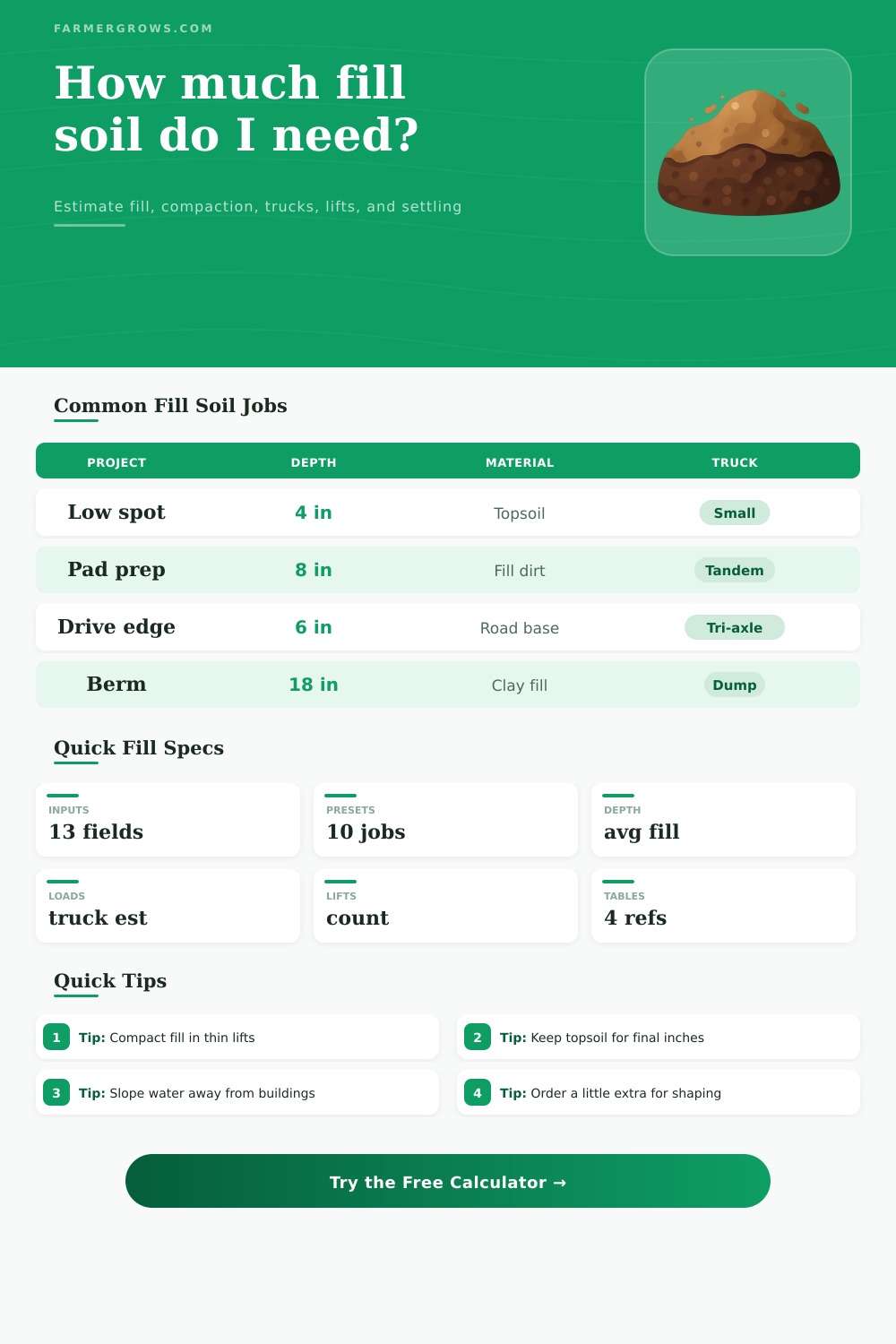
Fill Soil Calculator
Estimate the compacted fill, loose soil order, truck loads, lift count, and settling allowance needed to raise a depression, level a pad, or build grade.
Use this for planning fill dirt, screened topsoil, structural fill, road base, and berm material. Field measurements, drainage, local soil tests, and any engineered pad requirements should still guide the final order.
Fill Soil Estimate
Your fill plan will appear here after calculation.
| Measured condition | Depth method | Common use | Planning note |
|---|---|---|---|
| Dish-shaped depression | (deep + edge) / 2 | Lawn low spot, washout | Works when the bottom tapers smoothly to the edge. |
| Flat pad raise | Same depth across area | Shed pad, barn apron | Enter low and edge depth the same, plus any grade raise. |
| Feathered shoulder | Deep side to zero edge | Driveway shoulder, swale edge | Use 0 for the shallow edge when it tapers to existing grade. |
| Irregular hole | Several depth readings | Pasture rut, equipment track | Average your readings and enter them as low and edge estimates. |
| Material | Compaction add | Shrink/swell | Best placement |
|---|---|---|---|
| Screened topsoil | 5% to 10% | 0% to 8% swell | Lightly firm, avoid hard compaction over roots. |
| Common fill dirt | 10% to 18% | 0% to 10% swell | Moist, thin lifts with tractor or plate compactor. |
| Clayey fill | 12% to 22% | -5% to 8% | Keep near workable moisture; avoid wet clods. |
| Road base | 8% to 15% | 0% to 5% | Compact in lifts for drive and access support. |
| Truck type | Typical loose volume | Approx weight range | Use case |
|---|---|---|---|
| Small dump trailer | 2 to 4 cu yd | 2 to 6 tons | Garden beds, tight yards, small low spots. |
| Single axle dump | 5 to 7 cu yd | 6 to 10 tons | Residential fill and screened topsoil orders. |
| Tandem dump truck | 10 to 14 cu yd | 12 to 20 tons | Pad prep, lane shoulders, barnyard repairs. |
| Tri-axle dump truck | 15 to 18 cu yd | 20 to 25 tons | Large grade work with good access and room to dump. |
| Lift thickness | Hand tools | Plate compactor | Farm equipment |
|---|---|---|---|
| 3 to 4 in | Best for small patches | Excellent control | Usually too thin for rough grading. |
| 5 to 6 in | Workable with tamping | Common target | Good finish lift for yards and pads. |
| 7 to 8 in | Difficult to firm | Use heavier passes | Practical with tractor tires on moist fill. |
| 10 to 12 in | Not recommended | Often too thick | Only for rough non-structural fills. |
Build from the bottom up. Strip loose organics first, place fill in lifts, and compact each lift before adding the next. A thick loose dump can settle unevenly even if the top looks smooth.
Plan drainage before ordering. Fill should not trap water against buildings, trees, or fence posts. Leave a workable crown or slope, then reserve better topsoil for the final growing layer.
A fill soil calculator estimate how much soil is required to fill a low areas in your yard. You might have a low area due to rain settling in that spot in your yard. Alternatively, you might have dug in your yard to create a level area for your lawn or a pad for a shed or other structures.
A fill soil calculator help calculate the volume of soil required to fill the low area. A fill soil calculator accounts for the dimension of the area to be filled, the depth of the area to be filled, and how the soil will settle after being placed in the low area. To use a fill soil calculator, you must enter the dimensions of the area to be filled.
How to Use a Fill Soil Calculator
For rectangular areas, you must enter the length and the width of the area. For circular area, you must enter the diameter of the circle. For triangular or other custom shapes, you must enter the measurements of the custom shape.
You must also enter the depth of the shallowest and deepest point in the low area. The fill soil calculator will account for these depths and calculate the average depth of the soil to be placed in the low area. A fill soil calculator also use a compaction factor to calculate the volume of soil to order.
When a truck delivers the soil, the soil is in a loose state. A compaction factor allow the fill soil calculator to account for the volume of soil that machinery will compact. Additionally, soil settle in low areas after it is placed.
A settling allowance allow the fill soil calculator to calculate for the drop in the level of the soil over time. Some soil type shrink and swell different than others. The shrink-swell percentage of the soil allow the calculator to adjust the amount of soil to account for the shrinkage or swelling of the soil.
Using a fill soil calculator, you can also enter the size of the delivery trucks. The volume of soil to be delivered divided by the capacity of the delivery truck will calculate the number of trip the delivery trucks will make to deliver the soil. Additionally, you must consider the lift thickness of the soil.
If you place too much soil in a low area at once, it will not compact appropriate. Using a fill soil calculator allow you to calculate how many layer of soil will be placed in the low area to ensure that each layer can compact appropriate. Depending on the type of soil selected for the low area, a fill soil calculator will use the density of that soil type in its calculations.
For example, if you will use screened topsoil for a garden in a low area, the calculations will use the density of screened topsoil. If you will use structural fill for a shed pad, the calculations will use the density of structural fill. Since the density of these soil types are different, the total volume of soil that will be ordered will change with the type of soil that is selected.
When ordering soil for a low area in the yard, it is easy to make mistakes. For instance, people may order too little soil for a low area because they only measure the depth of the hole. In this case, the ordered amount of soil will not be enough to fill the low area after the soil settle in the area.
Alternatively, people may order soil for a low area in the yard but order too much soil because they do not account for the way that soil will compact. In this situation, there will be extra soil delivered that will not be used in filling the low area. To avoid these mistakes, using a fill soil calculator will help you calculate the area to be filled, the type of soil to order, and provide for settling in the soil volumes.