Mulch Calculator
Estimate mulch volume for garden beds, tree rings, paths, and play areas with bag counts, bulk cubic yards, settled depth, delivery volume, and loaded weight.
Use installed depth for the mulch layer you want to place today. The settling field estimates the lower depth after the material compresses and weather settles it.
Mulch Estimate
Volume includes selected overage. Weight uses typical loose bulk density for the selected material.
General landscape beds, slopes, and mixed borders. Interlocks well after watering.
Decorative shrub beds where larger chips and slower breakdown are preferred.
Lightweight aromatic mulch for ornamental beds and paths with moderate settling.
Color-focused beds. Weight depends heavily on moisture and chip size.
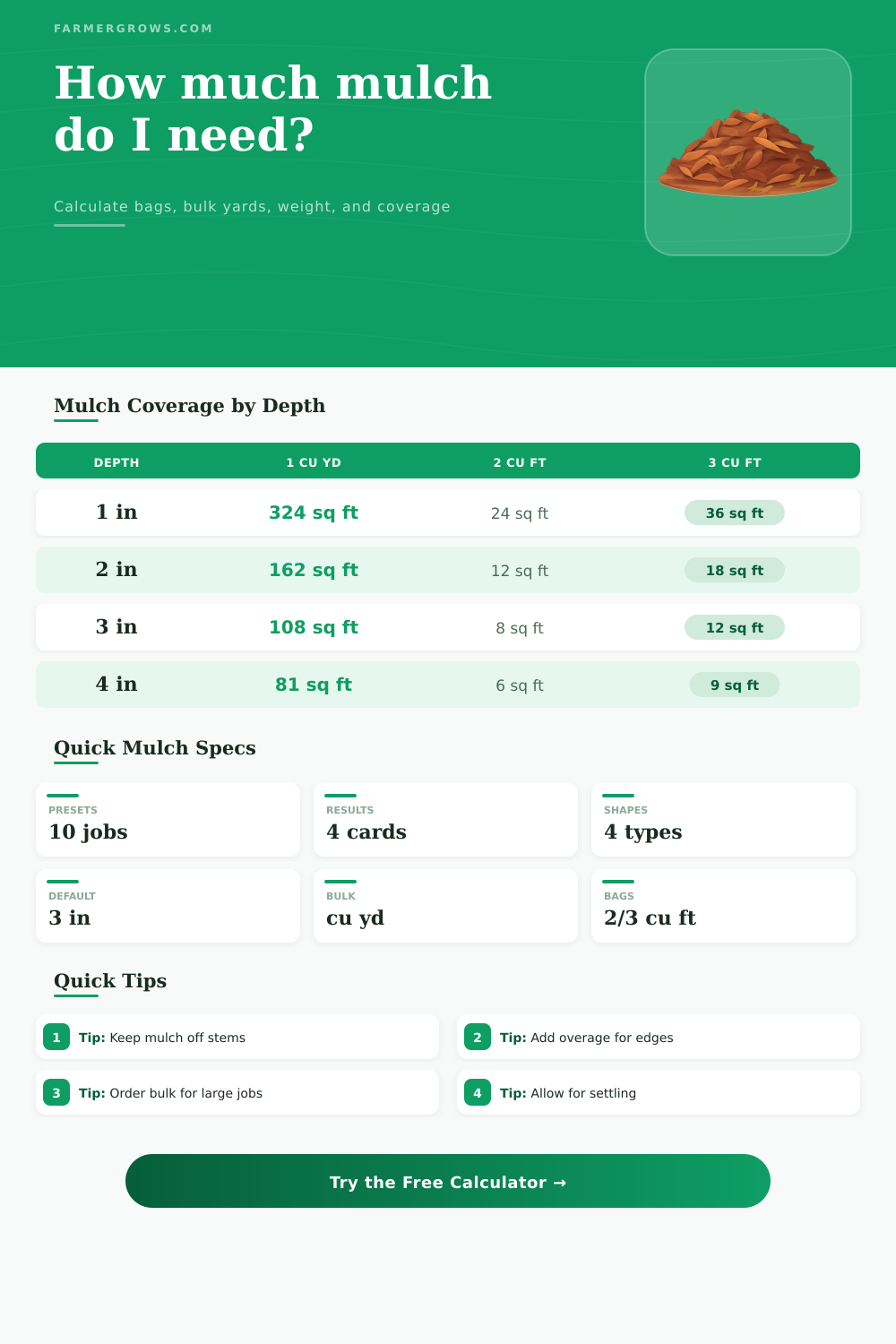
| Installed depth | Coverage per cu yd | Coverage per 2 cu ft bag | Coverage per 3 cu ft bag |
|---|---|---|---|
| 1 in | 324 sq ft / 30.1 m² | 24 sq ft / 2.2 m² | 36 sq ft / 3.3 m² |
| 2 in | 162 sq ft / 15.1 m² | 12 sq ft / 1.1 m² | 18 sq ft / 1.7 m² |
| 3 in | 108 sq ft / 10.0 m² | 8 sq ft / 0.7 m² | 12 sq ft / 1.1 m² |
| 4 in | 81 sq ft / 7.5 m² | 6 sq ft / 0.6 m² | 9 sq ft / 0.8 m² |
| 6 in | 54 sq ft / 5.0 m² | 4 sq ft / 0.4 m² | 6 sq ft / 0.6 m² |
| Package or load | Volume | Bags per cubic yard | Best use |
|---|---|---|---|
| 2 cu ft bag | 0.074 cu yd / 0.057 m³ | 13.5 bags | Small beds and touch-ups |
| 3 cu ft bag | 0.111 cu yd / 0.085 m³ | 9 bags | Medium beds with fewer bags |
| 1 cubic yard bulk | 27 cu ft / 0.765 m³ | 13.5 two-cu-ft bags | Pickup or small delivery |
| 4 cubic yard delivery | 108 cu ft / 3.06 m³ | 54 two-cu-ft bags | Large weekend bed refresh |
| Project | Area | Volume at 3 in | 2 cu ft bags |
|---|---|---|---|
| Tree ring, 6 ft circle | 28 sq ft | 0.26 cu yd | 4 bags |
| Small bed, 10 x 20 ft | 200 sq ft | 1.85 cu yd | 25 bags |
| Playground, 15 x 15 ft | 225 sq ft | 2.08 cu yd | 29 bags |
| Front border, 4 x 45 ft | 180 sq ft | 1.67 cu yd | 23 bags |
| Large yard bed, 50 x 50 ft | 2500 sq ft | 23.15 cu yd | 313 bags |
| Material | Typical density | Settling behavior | Coverage note |
|---|---|---|---|
| Shredded hardwood | 500-800 lb/yd³ | Moderate, knits together | Good at 2-4 in bed depth |
| Pine bark nuggets | 350-550 lb/yd³ | Low to moderate | Large pieces can leave air gaps |
| Leaf mulch | 250-550 lb/yd³ | High after rain | Add more overage for fluffy loads |
| Compost mulch | 800-1200 lb/yd³ | Moderate, dense | Use thinner layers near crowns |
| Straw mulch | 150-350 lb/yd³ | High, compresses quickly | Common for vegetable paths |
| Rubber mulch | 600-800 lb/yd³ | Low | Often used deeper in play areas |
Depth check: Measure existing mulch before ordering a top-up. If the bed already has usable cover, order only the added depth needed.
Delivery check: Bulk mulch is measured loose. A slightly larger order helps cover curved edges, wheelbarrow loss, and settling after watering.
Mulch is a layer of material that is spread over a garden bed in order to cover the soil. Many people utilizes mulch in there garden beds because mulch help to suppress the growth of weeds in those beds and because mulch helps to retain moisture in the soil. Before purchasing mulch, though, it is important to determine the amount of mulch that will be required in order to cover the garden bed.
If the individual purchases that is too little mulch, the individual will have to return to the store to purchase the remaining mulch. However, if the amount of mulch that is purchased are too much, there will be extra mulch that will not be utilize. To assist in calculating the amount of mulch that will be required for a given area, there are tools available to those planning their garden bed known as mulch calculators.
How to Figure Out How Much Mulch You Need
These mulch calculators can help the individual to calculate the volume of mulch that will be required to cover the garden beds by utilizing different variable. Each of these variables can be used to calculate the amount of mulch that will be required. One of the variables to consider is the depth of the mulch layer that will be added to the garden beds.
The depth of the mulch layer can change the total amount of mulch that is require for covering the beds. A depth of one inch, for instance, is often considered to be too shallow for mulch layers; it will not be able to prevent the weeds from growing. A depth of three inches, though, is often considered to be the common depth for garden beds.
Three inches of mulch will help to block the sunlight from the soil while still allowing the water to reach the roots of the plants growing in the beds. Four and six inches of mulch are often used for paths and play area in yards; it will provide more cushioner for those using the area. This depth of the mulch layer can be entered into the calculator to calculate how many cubic yard of mulch will be required.
Another of the variables to consider is the shape of the garden beds. The individual will have to measure the shape of the garden beds in order to determine the area of each bed. Each bed may not be a rectangle, though; some may be a circle while others may be a triangle.
Mulch calculators often allow an individual to choose the shape; the calculator may allow the individual to select shapes like a circle (for tree rings), a triangle (for corners), and to enter a custom area for any other type of garden bed. Once the individual enters the area of the garden beds, the calculator will convert that area to cubic yards and will also display the number of bag of mulch that will be required. Mulch bags may be chosen for smaller projects, but bulk mulch may be better for larger projects.
A third variable to consider is the overage of mulch and settling of the mulch after it is added to the garden beds. Overtime, some of the mulch may become lost during the process of adding the mulch to the garden beds, such as when the mulch falls onto the lawn or the individual places it into a wheelbarrow. Additionally, the mulch may settle into the soil and become thinner due to the rainfall after it has been added to the soil.
These factors must be consider; otherwise, the individual may find that they are out of mulch before the garden beds are completed. The fourth variable to consider is the type of mulch that will be purchased. Some types of mulch are denser than other type of mulch.
For example, shredded hardwood mulch is of medium density. Shredded hardwood mulch also stays in place well after being added to the soil and being watered. Bark nuggets is lighter than other types of mulch.
Additionally, people often utilize bark nuggets in decorative beds in the yard because the bark mulch does not break down as quickly. Rubber mulch does not settle when it becomes wet with rainfall. The density of the mulch that is purchased will impact the weight of the mulch.
The mulch calculator can determine this weight. Individuals can also use the mulch calculator to determine the number of truckload of mulch that will be required to deliver the amount of mulch that is ordered. The calculator will also display the weight of the mulch; this can help the individual to determine if it can be transported in a pickup truck or if a dump truck will be needed to transport the mulch to the garden area.
Finally, the individual should order the mulch at least one or two days prior to adding mulch to the garden beds. Mulch should not of be allowed to sit for too long. The individual should spread mulch over the garden beds at least a few inches away from the trunks of the plants and the stem of the plants.
If the mulch is placed too close to the trunks or stems, the plants may develop rot at their base. Additionally, using a mulch calculator will help the individual to avoid any mathematical error in calculating the amount of mulch that will be needed to complete the individuals garden project.