Bushel Weight Calculator
Convert crop bushels into pounds, short tons, metric tonnes, clean dry bushels, and truck or bin volume using test weight, moisture, dockage, shrink basis, and bulk density.
Use elevator, contract, or state grain standards for settlement. This calculator uses water-only moisture shrink after dockage and converts all loads from pounds into standard-weight bushels.
Load weight summary
Clean pounds and basis bushels update from your crop, test weight, moisture, dockage, and volume inputs.
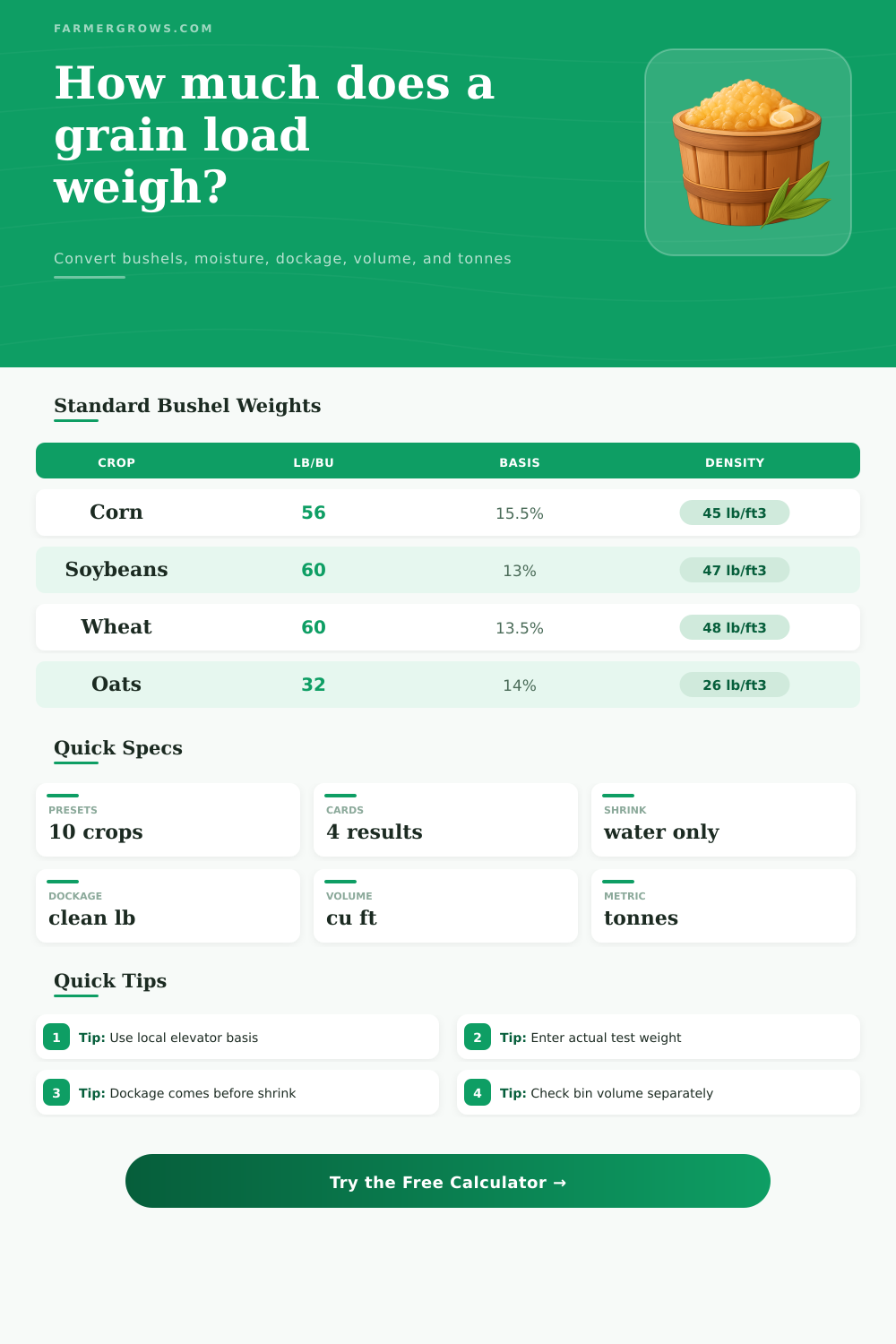
| Crop | Standard lb/bu | Common basis moisture | Typical test weight note |
|---|
| Moisture to basis | Water-only shrink | 100,000 lb becomes | How to read it |
|---|---|---|---|
| 16.5% to 15.5% | 1.18% | 98,817 lb | Light wet corn adjustment |
| 18.0% to 15.5% | 2.96% | 97,041 lb | Common harvest corn shrink |
| 20.0% to 15.5% | 5.33% | 94,675 lb | High moisture bin or dryer load |
| 14.5% to 13.0% | 1.72% | 98,276 lb | Soybeans above market basis |
| 15.0% to 13.5% | 1.73% | 98,266 lb | Wheat or rye above basis |
| Crop | Typical lb/cu ft | Cu ft per 1,000 lb | Truck/bin note |
|---|
| Crop | 1,000 standard bu weighs | Approx volume at density | Metric tonnes |
|---|
Test weight first: If you are converting physical volume, use the measured test weight for the load instead of assuming the standard crop value.
Settlement check: Most tickets remove dockage before moisture shrink, but local buyer rules can add handling shrink or different basis moisture.
When you are selling or storing grain, the weight of the grain is what will determine how much you will be paid for the grain. An bushel is a unit of volume for grain, but the bushel also contain a weight standard for each type of crop. Each buyer, dryer, and contract for grain will use this standard to determine how much grain you are receiving.
Shifts in the moisture level of the grain, the dockage level of the grain, or the test weight of that grain will impact the number of bushels of grain that are counted as “clean”. Each of these factors will impact the number of clean bushels that will be counted for that load of grain, which will impact whether or not the load meet the terms of the contract for that grain. Growers will establish a target moisture level for the grain that they will be selling or storing.
How Moisture, Dockage and Test Weight Change Grain Bushels
The basis moisture is the moisture percentage that is printed on the settlement ticket for that load of grain, and that is the moisture percentage that the grain elevator will use to determine how much weight should be removed from the grain to account for the moisture. If the moisture of the grain is above the target moisture level, then the water-only shrink calculation will remove the weight from the grain. Dockage will be removed from the grain prior to adjust for moisture content in the grain.
A calculator can be used to determine the number of clean bushels of grain that will be counted on the settlement sheet for that load of grain. The calculator will not, however, display the number of gross bushel of grain that are contained within the truck that delivered the grain to the farm. Test weight is used to determine how many pound of grain are contained within a bushel of that crop.
For instance, a bushel of corn will contain different weights than a bushel of soybeans. The bulk density value of grain will be used to calculate the total pounds of grain that are being delivered to the farm from the truck, and that value will be used in tandem with the test weight of the grain to calculate the number of bushels of grain that are being delivered. If the test weight of the grain is measured to be lower than the expected test weight for that type of crop, then there will be fewer bushels of that type of grain than expected, leading to potential surprise for the farmer when the settlement ticket is issued for that load.
Moisture shrink will be employed with a specific principle. The higher the moisture percentage of the grain that is being measured, the more the weight of that grain will drop to account for the moisture content. For example, a load of grain with 20% moisture will lose more weight accounting for moisture content to reach 15.5% than a load of grain with 17% moisture will lose.
The moisture shrink equation will calculate the exact amount of weight that will be lost due to the moisture content of the grain prior to settlement of the load. Many farmer pay close attention to the moisture shrink of their grain. This is due to the fact that moisture shrink will impact the total payment that is made for the grain.
Dockage is also lost prior to any moisture calculations. Dockage is any foreign material found in the grain that is being sold, as well as chaff and broken kernel of grain that do not meet quality standards for that type of crop. The number of pounds of grain that are lost due to dockage will be calculated prior to the moisture shrink calculation.
For instance, if a truck delivers 50,000 pounds of grain with 2% dockage, then 1 ton of grain will be removed for dockage prior to calculating the water shrink for that grain. If the shrink calculation is calculated with the gross weight of the load of grain, the number of bushels will be determined incorrect. The volume of grain that is delivered to a farm will be useful to calculate if the scale ticket is missing or if you would like to know the capacity of the bin that will receive the grain.
The bulk density of the grain will allow you to calculate the total pounds of grain that is delivered to the farm, and using the test weight of that same type of grain will allow you to calculate the number of bushels of that type of grain that is delivered. Each bin will have a different volume of grain that it can hold due to the different bulk density of the crops that are grown on the farm. For instance, a bin may hold 10,000 bushels of oats but only 5,000 bushels of wheat due to the density of each of those types of grain.
Ensuring that the volume of grain is determined before the truck departs from the farm will ensure that the bin is of a size that can hold the amount of grain that is being delivered. The actual loads of grain that are delivered to the farm will never reflect the numbers that are taught within the barns. Moisture content of grain will vary from field to field and hour to hour during harvest.
The test weight of the grain may be lower than expected if the corn that is being harvested is not yet mature or if there were delay in drying the corn after harvest. The amount of dockage may be higher than expected if there is alot of wind during harvest that blow chaff into the grain. A calculator will provide a general idea of the cost of the grain based off those variables, but there will always be a need for a scale ticket and a lab test to determine the actual moisture, dockage, and test weight of the grain.
A calculator for grain load will allow a farmer to have an idea of how much the grain will settle for when all of the variable are accounted for. It is beneficial to establish a habit of entering the actual test weight and moisture of the grain into the calculator for each of the first few loads of the day. By entering these variables into the calculator and observing the amount of bushels that are calculated, farmers can have a conversation with buyers that is grounded in the correct and most accurate numbers for that load of grain.
Any conversation regarding the grain that is being sold will be grounded in these numbers instead of approximated guesses for the weight of that grain.