
And then there’s raising male chickens. You just learn a lot about keep male chickens as you go along. For example you start out with your day old chicks all alike. And within a few months males is weighing differently, acting different and need to be treated differently. Their names also change.
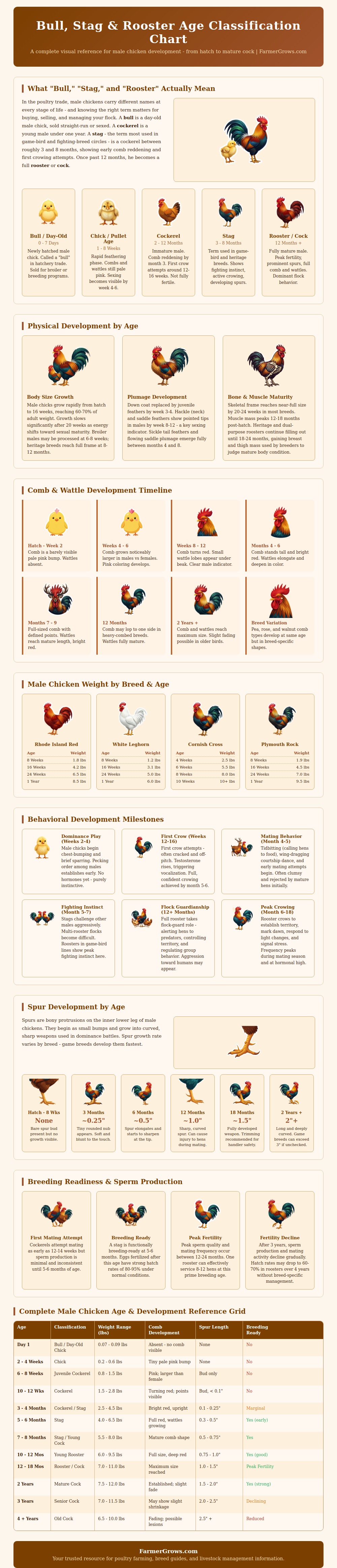
At day old they’re called by their sex at the hatchery… A bull (male). Then they get older, and before they reach a year, they’re considered a cockerel (immature male chicken). A stag sits in that middle window where the bird looks grown but is not yet fully mature, and once he’s past twelve months, he become a rooster or cock.
How Male Chickens Change as They Grow
Understanding what stage they are at help determine who stays in the breeding pen, who goes into another run, and who gets additional feed. All of this fits neatly into the chart below. You’ll notice it has something to do with things that change in your eyes. The comb changes from yellowish nubs to bright red signs of age, and the wattles do the same. The spurs also change growing from nothing to long and hooked like rakes.
Why does all of this mean anything? They all connect with what’s happening internally and externally. For example fertility-wise, a bird whose comb is turning red probably isn’t yet reliable at fertilizing eggs. Behaviorally, a bird with half-inch-long spurs will be capable of causing harm while courting or fighting.
The timeline help avoid guesswork. Each breed’s weight gain has its own pace. Meat birds grow fast; they’ll tip the scales within weeks. Dual purpose heritage breeds keeps gaining until the second year, packing on more muscle and frame as time passes. This is why it’s ok to have two roosters on the same chart with the same date. Each of those lines represents a different breed (see chart). If you find yourself with a little bird at 6-months old, don’t assume he was fed poorly, maybe he’s just slow to mature.
The same goes for behavior: Chicks generally start chest-bumping early in life but it’s primarily just fun. By age four or five months, though, they’re serious about testing one another. Their early crow attempts (which are usually short and crackled) matures to full-blown territorial calls. About then, courtship behaviors show up, but hens typically don’t pay much attention to young males who mistime things. This is when those milestones will give you some clues.
If you keep a mixed flock, that first clear crow marks the beginning of growing aggressiveness. It is also the sign to determine whether additional housing might be necessary.
Most people don’t think about spur growth until it happens. Then you get a nick. The chart shows it moves through set stages. At 3 months, it is a soft nub. At six months, it’s a half-inch point. By one year a full inch. Beyond an inch and a half, spurs can be a pain to handle…particulary when checking for health issues or in other close quarter situation. Some folks just trim ’em then. Others let ’em grow but adapt their bird moving methods to match.
All of these indicators show whether a stag is ready to breed. Most breeds don’t reach full functional fertility until five or six months old according to the chart. By one to two years they’re in prime form. Before then they might try, but success rate is hit-or-miss. At age three they begin losing sperm quality and frequency of mating (although some birds can be an exception). So if you buy a stag as a breeder, wait until he reaches the five-month point before assuming he isn’t up to par.
This takes the surprises out of the stages. Fights don’t erupt because you planned ahead. Birds aren’t losing their breed qualities because you changed their feed. You know whose males are peaking during the right time so you can decide who stays for next breeding season. Instead of guessing or relying on your memory, you can see what is happening on a chart. Being able to notice even tiny clues of posture, comb color and crow volume makes the entire flock more predictable.