Storage Tank Volume Calculator
Estimate gross capacity, current fill volume, freeboard allowance, liquid weight, and reserve days for common farm storage tanks.
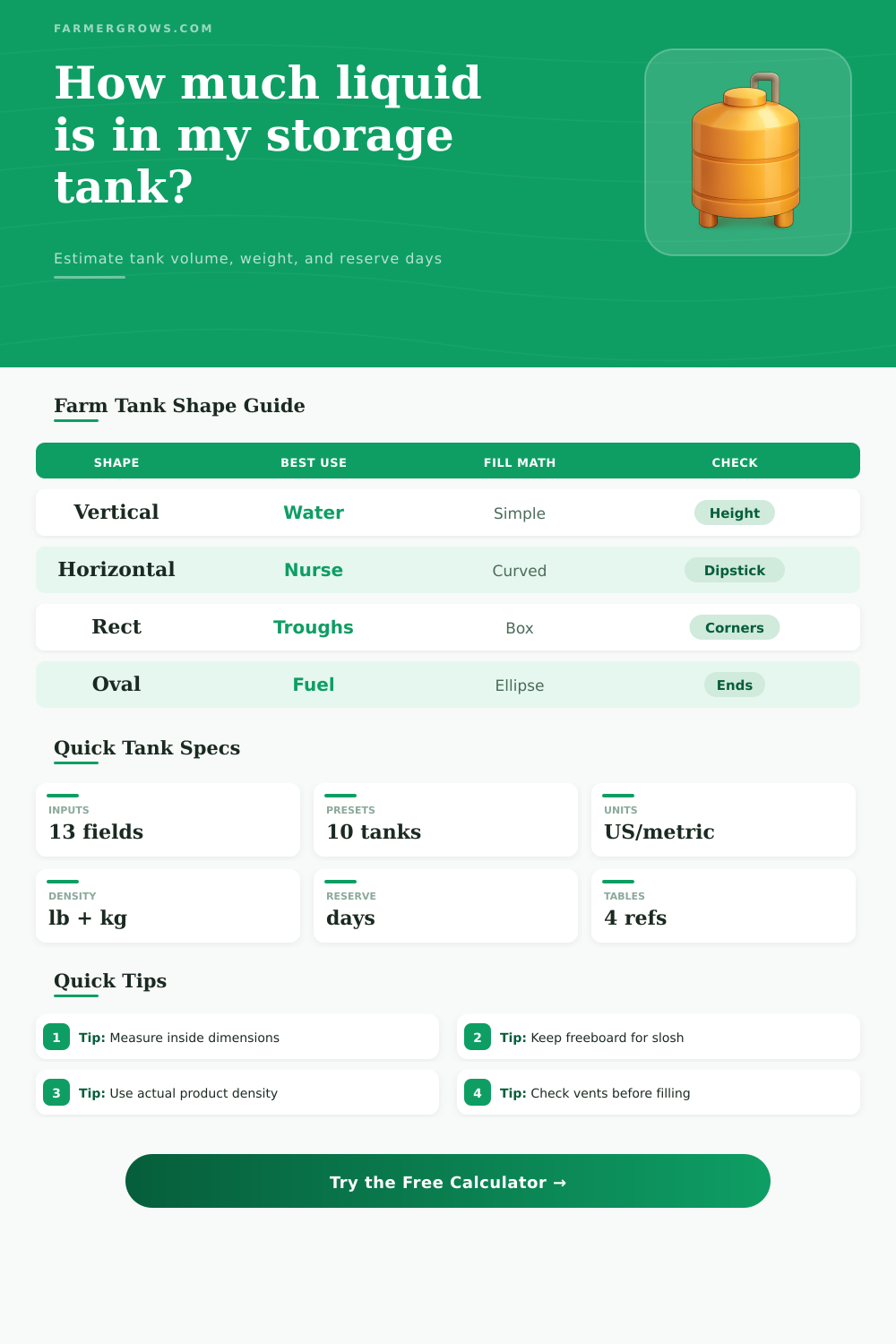
Use inside tank dimensions where possible. Horizontal and elliptical tanks use curved-segment fill math, while domed ends are treated as paired shallow half-ellipsoid caps.
Tank volume summary
Gross tank geometry, current fill, freeboard-limited working volume, and reserve planning.
| Volume conversion | US gallons | Liters | Cubic feet | Cubic meters |
|---|---|---|---|---|
| 1 US gallon | 1 | 3.785 | 0.1337 | 0.003785 |
| 1 cubic foot | 7.481 | 28.317 | 1 | 0.02832 |
| 1 cubic yard | 201.97 | 764.55 | 27 | 0.7646 |
| 1 cubic meter | 264.17 | 1,000 | 35.315 | 1 |
| Tank shape | Full volume basis | Partial fill basis | Best field measurement |
|---|---|---|---|
| Vertical cylinder | pi x radius squared x height | Fill height divided by straight height | Inside diameter and straight side height |
| Horizontal cylinder | Circle area x tank length | Circular segment area x length | Inside diameter, length, and dipstick height |
| Rectangular tank | Length x width x height | Length x width x liquid depth | Inside length, width, and liquid depth |
| Oval or elliptical | Ellipse area x tank length | Scaled ellipse segment area x length | Width, vertical depth, and length |
| Liquid | Density lb/gal | Density kg/L | 1000 gal weight | Farm note |
|---|---|---|---|---|
| Water | 8.34 | 1.00 | 8,340 lb | Useful baseline for irrigation and livestock water |
| Diesel fuel | 7.10 | 0.85 | 7,100 lb | Use temperature and supplier data for final load checks |
| Liquid fertilizer | 10.70 | 1.28 | 10,700 lb | Heavier than water, so tank stands and trailers matter |
| Molasses | 11.50 | 1.38 | 11,500 lb | Dense feed liquids need conservative support checks |
| Reserve plan | Daily use | 3 day reserve | 7 day reserve | Planning cue |
|---|---|---|---|---|
| Small trough supply | 75 gal/day | 225 gal | 525 gal | Good for small paddocks and short backup windows |
| Greenhouse nutrient mix | 250 gal/day | 750 gal | 1,750 gal | Watch refill timing during hot weather |
| Sprayer tender use | 800 gal/day | 2,400 gal | 5,600 gal | Match tender capacity to batch size and travel time |
| Fire or wash reserve | 1,500 gal/day | 4,500 gal | 10,500 gal | Keep this volume protected from routine drawdown |
For curved tanks: A half-full dipstick mark is not always half the usable gallons once freeboard and domed ends are included.
For heavy liquids: Confirm stand, trailer, slab, and tie-down ratings with the filled weight, not just the tank's gallon label.
To determine the size of a tank that is needed on the farm, you must know the amounts of liquid that is currently within the tank, as well as how long the liquid is intend to last. The size of the tank may be a vertical tank for water, a horizontal tank for milk, or some other types of liquid tank. If the tank that is selected for the farm are too small, the farm may experience periods without the needed liquid.
However, by sizing the tank to meet the demand of the farm, the farm will be able to remain in operation. In determining the size of the tank that is needed, there are a variety of method that can be used to attempt to calculate the volume of the existing tank. For instance, a farmer can read the volume of the tank from the label that is attached to the tank, or a farmer can guess the volume of the tank based off the number of gallons that were added to the tank during a previous fill up of the farm.
How to Measure Tank Size and How Long It Will Last
However, each of these method can lead to error in the measurement of the liquid volume. For instance, the volume of a horizontal cylinder will differ than a vertical tank that has domed ends; the shape of the tank will impact the measurements that are taken of the tanks volume. Thus, the shape of the tank must be taken into consideration when measuring the volume of the tank.
To calculate the volume of the tank, the calculator will require a variety of different variable from that tank to calculate the volume. The variables include the shape of the tank, the dimensions of the tank, and the height that the tank is currently filled to. The diameter and length of the tank will help to describe the main body of the tank.
However, the volume of the tank will also need to include the area of any freeboard that is provided in the tank; freeboard is provided in the tank to avoid pushing the liquid out of the vents of the tank. Furthermore, if the tank include rounded ends, the depth of those rounded ends will need to be included in the calculations of the volume of the liquid. Finally, the density of the liquid within the tank will need to be selected; the density will impact the weight of the liquid within the tank, and the weight will impact the load that the trailer or slab upon which the tank is positioned can support.
After the calculator calculates the volume of the tank, the volume can be divided by the amount of liquid that is used by the farm each day to determine how many day the current volume of the tank will last. For instance, if the tank holds 3,000 gallons of liquid, but the farm use 800 gallons of liquid per day, then 3,000 gallons could be divided by 800 gallons to determine the length of time that the tank will last. These days that are calculated allow the farm to prepare for storms, trips to town, or other issue that may prevent the arrival of the refill truck.
The reference tables that are provided on the page can be used to convert the volume of the liquid from one unit to another, such as from cubic feet to gallons. These reference tables can also be used to review the density of the different types of liquid. These reference tables can provide additional information regarding the variables that the calculator calculated; if the tank calculations indicate a different volume of liquid than expected, the reference table for densities could reveal that the density of the liquid is the reason for the differing figure.
When measuring the volume of the tank, many error may be made. For instance, a person may measure the volume of the tank by reading the label that is attached to the tank; however, the volume of the tank may be incorrect if the tank has been dentested, patched, or has had its liner replaced. Furthermore, the outside of the tank may be measured for volume rather than the inside of the tank.
In such a case, the thickness of the tank walls may not be measured into the calculation of the volume. Thus, errors may be made when measuring the volume of the tank. To avoid these error, the inside of the tank should be measured, as well as the density of the liquid within the tank.
Overall, the calculation of the volume of the tank allows for the volume of the tank to be treated as a moving target. The volume of the tank will change with the addition or removal of liquid from the tank, and according to the amount of liquid that is used in producing the product of the farm each day. Additionally, the volume of the tank can be compared to the volume of liquid that should be removed each day to ensure that there are not instance of the farm becoming without liquid at an undesirable time.
You should of used a larger tank if you want to avoid this. It’s important to remember that more furnitures might be needed if the tanks size is too small. You’ll want to check the labels carefully to avoid mistakes, because a mistakes can cost alot of money.
One of the most common error is measuring the tank size based on teh outside.