Wire Fence Calculator
Estimate farm fence perimeter, total wire or mesh, line posts, brace assemblies, gate allowance, rolls, staples, clips, strainers, and waste for livestock paddocks and boundary lines.
Use the calculator for material planning before walking the line. Final quantities should still reflect surveyed corners, water gaps, slope breaks, existing gates, soil strength, and local fence practices.
Fence Material Estimate
Quantities include selected terrain, animal pressure, gate openings, bracing style, and extra waste allowances.
| Fence type | Typical line post spacing | Common wire count | Brace expectation | Field note |
|---|---|---|---|---|
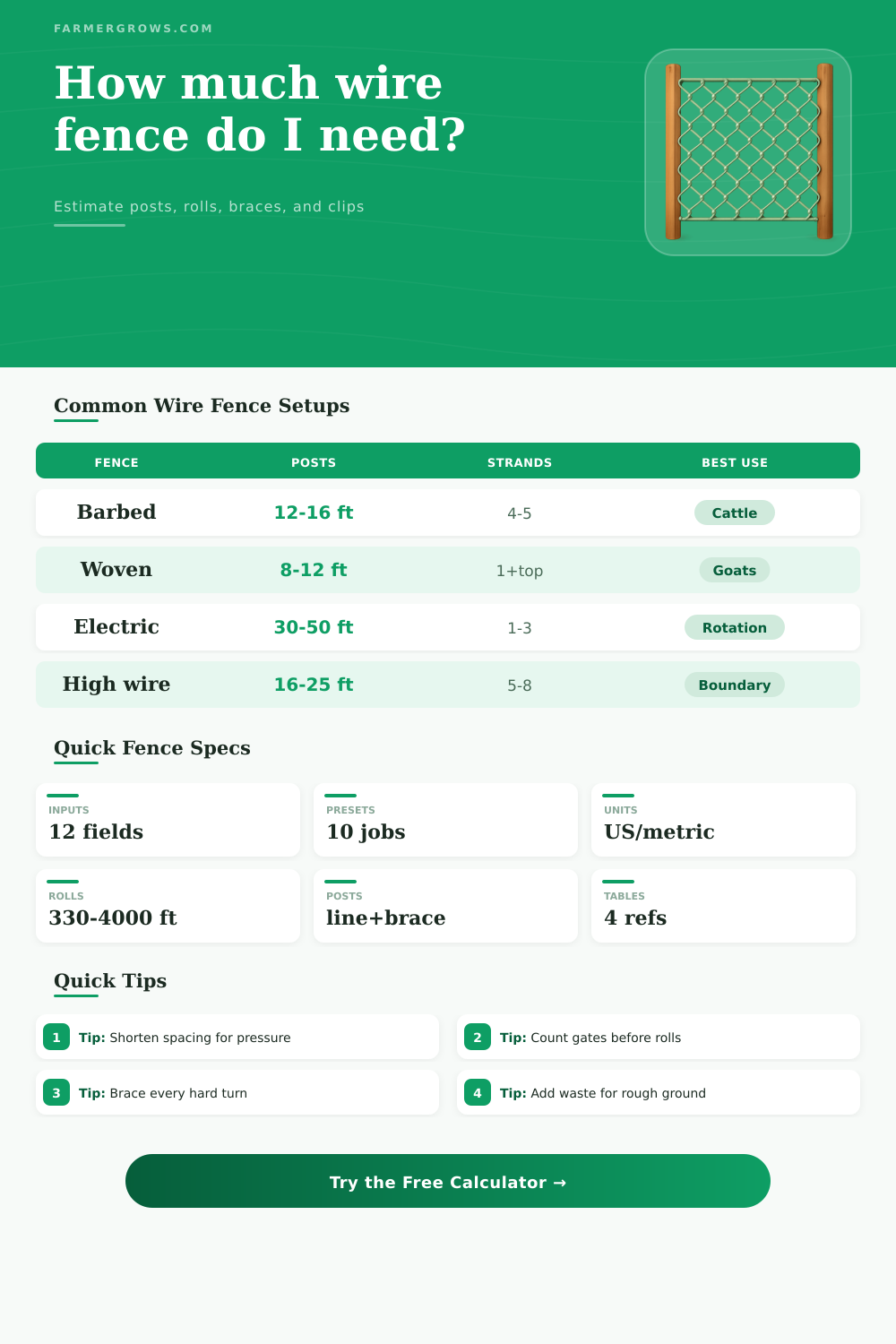
| Barbed cattle fence | 12 to 16 ft | 4 to 5 strands | H brace at ends and gates | Shorten spacing where cattle crowd, rub, or cross wet spots. |
| Woven goat or sheep fence | 8 to 12 ft | Mesh plus 1 or 2 wires | Strong end braces for stretched mesh | Use closer posts because small stock pressure is often low on the fence. |
| High tensile smooth wire | 16 to 25 ft | 5 to 8 wires | Heavy brace assemblies | Long spacing works only when tension, corners, and stays are controlled. |
| Temporary electric polywire | 30 to 50 ft | 1 to 3 strands | Light ends or reels | Good for rotation, not a permanent perimeter by itself. |
| Horse smooth wire with offset | 10 to 14 ft | 3 to 5 smooth wires | Visible, well braced ends | A hot offset reduces leaning and protects the main fence. |
| Roll or coil length | Often used for | Perimeter covered at 4 strands | Perimeter covered at 5 strands | Planning note |
|---|---|---|---|---|
| 330 ft | Woven field fence | 82.5 ft | 66 ft | Mesh rolls cover run length; extra wires need their own coils. |
| 500 ft | Utility smooth wire | 125 ft | 100 ft | Handy for short pens and repairs. |
| 660 ft | Barbed wire roll | 165 ft | 132 ft | Common for small paddocks and feedlot divisions. |
| 1320 ft | Barbed or high tensile | 330 ft | 264 ft | Quarter-mile rolls simplify longer boundary estimates. |
| 2640 ft | Smooth wire coil | 660 ft | 528 ft | Efficient for multi-strand high tensile work. |
| 4000 ft | Polywire reel | 1000 ft | 800 ft | Best treated as rotational fence supply, not braced perimeter wire. |
| Livestock or use | Common fence height | Wire spacing idea | Pressure level | Calculator adjustment |
|---|---|---|---|---|
| Beef cows | 48 to 54 in | 4 barbed strands or 5 smooth wires | Moderate | Normal pressure keeps post spacing near the entered target. |
| Bulls or weaned calves | 52 to 60 in | 5 strands plus hot wire if needed | High | High pressure shortens line spacing and raises attachment count. |
| Goats | 48 to 60 in | Woven mesh with offset wire | High low-line pressure | Woven mesh rolls are counted by run length, plus extra wires. |
| Sheep | 42 to 48 in | Woven mesh or 5 to 7 electric wires | Moderate | Close spacing helps keep mesh from sagging between posts. |
| Horses | 54 to 60 in | Visible smooth wire with hot offset | Moderate to high | Hardware count allows clips or insulators on each live wire. |
| Garden or orchard | 36 to 96 in | Mesh, rabbit apron, or deer wire | Wildlife | Predator or wildlife mode adds waste and tighter support. |
| Brace hardware item | Single H brace | Double H brace | Use in estimate | Practical check |
|---|---|---|---|---|
| Brace posts | 2 posts | 3 posts | Multiplied by corners, ends, and gate pulls | Choose larger posts for long high tensile or mesh stretches. |
| Horizontal brace rails | 1 rail | 2 rails | Counted as brace rails in the breakdown | Keep rails level and tight between post centers. |
| Diagonal brace wire | 1 loop | 2 loops | Counted as brace wire loops | Use twitch sticks, ratchets, or brace pins as your local method requires. |
| Tensioners or strainers | By strained wire | By strained wire | Based on strand count, pull points, and fence type | High tensile wire needs more deliberate tension control than light polywire. |
| Gate posts | 2 posts per gate | 2 posts per gate | Included separately from line posts | Wide gates often need deeper or larger hinge posts. |
Before ordering: Walk the full line and mark every gate, pull corner, creek crossing, and place where the fence changes direction. Those spots drive bracing more than total acreage does.
Before stretching wire: Match post spacing to animal pressure and soil. Loose sand, wet clay, heavy goats, bulls, and deer exclusion all deserve a more conservative layout.
Planning a fence requires a determination of how much material is needed to reach the ground. Knowing how much material is needed allow for the accounting of the line that will be walked and the corners that will be braced. The calculator can help with the math for fencing once the user enters the shape of the layout, the fence style, the post spacing, and the terrain allowance.
The calculator can save the person who is planning a fence from guesswork by accounting for the need for waste factor and the number of corners that need to be braced. However, in order for the calculator to present the correct numbers for fence planning, it is essential for the person to understand each of the variable in the fence planning calculator. One of the first variables to determine is the type of fence that will be constructed.
How to Plan a Fence and Calculate Materials
For instance, farmers typically use barbed wire for pastures that contain cattle because the cattle will respect the fence. However, farmers use woven mesh for the containment of goat or sheep. Additionally, high tensile wire can span further distances between fence posts but require stronger braces due to the constant tension of the wire.
Finally, electric polywire is used in fences that require the animals to be rotated into different pastures but it isnt typically used as a replacement for a braced perimeter fence. The calculator can automatically adjust the spacing and the number of clips or staples that will be used for constructing the fence according to the type of fence that is to be constructed. The shape of the fence layout is another critical variable to determine.
For example, a rectangle has two lengths and two widths that must be fenced in whereas a lane require fencing on both sides and both ends. Should the user enter the acreage for the pasturage into the calculator, the calculator will automatically calculate the number of equal side for a square pasturage and use those sides to determine the perimeter of the paddock. This calculation is essential for paddocks that have terrain that rolls into different elevations because the tape measure will not lie flat on the ground.
The terrain allowance and the pressure setting allow for the addition of extra wire for fences that roll with brush or for fences that have high tension between posts due to the behavior of the livestock. The number of corner, gates, and changes in direction for the fence will require more bracing than the total area that is to be fenced. Every corner requires an H-brace or a deadman and every gate will require two fence posts to allow for the movement of the livestock through the gate.
These numbers are calculated separately from the number of line posts so that there is no under-ordering of the fence bracing. Additionally, the calculator will calculate the number of clips or staples based off the method in which the fence is to be attached to the posts; posts requires more clips than T-posts. Often, the actual line that will be constructed for the farm will not match the drawing that is constructed for that farm.
For example, there may be water gap that need to be crossed, rocks that are in the pasture that must be avoided, or there may be existing trees that must be avoided. The waste percentage is used to account for these variables. Additionally, there are reference tables that show typical spacing requirement for each type of livestock; these tables will help the farmer to understand if the desired spacing is possible.
Common issue in fencing include ordering too little tension hardware yet too many line fence posts. The calculator allows for adjustments to the number of H-braces because each type of H-brace use a different number of fence posts; a double H-brace will use three fence posts instead of two but will hold high tensile wire that experiences freeze and thaw cycles. Additionally, light temporary fence end will work for polywire but will not hold up against the pressure of a bull charging into the fence.
Each of these variables are represented in the calculator in next to each other so that the farmer can make an informed decision on the number and types of fence posts, clips, and hardware that will be required. The final step in the fencing process is to walk the fence line that is to be constructed. During this step, every gate, corner, and change in slope should be marked on the land.
The number of fence posts that will be required for the bracing can be compared to the number of braces that will be constructed. If the number do not match, the fence should be redrawn with adjustments to the number of line and brace posts and the fencing math should be recalculated so that no guesswork is used when purchasing fencing hardware at the lumberyard.