Raised Bed Plant Calculator
Estimate how many vegetables, herbs, flowers, or transplants fit in a raised bed using row spacing, plant spacing, square-foot spacing, companion edge rows, germination, survival, and succession blocks.
Load a named raised bed plan with crop, spacing method, companion rows, survival assumptions, and succession blocks already filled in.
Planting Plan Results
Your raised bed plant count will appear here.
Spinach, leaf lettuce, and small herbs use square-foot spacing efficiently.
Carrots, radishes, onions, and beets need thinning more than wide rows.
Tomatoes, peppers, and cucumbers need air flow, trellis space, or cages.
Basil, onions, marigolds, and radishes can fit along usable bed edges.
| Crop | Plant spacing | Row spacing | Square-foot density |
|---|---|---|---|
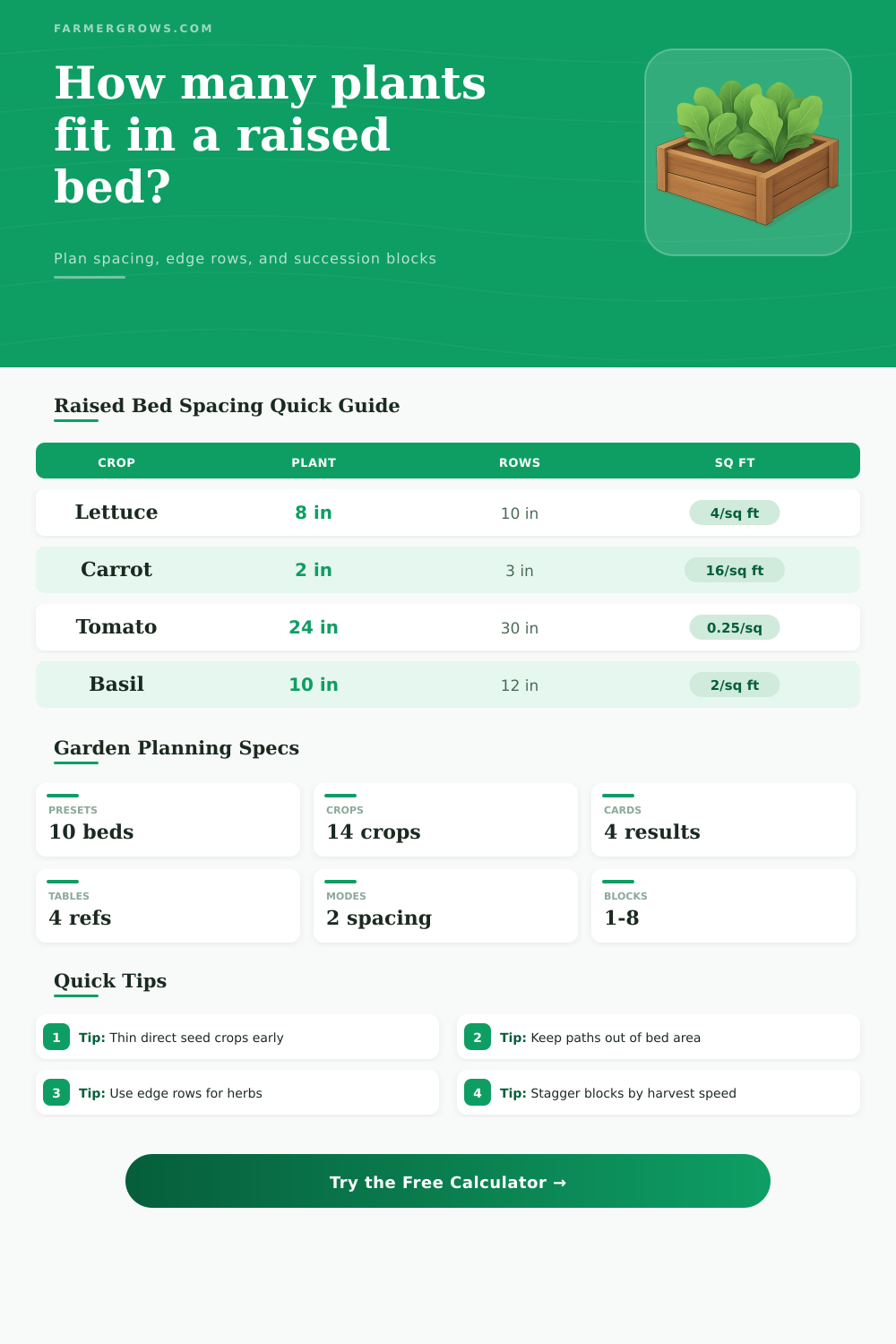
| Lettuce heads | 8 in | 10 in | 4 plants per sq ft for leaf types, 1 to 2 for heads |
| Carrots | 2 in | 3 in | 16 plants per sq ft after thinning |
| Bush beans | 6 in | 12 in | 4 to 9 plants per sq ft depending on variety |
| Staked tomatoes | 24 in | 30 in | About 1 plant per 4 sq ft |
| Peppers | 18 in | 24 in | About 1 plant per 2 sq ft |
| Broccoli or cabbage | 18 in | 24 in | About 1 plant per 2 sq ft |
| Bed plan | Bed area | Good crop fit | Typical count |
|---|---|---|---|
| 2x4 kitchen herb bed | 8 sq ft | Basil, parsley, cilantro edge mix | 12 to 24 plants |
| 3x8 pollinator strip | 24 sq ft | Marigolds, basil, flowers, onions | 30 to 70 plants |
| 4x8 family salad bed | 32 sq ft | Lettuce, spinach, radish succession | 64 to 256 plants |
| 4x12 summer fruiting bed | 48 sq ft | Tomatoes, peppers, trellised cucumbers | 8 to 24 plants |
| 30 inch market bed | 25 sq ft per 10 ft | Direct-seeded roots or greens | 80 to 400 plants |
| Crop type | Planning germination | Survival buffer | How to use it |
|---|---|---|---|
| Fresh transplants | 95 to 100% | 90 to 98% | Use starts needed plus a small replacement tray. |
| Leafy greens | 75 to 90% | 80 to 95% | Sow extra, then thin to final spacing. |
| Roots and onions | 65 to 90% | 75 to 95% | Overseed rows lightly and thin early. |
| Older seed lots | 50 to 75% | 70 to 90% | Raise sowing count or test germination first. |
| Succession style | Blocks | Block share | Best fit |
|---|---|---|---|
| One full planting | 1 | 100% | Tomatoes, peppers, cabbage, broccoli |
| Two harvest waves | 2 | 50% | Bush beans, lettuce heads, beets |
| Weekly salad strip | 4 | 25% | Spinach, lettuce, radish, cilantro |
| Market stagger | 6 to 8 | 12 to 20% | Fast roots and baby greens |
Spacing tip: Use the final mature spacing for transplants, but direct seed roots and greens slightly heavier so thinning creates the final stand.
Succession tip: For lettuce, radish, spinach, and beans, count one block as the planting you make on each sowing date, then use the season total for seed needs.
When planning a garden, there is several consideration to be made. The physical dimension of the raised bed wont necessarily tell you how many plant will grow within that raised bed. A plant calculator will help to determine how many plants will fit within the raised bed.
This calculator is helpful in that it account for the border of the raised bed, the spacing of the plants within the raised bed, and the possibility of the seeds planted within the raised bed fail to grow. If you utilize the plant calculator to determine how many plants you will grow within your raised bed, you can avoid both guessing how many plant will fit into the raised bed, and you can avoid having to count the number of plant that you plan to grow. Thus, the plant calculator will allow you to create a plan for your raised bed that will account for all of your plant.
Plan Your Raised Bed with a Plant Calculator
To create a workable plan within the plant calculator for your raised bed, you will have to provide several input for the calculator. Your inputs will include the length of the raised bed, the width of the raised bed, and the border measurement of the raised bed. The border measurement will help to calculate the area of the raised bed that can be used for the roots and leaves of the plants that you will grow.
Your choice between square foot density and row spacing within the plant calculator will determine the planting density for the various type of crops that you will plant within your raised bed. Some plants require that there be more air between the plants then other. Another important variable to include within the plant calculator are the germination rates and survival rates of the plants that will be planted within the raised bed.
The germination and survival rates will help determine the number of seed that will need to be planted into the raised bed in order to account for the number of plant that will emerge. If these variable are left out of the plant calculator, it is possible that there will either not be enough plant within the raised bed, or there will be too many seed that must be planted and thinned. Succession planting into the raised bed will also use these variables in it’s calculation within the plant calculator.
Another consideration for many gardener is the use of companion planting within the raised bed. Many people tend to forget to account for companion plant when they are creating a plan for there raised bed. For instance, if you are to plant carrots adjacent to basil plant, or if you are to plant marigolds along the perimeter of the raised bed, those plants will fit into the raised bed if the share percentage is adjusted to allow for those companion plants.
Thus, there is an advantage to utilizing the plant calculator to set these companion plants into the raised bed prior to planting the seed for other plants. Within the plant calculator, there are a variety of reference table that indicate the spacing requirements for various type of plants, as well as which types of plants often grow well alongside other plants within the same raised bed. These reference tables can assist in the decision of which plants to grow within the raised bed.
Additionally, you can utilize the presets within the plant calculator to start planning your garden, but which can be adjusted according to the type of seed that you plan to plant within the raised bed, or according to your climate. The plant calculator will provide a baseline for the number of plants that will grow within the raised bed, but it cannot account for all of the variable that will exist within the raised bed. Factors like soil temperature will impact how fast carrots emerge from the raised bed soil, as will heat wave that impact the survival of lettuce starts that were planted within the raised bed.
The rate at which the plants are consume or sold will also impact the raised bed plan, as the faster that the plants are consume, the more often that seed will need to be planted within the raised bed (succession planting). Thus, while the plant calculator will provide a number of plant that will be planted within the raised bed, it would of been necesary to use that number as the starting point for planning the raised bed, but to adjust the next round of planting within the raised bed according to the result of the previous rounds of planting. Once you understand how to use the plant calculator to determine the number of plant that will grow within the raised bed, you can adjust the raised bed plan based off the condition within the raised bed.