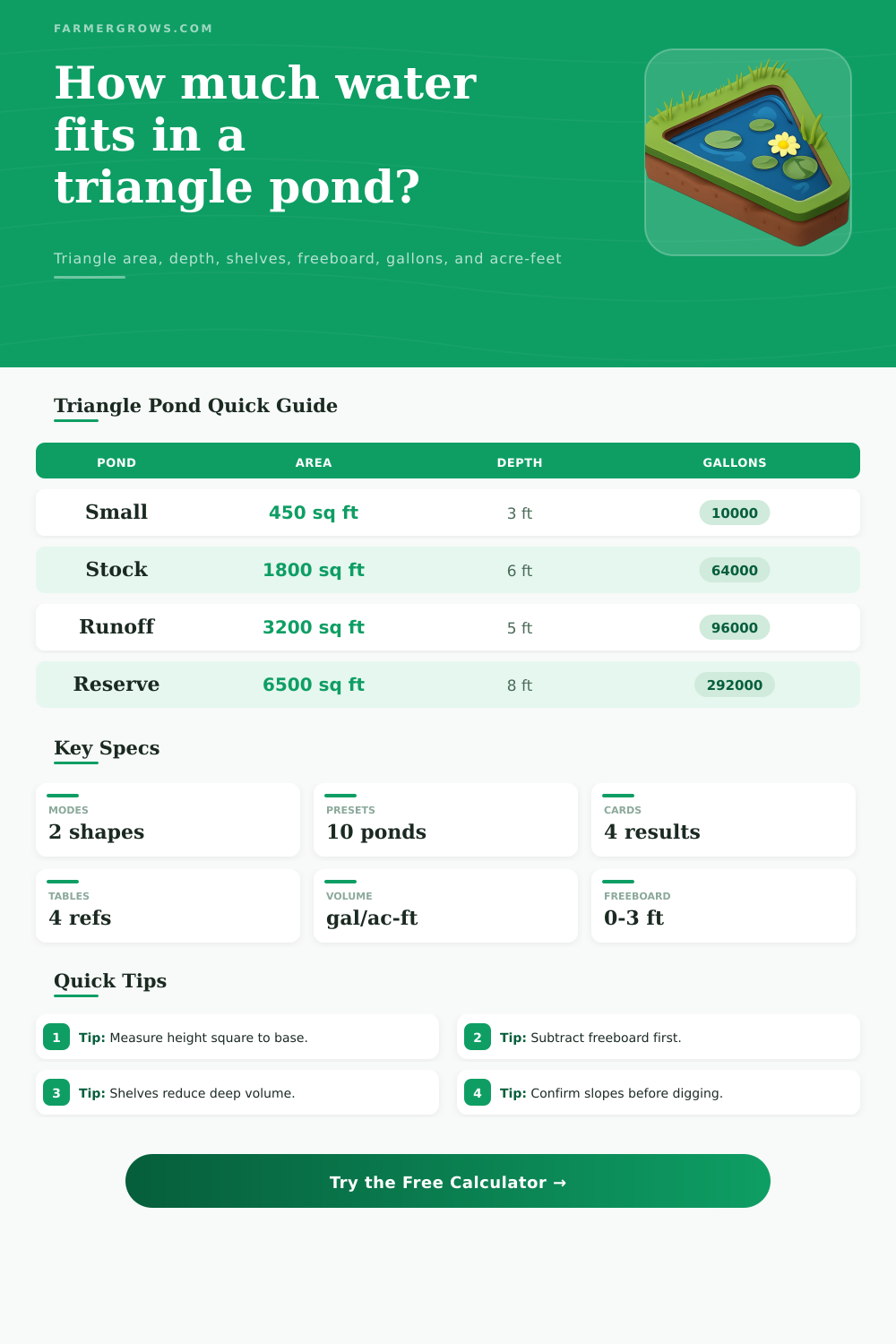
Triangle Pond Volume Calculator
Estimate water volume for triangular farm ponds from base-height dimensions or three measured sides, then adjust for average depth, maximum depth, side slope, shelf width, shelf depth, and freeboard.
Start with a realistic triangular pond, forebay, or water-harvest basin. Each preset loads units, triangle method, freeboard, side slope, shelf, and depth assumptions.
Triangle Pond Volume Results
Outputs show profiled pond volume, average-depth volume, water surface area, water depth after freeboard, gallons, acre-feet, and metric equivalents.
| Unit | Equals | Best Use | Calculator Output |
|---|
| Side Slope | Horizontal Setback | Profile Effect | Field Note |
|---|
| Feature | Typical Range | Volume Effect | Use When |
|---|
| Preset | Method | Water Area | Profile Volume |
|---|
Planning an triangular pond requires an understanding of how the triangular shape of the pond will affect the total volumes of water that the pond will hold. Triangular ponds are often built into properties whose corners are more odd then even, or where drainage swales meets fence lines. In order to plan the triangular pond, it is necessary to determine the volume of that pond, since the volume will indicate the amount of water that the pond can hold.
Beyond the area of the pond, there are other factor that will influence the volume of water that the pond can contain. For instance, you cant calculate the volume of a triangular pond with the surface area of the pond, but with the depth of the pond as well as the slopes of the sides of the triangular pond. The volume of a triangular pond can be calculated by determine the average depth that the pond will reach.
How to Calculate the Volume of a Triangular Pond
However, calculations of average depth is inaccurate in relation to the true volume of the pond. The depth calculation ignores the number of shallow ledge that will be included within the pond. Furthermore, shallow ledges impact the volume of the pond according to the slope of the sides of the pond; shallow slopes will lead to a reduction in the total volume of water that the triangular pond will hold.
In contrast, steep side will allow for the pond to hold more gallons of water per square foot of area, but require different type of soil than those required by shallow slopes within the pond. In addition to the depth and the area of the pond, another factor that you should consider in the planning of the pond is the inclusion of freeboard for the pond. Freeboard is the bank of land that will remain dry and that will sit above the water line of the pond.
Adding freeboard will ensure that the pond will not flood during periods of heavy rain, but will also lead to a reduction in the surface area of the pond and the total volume of gallons of water that the pond can contain. The provided calculator allow for the determination of how much adding freeboard of various depths to the pond will reduce the surface area and volume of the pond. Ponds also often include shelf within the pond.
These shelves are shallow ledges that extend from the edge of the pond; they provide space for the placement of plants within the pond, and provide an escape route for animal that wish to leave the pond. However, these shelves also reduce the total volume of gallon of water that the pond can contain. Thus, using the calculator allow for the separation of the volume that the shelves will occupy from the deep section of the pond; this helps to determine if the shelves are worth the reduction in the total volume of water that the pond can hold.
It is likely that the actual pond that is constructed will not be as close to the plan of a perfect triangle as is depict in a drawing on a sheet of paper. The banks of the pond may settle over time, or the liner for the pond may shift from the water within the pond. To account for this, it is recommended to include some percentage of reserve in the plan of the pond.
A percentage of ten or fifteen percent can be added to the total volume of the pond calculated with the calculator to account for this settling of bank and shifting of pond liners. This planning reserve will ensure that the pond is not underbuilt relative to the calculations performed for planning the pond. The calculator also allows for the volume of the triangular pond to be converted into various other units.
For instance, the volume can be expressed in gallons, acre-feet, or cubic meters. These different unit are often required to be expressed differently for the excavator that will dig the pond, or for the regulator of the pond. These conversion tables will ensure that the calculations for the pond remain accurate, and that no error are introduced into the calculations when converting the volume measurements by hand.
Many people may prefer utilizing the average-depth method to calculate the volume of a pond. This method is simple and easy to calculate. However, the profiled calculation is more accurate; the profiled calculation includes the slopes and shelves of the pond in its calculations of the total volume.
Furthermore, because the profiled calculation factors in the loss of gallons of water to the edges of the pond, the profiled calculation will often mathematical produce a lower value of total volume than the average-depth method calculations. When understanding the difference between these two methods of calculation, an individual will understand the actual shape and volume of the pond that is to be built. Finally, by performing either the profiled or average-depth method calculations, an individual will know whether the pond will be suitable for stocking with water life, for providing water for stock animal, or for other irrigation uses.