Kidney Shaped Pond Volume Calculator
Estimate a curved pond from two lobe diameters, waist width, overall length, average depth, planting shelves, side slope reduction, gallons, and practical liner allowance.
Load a common kidney pond outline, then tune the lobes, waist, shelves, depth, slope, and liner slack to match your dig.
Kidney Pond Estimate
Results update as you enter pond measurements.
These cards show the live geometry used by the calculator so you can compare lobe area, waist area, curved adjustment, and depth effects.
| Preset | Good for | Typical depth | Planning note |
|---|---|---|---|
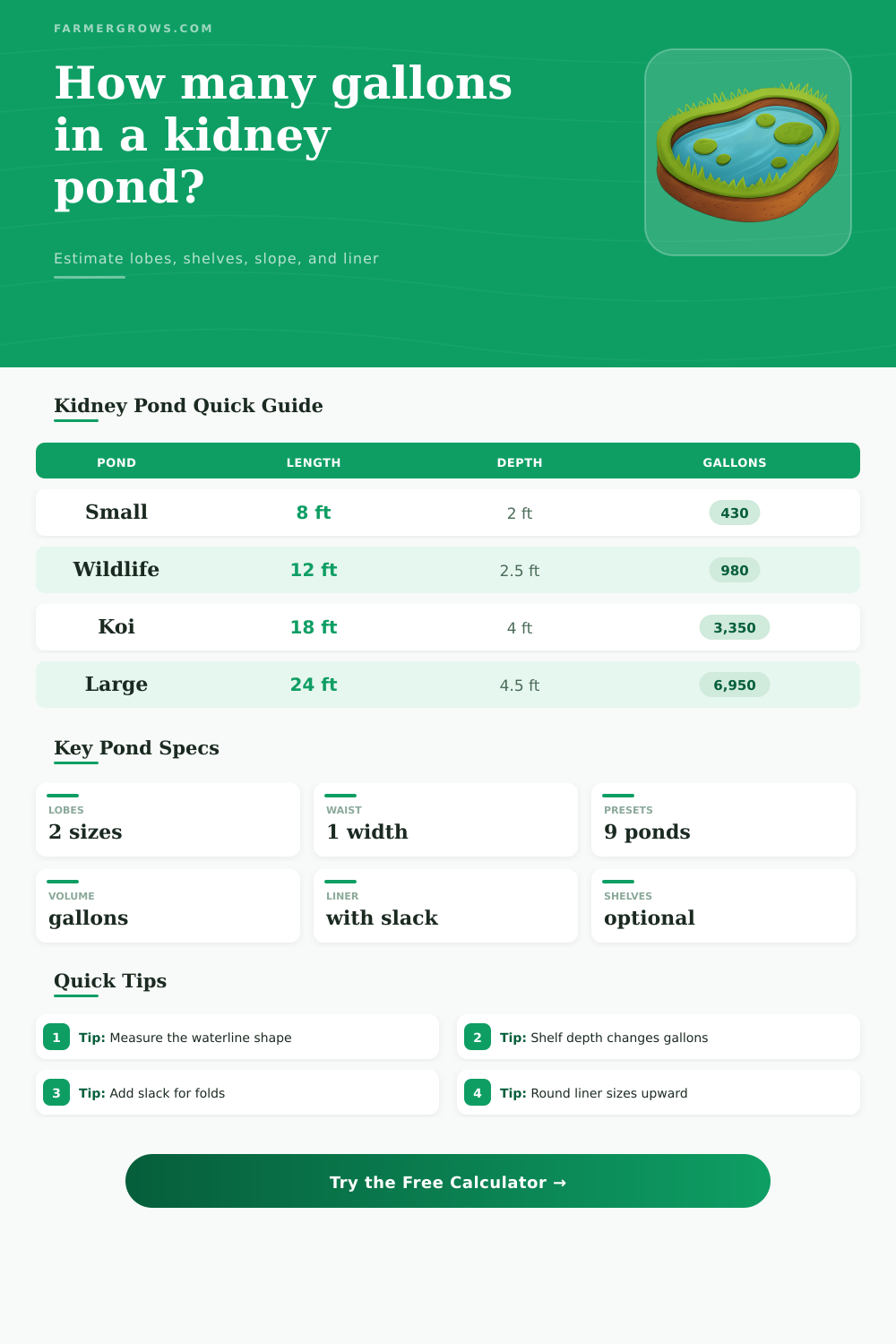
| Patio wildlife | Small frogs, plants, and water feature pumps | 2 ft | Keep one lobe shallow for baskets and stones. |
| Backyard garden | Mixed ornamental pond with curved planting edge | 2.5 to 3 ft | Use balanced curve unless the waist is very narrow. |
| Small koi | Compact fish pond with deeper winter refuge | 4 ft | Check local fish depth needs before final digging. |
| Large display | Long kidney pond with waterfall or bridge accent | 4 to 5 ft | Round liner dimensions up to the next stocked size. |
| Method | Area factor | Use when | Effect |
|---|---|---|---|
| Tight pinched kidney | 0.94 | Waist is narrow and lobes do not fully bulge | Reduces plan area before depth. |
| Balanced kidney curve | 1.00 | Normal ornamental kidney outline | Uses lobe and waist geometry directly. |
| Full rounded lobes | 1.06 | Both lobes are broad and the waist is gentle | Adds curved edge fullness. |
| Measured adjustment | custom | You have a scaled outline or waterline trace | Applies your entered percent adjustment. |
| Unit | Equals gallons | Equals liters | Use in pond planning |
|---|---|---|---|
| 1 cubic foot | 7.48 gal | 28.32 L | Core conversion from area times depth. |
| 100 cubic feet | 748 gal | 2,832 L | Useful for small kidney ponds. |
| 1 cubic yard | 202 gal | 765 L | Helpful when comparing excavation volume. |
| 1 cubic meter | 264 gal | 1,000 L | Metric check for pump and filter sizing. |
| Feature | Typical input | Calculator role | Planning note |
|---|---|---|---|
| Edge overlap | 1 to 2 ft | Adds material beyond the pond rim | More overlap helps anchor stone edging. |
| Fold slack | 5 to 12% | Increases sheet length and width | Kidney shapes need folds around the waist. |
| Planting shelf | 10 to 30% | Blends shallow and deep water depth | Large shelves reduce gallons quickly. |
| Side slope | 5 to 20% | Reduces final water volume | Steep walls use less reduction than soft banks. |
Measure the finished waterline, not the outside berm. The liner calculation already adds overlap beyond that edge.
A wide shelf can remove hundreds of gallons from a kidney pond, so enter shelf share before sizing pumps or filters.
Kidney shape ponds are often chosen by many individuals due to the fact that kidney shape ponds tend to provide a more natural looking addition to the landscape than ponds that has more rectangular or circular shapes. Kidney shape ponds contain a curved outline of the pond that is placed against the lawn, as well as a pinched waist portion of the pond that divide the pond into separate areas. The curved shape of the pond, however, make it more difficult to calculate the volume of the pond than ponds with more basins.
You must calculate the volume of the pond by accounting for both the rounded end of the pond, as well as the narrow middle waist of the kidney shaped pond. To calculate the volume of a kidney shaped pond, three measurement of the pond must first be taken. Each measurement is of the length of the pond, the diameter of each rounded lobe of the pond, and the width of the waist of the pond.
How to Measure a Kidney-Shaped Pond for Volume and Liner
These three measurements can help to determine the area of the pond’s waterline, but do not account for the depth of the pond. The depth of the kidney shaped pond is also an important measurement for calculating its total volume. Kidney shape ponds are often not of a consistent depth; instead, there may be shelf that include plants placed into the pond, or the bank of the pond may be sloped instead of straight.
The area of the pond that is covered by shelf that contain plants will reduce the total volume of that pond. Similarly, banks of the pond that is sloped instead of straight will also reduce the total volume of that pond. For these reasons, it is important to distinguish between the depth of the pond that is planned to be dug into the ground, known as the planned depth of the pond, and the effective depth of the pond.
The effective depth will always be less than the planned depth of the pond, due to the fact that those shelf and banks will claim part of the depth of the pond. In determining the size of the liner that will cover the kidney shaped pond, the liner must cover the length of the pond, the widest part of the pond, and the banks of the pond. You will apply the liner to the banks of the pond to cover their edges.
Because the pond features a waist that is curved, the liner will need to include additional slack to allow for the liner to cover those curved areas. Furthermore, the liner will need to include an allowance for the liner to overlap the edge of the pond, such as if it is to be anchor to the pond using stone or soil. When determining the size of the liner for the kidney shaped pond, it is best to round the calculation of the ponds volume upward to the next available size of liner.
The reference tables provided on this page help to provide information regarding the calculations necessary to determine the volume of a kidney shaped pond. These table include tables with information on the area factor for pond approximations, depth conversion, gallon and liter conversion, and overlap and slack specifications for ponds. These tables can help to ensure that an individual understand the volume calculations for their planned kidney shaped pond prior to beginning to dig into the ground to form the pond.
There are some mistake that many individuals make when attempting to calculate the volume of their planned kidney shaped pond. One common mistake is to treat the depth of the shelf of the pond as the same as the depth of the remainder of the pond. However, the depth of the shelf will claim some of the volume of the pond, reducing the total volume.
Another common mistake is to measure the outside of the berm (the bank of the pond) that is create after digging into the ground. This will lead to an underestimation of the size of the pond, which will result in purchasing an incorrect amount of liner for the pond. Kidney shape ponds can have different area factor depending upon the size and shape of the pond.
Kidney shape ponds that have shallow depth in the waist area will have a lower area factor than kidney ponds that have broad lobes that extend from each side of the waist. An alternative to using area factors is to use the “measured adjustment” option for the area factor, which can be used if the pond is trace on the ground with a planimeter. The area factor will impact the final number of gallon of water that will be contained within the pond.
That number of gallon will impact the size of the pump that will be require for the pond. While the calculator included on this page will calculate the area and volume of the pond, the calculator does not make any design decision for the pond. Decisions regarding the depth of the shelf of the pond, for example, or the slope of the banks of the pond, are up to the individual who plans the pond.
For example, ponds that are to contain plants may require shallow shelf of the pond, while ponds that contain fish like koi may have deeper area of the pond. It is important to run a few scenario with different percentage of shelf of the pond, for instance, to understand how the volume will change with those different percentage. Such knowledge helps to ensure that the individual understands the relationship between the kidney shaped pond and the size of the liner that will cover the pond.
After the pond is dug and constructed, the same measurement of the pond can be utilized to order replacement liner for the pond, or to make adjustments to the equipment that is located within the pond.