Raised Garden Bed Soil Depth Calculator
Match crop root depth, bed height, native soil access, drainage layer, compost topdress, irrigation depth, seasonal crop type, and fill volume before you load the bed.
Load a realistic raised bed scenario, then adjust the dimensions, root depth, native soil quality, drainage layer, compost topdress, and irrigation depth.
Raised Bed Soil Depth Output
Calculated from bed size, crop roots, native soil access, layers, and irrigation depth.
| Crop group | Typical active roots | Minimum bed if open bottom | Barrier-base target |
|---|---|---|---|
| Lettuce, spinach, arugula | 6 to 8 in | 6 to 8 in | 8 in |
| Cilantro, parsley, basil, shallow herbs | 8 to 10 in | 8 in | 10 in |
| Onion, garlic, leek | 8 to 12 in | 8 to 10 in | 12 in |
| Carrot, beet, radish, turnip mix | 10 to 16 in | 10 to 12 in | 14 to 16 in |
| Pepper, eggplant, bush bean | 14 to 18 in | 12 to 15 in | 18 in |
| Tomato, cucumber, squash | 18 to 24 in | 14 to 18 in | 20 to 24 in |
| Potato, sweet potato | 16 to 24 in | 14 to 18 in | 18 to 24 in |
| Asparagus, rhubarb, perennial herbs | 24 to 36 in | 18 to 24 in | 24 to 30 in |
| Native soil condition | Root access credit | Best use | Depth caution |
|---|---|---|---|
| Excellent loose loam, open bottom | Up to 12 in | Deep crops over prepared ground | Keep bed bottom open and weed-free |
| Good garden soil, open bottom | Up to 8 in | Most vegetables in 10 to 15 in beds | Fork broad beds before filling |
| Fair soil, light compaction | Up to 4 in | Greens, herbs, onions, short roots | Add depth for carrots and tomatoes |
| Poor compacted clay or rubble | Up to 1.5 in | Shallow crops or deeper constructed beds | Avoid counting much subsoil depth |
| Barrier base, fabric, hardpan, or deck | 0 in | Planters and contained beds | Full crop depth must be inside bed |
| Bed size | 8 in fill | 12 in fill | 18 in fill |
|---|---|---|---|
| 3 x 6 ft | 0.44 yd3 / 6 bags | 0.67 yd3 / 9 bags | 1.00 yd3 / 14 bags |
| 4 x 4 ft | 0.40 yd3 / 6 bags | 0.59 yd3 / 8 bags | 0.89 yd3 / 12 bags |
| 4 x 8 ft | 0.79 yd3 / 11 bags | 1.19 yd3 / 17 bags | 1.78 yd3 / 24 bags |
| 4 x 12 ft | 1.19 yd3 / 17 bags | 1.78 yd3 / 24 bags | 2.67 yd3 / 36 bags |
| 5 x 10 ft | 1.23 yd3 / 17 bags | 1.85 yd3 / 25 bags | 2.78 yd3 / 38 bags |
| Crop stage | Useful wetting depth | Raised bed note | Check method |
|---|---|---|---|
| New seedlings | 3 to 5 in | Keep top layer evenly moist | Finger check below mulch |
| Leafy harvest crops | 6 to 8 in | Shallow roots need frequent pulses | Probe after 30 minutes |
| Roots and bulbs | 8 to 12 in | Water below the swelling root zone | Use a trowel slot |
| Fruiting summer crops | 12 to 18 in | Deep watering improves heat resilience | Push rod into moist soil |
| Overwintering crops | 8 to 14 in | Do not leave saturated lower layers | Check before hard freeze |
Drainage rock, false bottoms, and coarse woody layers reduce the depth roots can actually use. Subtract those layers before judging whether a bed is deep enough.
Open-bottom beds over loose garden soil can support deep crops with less purchased mix, but compacted clay, fabric, or decking should be treated like a barrier.
Raised garden bed are structures that are used to grow food. The depth of the soil within those raised garden beds is one of the critical factor in determining how succesful the growth of food within those raised beds will be. The depth of the soil determines how much room the roots of the plants have to grow within the raised bed.
While many gardeners may believe that the height of the sides of the raised bed is the most important measurement of the raised bed, the amount of usable root space within that raised bed is actualy the most important measurement of that raised garden bed. Root depth is one of the most important variable to consider in creating a raised garden bed. Different plants requires different amounts of depth for there roots.
How Deep Should the Soil Be in a Raised Garden Bed
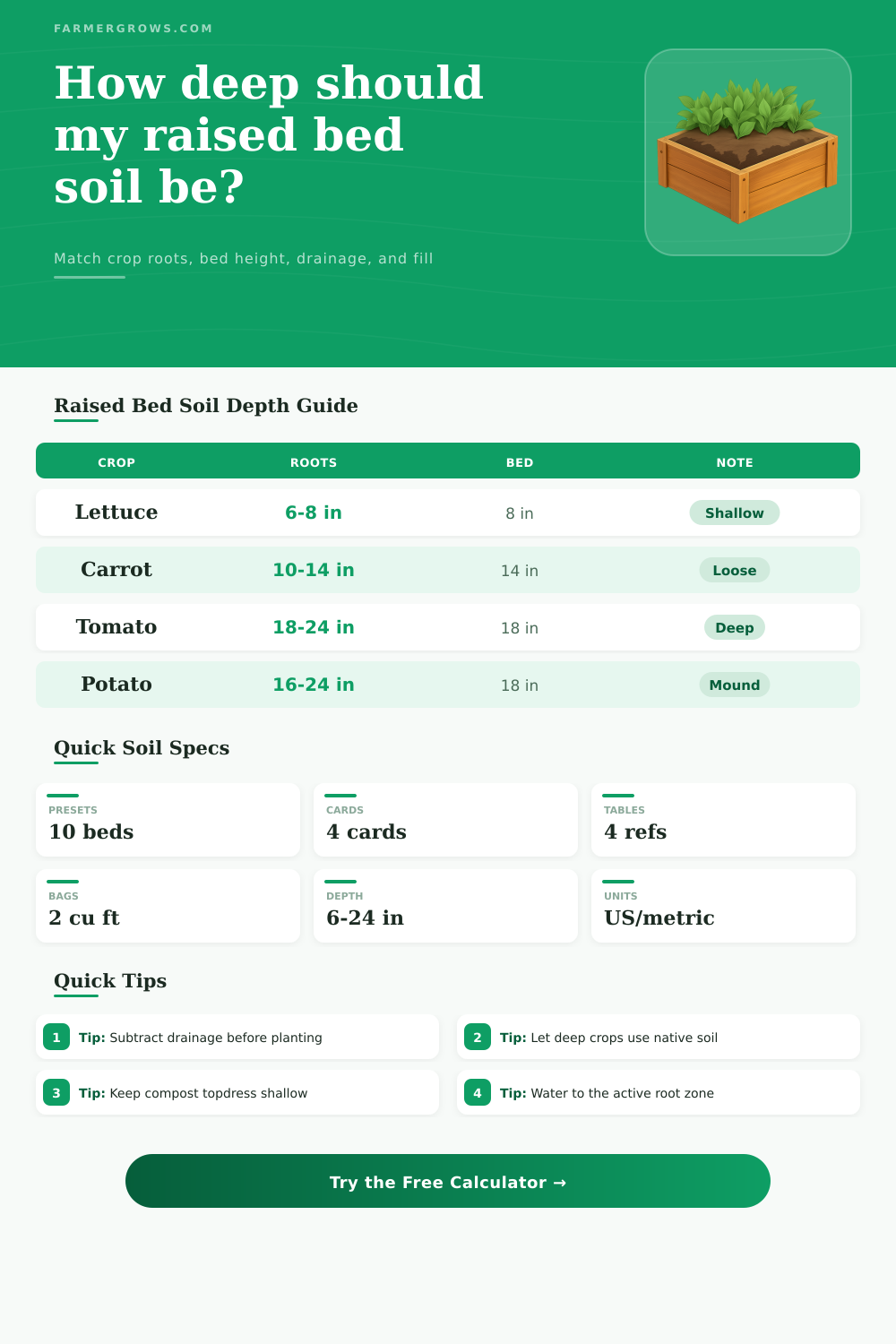
Plants like leafy greens have shallow roots, thus, six to eight inches of soil is often enough for these types of plants. Plants like carrots and beets, however, require more root depth than plants like leafy greens. If the soil within the raised bed is too loose or stony, carrots and beets will struggle to grow.
Plants like tomatoes, cucumbers and potatoes has roots that spread further beneath the raised bed to depths of twelve inches or more. If the raised garden bed is too shallow for these types of plants, their roots wont have enough room to grow within the raised bed. The quality of the native soil beneath the raised garden bed will also impact the depth requirement of that raised bed.
If the native soil is a loose loam soil, the roots of the plants will be able to grow into the native soil beneath the raised bed. In this case, the depth of the raised bed can be less deep than the depth requirements of the plants whose roots will grow into the native soil. However, if the native soil is compacted clay soil, or if a fabric barrier beneath the raised bed prevents the roots of the plants from growing into the native soil beneath the raised bed, then the raised bed must include within it all of the depth that the plants roots require.
Raised garden beds often include drainage layers at the bottom of the raised bed to allow for the roots of the plants to breathe, and compost may be added on top of the soil within the raised bed. Each of these component will impact the amount of usable soil within the raised bed. For instance, if gravel or wood chips are placed beneath the soil within the raised bed, those gravel or wood chips will take up some of the depth within the raised bed that the roots of the plants will need.
Therefore, that depth of the drainage layers should of been counted separately from the depth of the soil within the raised bed. Additionally, the compost may break down over time, thus reducing the amount of depth of the soil within the raised bed. Therefore, the depth of the soil within the raised bed should also be counted separately from the depth of the base soil within the raised bed.
The depth that the plants will be irrigated to is another factor that may impact the depth of raised bed within which the plants will grow. For instance, if the raised bed is irrigated with light watering sessions throughout the growing season, the water may not reach the depth of the roots of the plants. Therefore, the depth of irrigation must be equal to the depth of the root zone of the plants for the roots of those plants to receive enough water.
If the irrigation depth does not equal the depth of the root zone of those plants, the plants will be stressed due to lack of water for their roots. Finally, the season in which the raised bed will be utilized will also impact the depth of the raised bed. For instance, crops that are grown during the cooler months of the growing season will reach the end of their growing season before the heat of summer arrives.
Thus, shallow raised beds may be utilized during the cool-season months. However, summer fruiting crops and perennials will require raised bed depths that are deep enough to allow the roots of those plants to survive the changes in temperature that occur during the summer months. Therefore, if the bed is only deep enough for spring season crops, the summer crops may struggle to survive within the raised bed.
The calculator included with these instructions will assist in determining the depth of soil that is required for the raised bed based off the dimensions of the raised bed and the types of crops that are to be grown within that raised bed. Four figures will be provided to the user with the raised bed and crop dimensions: the depth of the growing media, the actual root zone that can be expected within the raised bed, the total volume of soil that will be needed for that raised bed, and the amount of water that will be delivered during a full watering session of that raised bed. Each of the reference tables included with the calculator can be utilized to determine the root depth requirements of various types of crops, and to determine how much credit may be earned by the native soil within the raised bed before purchasing the soil that will be used within the raised bed.
Finally, the moisture of the soil can be checked with a probe after the plants have been planted within the raised bed. The soil may settle within the raised bed over time, thus altering the depth of soil within that raised bed.