Acreage Calculator Four Sides
Estimate a four-sided parcel from side A/B/C/D, a diagonal, one included angle, a Brahmagupta cyclic estimate, or a trapezoid setup with usable-area and perimeter-buffer adjustments.
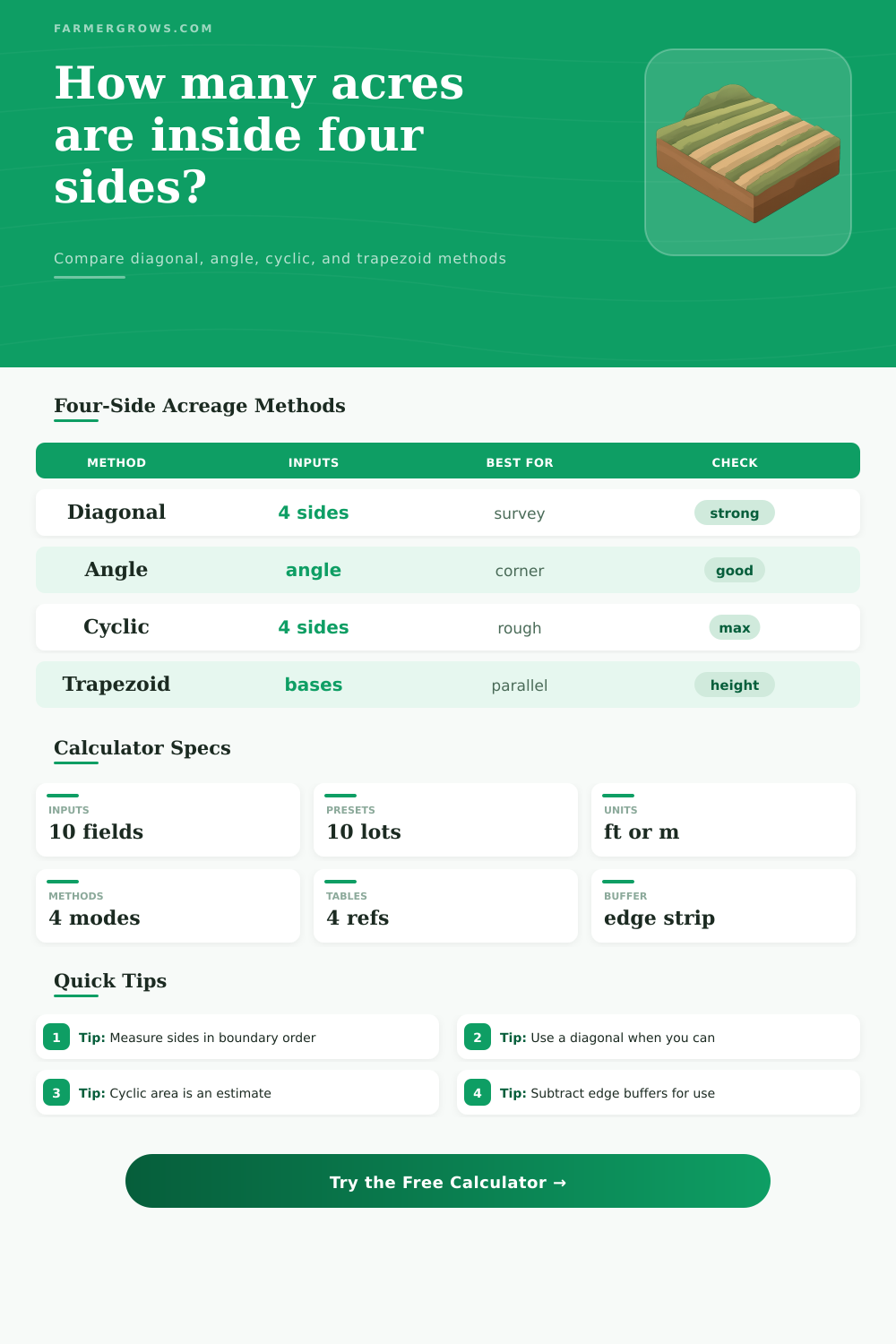
Name the sides in boundary order around the field. A measured diagonal is usually the strongest four-side input; the cyclic estimate is a useful upper estimate when only the four boundary lengths are known.
Four-Side Acreage Results
Area, usable area, perimeter, and buffer estimate for this parcel.
| Method | Extra Input | Formula Core | Field Use |
|---|---|---|---|
| Diagonal option | Diagonal across the parcel | Heron triangle 1 + Heron triangle 2 | Best general choice for measured four-sided lots |
| Angle option | Included angle between A and B | 0.5 x A x B x sin(angle), then Heron | Useful when a corner angle is available but diagonal is not |
| Brahmagupta / cyclic estimate | None beyond four sides | sqrt((s-a)(s-b)(s-c)(s-d)) | Planning estimate when angles are unknown |
| Trapezoid mode | Height or legs for estimate | ((A + C) / 2) x height | Parallel-sided crop blocks, terraces, and row areas |
| Land Unit | Square Feet | Square Meters | Conversion Formula |
|---|---|---|---|
| 1 acre | 43,560 sq ft | 4,046.856 sq m | sq ft / 43,560 |
| 1 hectare | 107,639.104 sq ft | 10,000 sq m | sq m / 10,000 |
| 1 square meter | 10.7639 sq ft | 1 sq m | sq m x 10.7639 |
| 1 square yard | 9 sq ft | 0.8361 sq m | sq yd x 9 |
| Parcel Type | Typical Sides | Preferred Method | Planning Buffer |
|---|---|---|---|
| Market garden | 100 to 300 ft per side | Diagonal or trapezoid | 3 ft to 8 ft for paths and headlands |
| Small pasture | 250 to 800 ft per side | Diagonal split | 5 ft to 12 ft for fence and gates |
| Orchard block | Parallel or near-parallel rows | Trapezoid mode | Row-end clearance plus spray access |
| Rough woodlot | Uneven boundary lines | Angle or cyclic estimate | Use conservative usable percent |
| Buffer Width | Where It Fits | What It Removes | Use With |
|---|---|---|---|
| 0 ft | Survey-only acreage | No edge strip removed | Land records or gross field estimate |
| 3 to 6 ft | Garden paths or light margins | Small working strip around boundary | Vegetable plots and nursery blocks |
| 8 to 12 ft | Fence clearance and equipment turns | Moderate headland area | Pasture, hay, and small crop blocks |
| 15 ft or more | Pond, creek, road, or windbreak edges | Larger non-planting strip | Conservation buffers and access lanes |
Measure one diagonal when possible: four side lengths alone can describe more than one quadrilateral. A diagonal pins the shape into two measurable triangles and removes most of the guesswork.
Separate gross from usable land: keep the gross acreage for records, then use buffer width and usable percent for seed, fertilizer, irrigation, plastic mulch, and working-row planning.
Calculating the area of a four-sided field is a neccesary task for a person who is interested in determine the amount of land that can be used for planting crops or grazing animal. Four different boundary length can describe many different fields with varying degree of angles, so four boundary lengths are not enough to determine the area of a field. Therefore, in order to find the area of a field that has four boundaries, there must be a specific method for calculating such an area.
There are four different method that may be utilized with the calculator to determine the area of a four-sided field. One method for calculating the area is by employing the diagonal method. The diagonal method works by dividing the four-sided field into two separate triangle, then measuring the distance from one corner of the field to the opposite corner of the field.
How to Find the Area of a Four-Sided Field
Another method for calculating the area is by employing the angle method. With this method, only one corner angle of the field need to be measured. The cyclic method is another means of calculating the area of a four-sided field.
With this method, it is necessary to assume that the field can be inscribed within a circle. The cyclic method is useful for fields whose angles are not known, but the measurement often return an estimate of the area that is larger than the actual area of the field. Finally, the last method for calculating the area is the trapezoid method.
For this method, it is necessary to assume that two of the sides of the field are parallel to one another. In this case, the height of the field is needed. The measurement from the two base to one another.
Depending upon the specific method that is used to calculate the area of a four-sided field, there will be different degree of uncertainty in the measurement of that area. For instance, the diagonal method is likely to provide an accurate measurement of the area of a field because measuring the diagonal of the field force the triangles to form a specific, measured shape. The angle method is likely to provide accurate measurement of a field if the corner angle that is measured is one of the visible corner of the field.
However, any inaccuracies in measuring that angle will have a large impact upon the area measurement for long side of the field. The cyclic method is likely to be convenient and provide an accurate measurement to the farmer with only the assistance of a tape measure and a notebook for recording the measurement, but it is likely that the measurement will be of an area that is larger than the area that can actualy be utilized within the field. Finally, the trapezoid method will be accurate in measuring the area of a field only if the two base of that field are actually parallel to one another, and if the height of the field is known.
It is common for four-sided field to have some area within the field that cannot be utilized for planting crops. The calculator allows for a perimeter buffer width and usable percentage for fields to be adjusted to account for this. A perimeter buffer width allows for the width of the strip of land along the perimeter of the field to be removed from the total area of the field.
This strip of land may be utilized for fence, spray areas, or another non-cropped area. The percentage of the field that is usable for crops can be determined by entering the percentage of the total area of the field that may actually be utilized for planting crops; area like paths, headlands, or other strip of land that are not utilized for crop planting may be accounted for with this percentage. By accounting for both the perimeter buffer width of the field and the percentage of the field that is usable for crops, the calculator can provide the acreage of a field that may be utilized for planting crops.
Each of the method for calculating the area of a field can be used under different scenarios. The diagonal method can be used if the distance from one corner of a field to the opposite corner can be measured. The angle method can be used in place of the diagonal method if the corner of a field can be measured, but where the field is not “open” to measuring the diagonal; for instance, if a ditch or another crop is positioned between the two corner of the field.
Finally, if a four-sided field is located in rough terrain where it is difficult to measure angle or diagonals, but where the length of each side is known, the cyclic method can be used to calculate the area of the field. A decision must also be made regarding the width of the perimeter buffer for the field. Fields for market garden may have a relatively small perimeter buffer width of three feet, but fields that are to be sprayed with pesticide or herbicide will likely need an eight to twelve foot perimeter buffer width to allow for movement of the spray vehicle.
Additionally, a wider perimeter buffer width may be needed if the field is to be bordered by a pond, creek, or road. Thus, different buffer width value should be tested prior to determining the area that will actually be utilized for growing crop. Depending upon the type of land that is to be utilized, there are different recommended method for calculating the area.
Market garden that are to be used to grow crops that require the use of parallel edge can utilize the trapezoid method for calculating the area of the field. Pasture area can utilize the diagonal method to determine the area since the fence line may have been established for those pasture. Orchards or row crop can use the trapezoid method for the same reason as market gardens.
Finally, woodlots or rough land that may be difficult to measure can use the cyclic method to calculate the area. After calculating the area of a field using either of the four method, three different number can be obtained. The gross acreage of a field can be determined, the acreage of the field that will be used for working the land can be calculated using the field buffer width, and the percentage of the land that will be utilized for planting crops can be determined.
Each of these three number should be noted separately by the farmer because he or she will not want to order the material necessary to plant crops within land that will not be able to be utilized for that purpose. By noting the area of the field that will be planted with crop, and by considering the width of the perimeter buffer of that field, the farmer can create an accurate plan for planting crop on that field.