Thousand Seed Weight Calculator
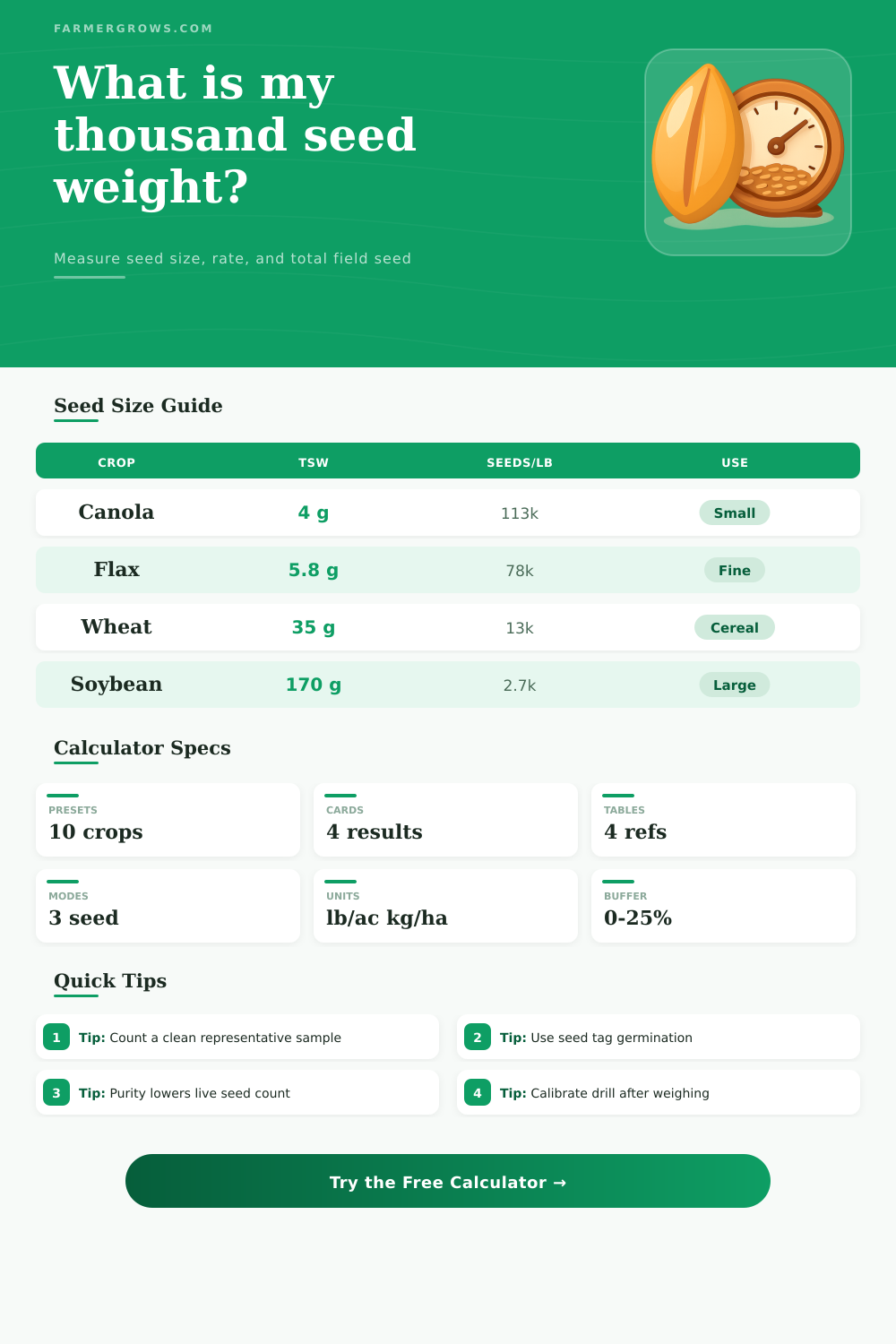
Measure TSW or TKW from a counted sample, convert it to seeds per pound, then estimate seeding rate, live seed delivery, total field seed, and overage.
Use a clean, representative sample from the seed lot. The calculator treats germination and purity as live-seed factors, then adds your overage after the required seed count is found.
Thousand Seed Weight Result
Your seed size, seeding rate, and total field seed will appear here.
| TSW or TKW | Approx seeds/lb | Seed size class | Rate effect |
|---|---|---|---|
| 4 g | 113,398 | Tiny | Low lb/ac can still deliver many seeds. |
| 10 g | 45,359 | Small | Good range for fine forage and cover crop seed. |
| 35 g | 12,960 | Cereal | Typical wheat-style drill calibration range. |
| 100 g | 4,536 | Large | Pounds rise quickly for the same seed count. |
| 250 g | 1,814 | Very large | Bulk handling and hopper capacity become important. |
| Germination | Purity | Live seed factor | Seed needed for 1M live seeds |
|---|---|---|---|
| 98% | 99% | 97.0% | 1.03 million raw seeds |
| 95% | 98% | 93.1% | 1.07 million raw seeds |
| 90% | 97% | 87.3% | 1.15 million raw seeds |
| 85% | 95% | 80.8% | 1.24 million raw seeds |
| 75% | 92% | 69.0% | 1.45 million raw seeds |
| Crop or use | Typical target seeds/ac | Common TSW range | Planning note |
|---|---|---|---|
| Wheat | 1.2M to 1.8M | 28 to 45 g | Raise target for late planting or low tillering. |
| Barley | 1.1M to 1.5M | 32 to 48 g | Plump seed can change drill settings sharply. |
| Canola | 350k to 650k | 3.5 to 6 g | Use strong emergence assumptions carefully. |
| Soybean | 120k to 180k | 140 to 220 g | Seed size often appears as seeds per pound on tags. |
| Field pea | 350k to 450k | 180 to 300 g | Seed treatment and cracking losses can matter. |
| Acres | 50 lb/ac | 100 lb/ac | 150 lb/ac | 200 lb/ac |
|---|---|---|---|---|
| 20 | 1,000 lb | 2,000 lb | 3,000 lb | 4,000 lb |
| 40 | 2,000 lb | 4,000 lb | 6,000 lb | 8,000 lb |
| 80 | 4,000 lb | 8,000 lb | 12,000 lb | 16,000 lb |
| 160 | 8,000 lb | 16,000 lb | 24,000 lb | 32,000 lb |
Measure more than once: Weigh two or three counted samples and average them when seed lots contain splits, shriveled kernels, or uneven cleaning.
Keep rate and biology separate: Germination and purity change live seed delivery; overage is only a handling buffer after those quality losses are applied.
Determining the thousand seed weights is a necessary step in determining how many plant will grow in your field. The thousand seed weight, also known as TSW or TKW, is a measurement of the weight of one thousand seeds. If you know the thousand seed weight, you can calculate how many seeds is in a bag of seed.
You can use the thousand seed weight along with germination and purity to determine how many live seeds will be planted in the field. Using the calculator, you can determine how many seeds to order by plugging in the thousand seed weight, germination test, and the total acres to be planted. However, you must decide on a target density for your field.
How to Find and Use the Thousand Seed Weight
To find the thousand seed weight for your seed lot, count the number of seeds in a sample of the seed and weigh the sample. You must use a representative sample from the middle of the tote or the middle of several bag of seed. If the seed has been cleaned twice, its weight will be greater than if the combine pulled the seed out.
In this case, you will have to recheck the thousand seed weight of the lot of seed. Ensure you weigh the sample rather than counting the number of seeds; the thousand seed weight will be expressed in the weight of one thousand seed. Germination and purity is different from the thousand seed weight but will impact the number of live seeds that are planted in the field.
The germination rate of the seed may be listed at 95% on the tag of the seed. However, the laboratory recorded that germination rate under ideal conditions. The germination rate in your field may be less due to cooler soil in the field, the soil may crust over the seeds, or the field may have seed-placed fertilizer that kill the seeds.
The calculator will combine the germination and purity of your seed into one live seed factor. Many farmer will use an overage to allow for some error in the drills. An overage may be incorporated into the total number of pounds of seed to order.
However, many operators wont use an overage. Without an overage, the corners of the field may appear to have less than the center of the field. You can allow for an overage in your calculation of the total pounds of seed to order.
Depending on the type of crop that is to be planted, the thousand seed weight will have to be determined with a certin level of precision. For crops such as canola and flax, a small change in the thousand seed weight will have a significant impact on the pounds of seed that is required per acre. For crops like wheat and barley, the thousand seed weight will be in the middle range so that determining the thousand seed weight once before planting will be enough to determine the pounds of seed to order per acre.
For crops like soybean and field pea, the thousand seed weight can change significantly. Each soybean or field pea lot will have a specific thousand seed weight that is related to the crop variety and the conditions in which the seeds were grown the previous year. You can take a sample from every new tote of seed to ensure that there is neither too much nor to little seed to plant in your fields.
The seed dealer may recommend the number of pounds of seed to plant per acre using the average thousand seed weight for that variety of crop. However, if the specific lot of seed that you have is ten percent heavier than the average, you will have to adjust the planter settings to account for this. If the specific lot of seed is lighter than the average, you will have to plan for a higher seed count that may lead to lodging in cereal crops.
The calculator can convert these comparisons into numbers so that you will not have to perform the mental math in your head. Many people will choose to keep a record of the number of seeds per pound of seed. This is especially true for crops with smaller seeds.
The thousand seed weight is the reciprocal of the seeds per pound, so if the calculator determines one value, the calculator will present the other. By showing both values, the calculator will save you the time and effort to perform the conversion between these two values. The reference tables will show you the relationship between the number of seeds per pound and the thousand seed weight for numerous crops.
There are several other factors in the field that will have an impact on the final stand, despite what the calculator will determine for you. The moisture in the soil, the amount of residue in the fields, and the accuracy of the planter drill will all have an impact on the actual number of seeds planted into the field. For example, a lot of seed that demonstrated a germination rate of 92% in the warm setting of a laboratory may germinate to an 85% rate in the cool shed in which the seed was stored for three weeks before planting.
In these cases, you may choose to run a germination jar test on your seed to determine the current germination rate of the lot of seed. This test will provide you with up to date information on your seed lot as compared with the age of the information on the tag of the bag of seed. The calculator will not replace your judgment on your fields but will eliminate the need to remember and calculate these numbers.
The thousand seed weight will also impact the amount of seed that you will need to store in your barn or other area to be used for planting. A lot of soybean seed that weighs more thousand seed weight will require more volume of storage for your soybean than a soybean with a low thousand seed weight. If your planter boxes are already full of soybean seed, ordering a heavier Thousand seed weight for soybean may require you to refill the planter more often.
The calculator will determine the total pounds of seed that are required and output that amount in fifty-pound units of seed that may be easier to order for your farm operations. You should treat the determination of the thousand seed weight as a routine task for your farm operation. Maintain a digital scale and counting trays in your shop.
When each new tote of seed arrives, pull a sample of the seed and write the Thousand Seed Weight on the tote of seed. By checking the Thousand Seed Weight of each variety of seed regularly, you will begin to notice how different varieties of seeds and different weather conditions impact the Thousand Seed Weight of that type of seed. The calculator will make this routine task easier for you.