Planting Grid Calculator
Estimate how many plants fit in a garden bed using center-to-center grid spacing, row crop spacing, companion rows, square-foot planting density, border setback, path allowance, and overage.
Use the harvestable bed size, then subtract setbacks and paths before comparing planting methods. The calculator returns the selected method count plus side-by-side row, grid, square-foot, and companion-row estimates.
Planting Grid Results
Your bed count will appear here.
| Crop type | In-row spacing | Square-foot density | Good method |
|---|---|---|---|
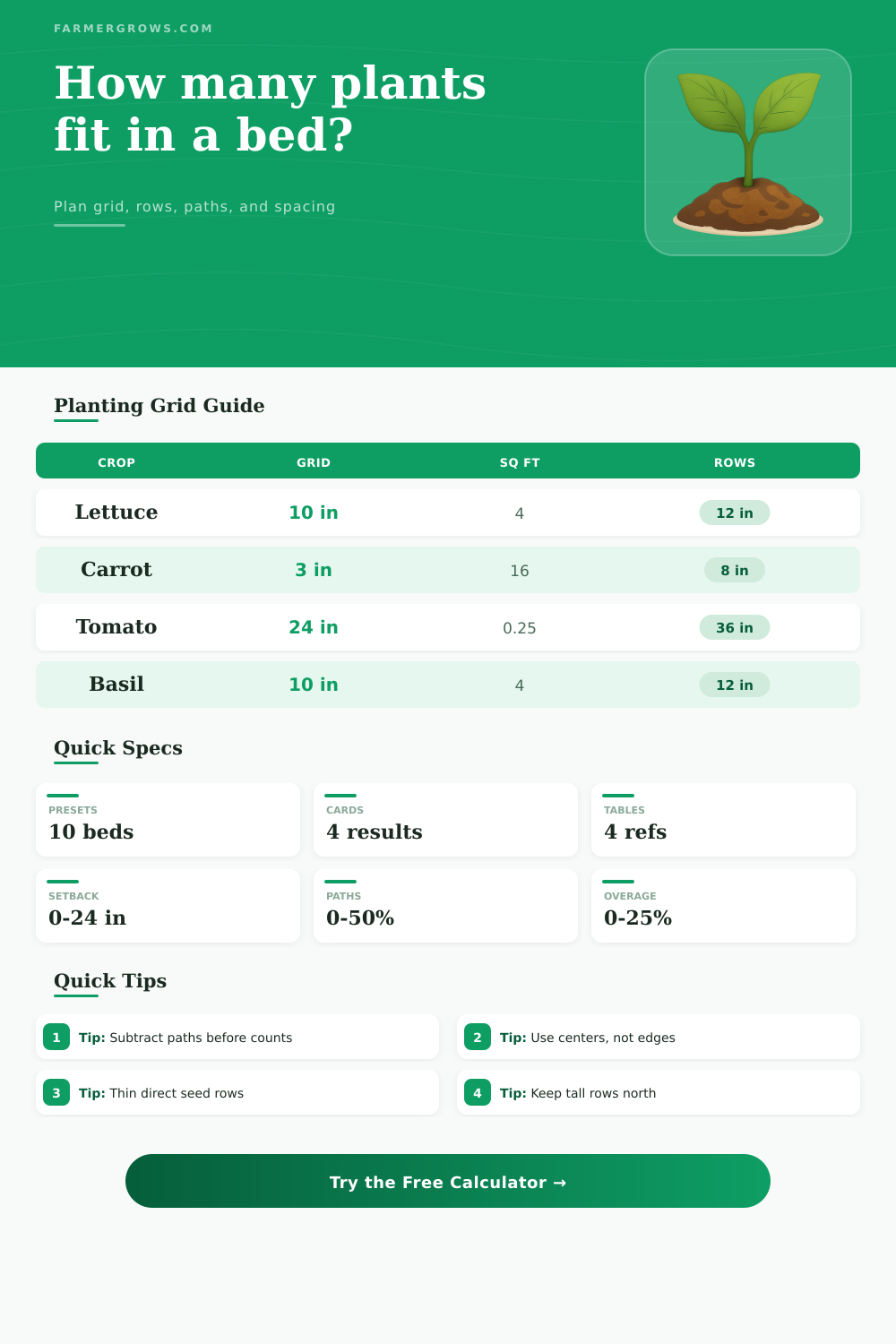
| Carrot, radish, scallion | 2 to 3 in | 16 plants per sq ft | Square-foot or dense grid |
| Beet, spinach, bush bean | 4 to 6 in | 9 plants per sq ft | Rows or square-foot blocks |
| Lettuce, basil, parsley | 8 to 12 in | 4 plants per sq ft | Grid centers or square-foot |
| Pepper, kale, cabbage | 15 to 18 in | 1 plant per sq ft | Rows with airflow allowance |
| Tomato, cucumber, squash | 18 to 36 in | 0.25 to 1 plant per sq ft | Rows, trellis, or wide grid |
| Method | Formula idea | Best use | Planning caution |
|---|---|---|---|
| Grid centers | columns x rows from center spacing | Transplants, herbs, evenly spaced beds | Uses exact centers and may exceed square-foot density for tiny beds |
| Crop rows | rows across width x plants per row | Direct-seeded rows, trellised crops, machine or hand cultivation | Row spacing controls airflow and harvest access |
| Square-foot | effective area x plants per sq ft | Raised beds, intensive blocks, small gardens | Use only planted area after path allowance |
| Companion rows | main rows plus companion rows at their own spacing | Flowers, basil, alliums, trap crops beside vegetables | Companions still occupy row space and should be counted |
| Bed example | Usable area after 3 in setback | 4 per sq ft count | 16 per sq ft count |
|---|---|---|---|
| 4 x 4 ft square bed | 12.3 sq ft before paths | 49 lettuce or basil plants | 196 carrot positions |
| 4 x 8 ft raised bed | 26.3 sq ft before paths | 105 lettuce or basil plants | 420 carrot positions |
| 3 x 20 ft market strip | 48.8 sq ft before paths | 195 leafy positions | 780 root positions |
| 8 x 12 ft block bed | 86.3 sq ft before paths | 345 leafy positions | 1,380 root positions |
| Adjustment | Typical range | What it changes | When to use it |
|---|---|---|---|
| Border setback | 2 to 6 in | Removes edge space before counting centers | Raised beds, paths, irrigation lines, bed walls |
| Path allowance | 0 to 20% | Reduces effective planting area for square-foot counts | Large beds, harvest stepping stones, teaching gardens |
| Companion rows | 0 to 3 rows | Shifts some row capacity from main crop to companion crop | Flowers, herbs, alliums, beneficial insect strips |
| Overage | 5 to 20% | Adds extra starts or seed positions to the selected count | Germination loss, culls, transplant shock, thinning |
Use center lines: Measure spacing from plant center to plant center. A 3 inch border setback means the first plant center is 3 inches from the edge, not that the foliage ends there.
Keep access realistic: If the bed is wide enough that you step into it, add a path allowance before trusting square-foot counts, then add overage only after the plant count is chosen.
When you plan your garden beds, you must determine how many plants will fit into that garden bed. Many people believes that you can calculate how many plants will fit by calculating an area of the bed (length times width). However, to calculate the actual plant capacity of your garden bed, you must subtract the area of any path, borders, or other non-gardening elements from that total area.
Plants require space to be planted from the center of one plant to the center of the next, not from one leaf to the next leaf. Using a rough guess to determine how many plant will grow in your garden bed can lead to error. If you do not allow enough space for each plant, the plant may not be able to reach it’s full growth potential.
How to Figure Out How Many Plants Fit in a Garden Bed
A calculator can help you account for these mathematical calculations of how many plants will fit into your determined dimension. In addition to the length and width of the bed, you must also account for the border setback. A border setback is used to move the center of the first plant away from the edge of the bed to account for the roots of the plant.
For instance, if your garden bed is four feet in width, and you use three-inch borders on each end of the bed, you will lose six inches of your garden bed to these root requirement. Additionally, if you plan to step into the garden bed to weed your plants, you will need to account for that area as well. For instance, if you plan to step into the bed, you will need to subtract the area for the path from the total square footage of the bed; you should leave the path allowance at zero if the garden bed is narrow, but you will need to increase the path allowance if the garden bed is wide.
In addition to accounting for the size of your garden bed, you can also use a calculator to determine how many plants will fit into your bed based off different method of plant spacing. Grid spacing calculates the number of plants that may grow in a garden bed if they are spaced equal in each direction; this is useful for plants that require much airflow. Row spacing calculates the distance in between rows of plants.
Square-foot spacing calculates the number of plants that will grow in the entire bed, based on the area of that bed; it does not use rows. Finally, companion rows calculates the number of plants that may grow in the bed if some of the row are used for other plants; this is useful for those that wish to avoid shading their main crop. Additionally, you can plan your garden bed using either intensive block planting method or traditional row planting method.
Square-foot gardening method allow for the crops to be planted quite close together. This method requires that you can reach each area of your garden bed without compacting the soil. Row gardening method allow for more room for your cultivation tools, and allow for more airflow for plants like tomatoes or peppers.
In determining how many plant you will grow in your garden bed, you can use any of the method mentioned above. However, you should also consider the environmental factor for each of your planned plants. For instance, soil temperature and sunlight will affect how your plants grow; some plants require more sunlight than others, and some climate may have different soil temperature than others.
Finally, different varieties of the same type of plant may grow differently; carrots, for instance, may require different spacing in hotter soil then they do in cooler soil. Companion rows may also shade your main crops if the companion plant are too tall. Finally, you should plan for some overage of the number of plants that you will grow.
For instance, some seed may not germinate, some pests may kill the seedling, and the number of plants that grow from each seed is not always as expected. By adding some percentage of plants to the total number that you calculate, you account for this and wont have to go to the nursery for your plants. The reference tables that are included provide the spacing for various type of plants.
These are general guidelines, but you can adjust these number for different varieties of plants. Many people make errors in calculating the number of plants that will grow in their garden bed. For example, if they do not account for the border setback, they may find that their plants are growing against the border.
Furthermore, many do not account for the area that they will need to step into the bed to weed their plants. People should of make these calculations early in the planning of the bed to ensure that they do not purchase too many seedlings, or do not have enough room for their plants to grow.