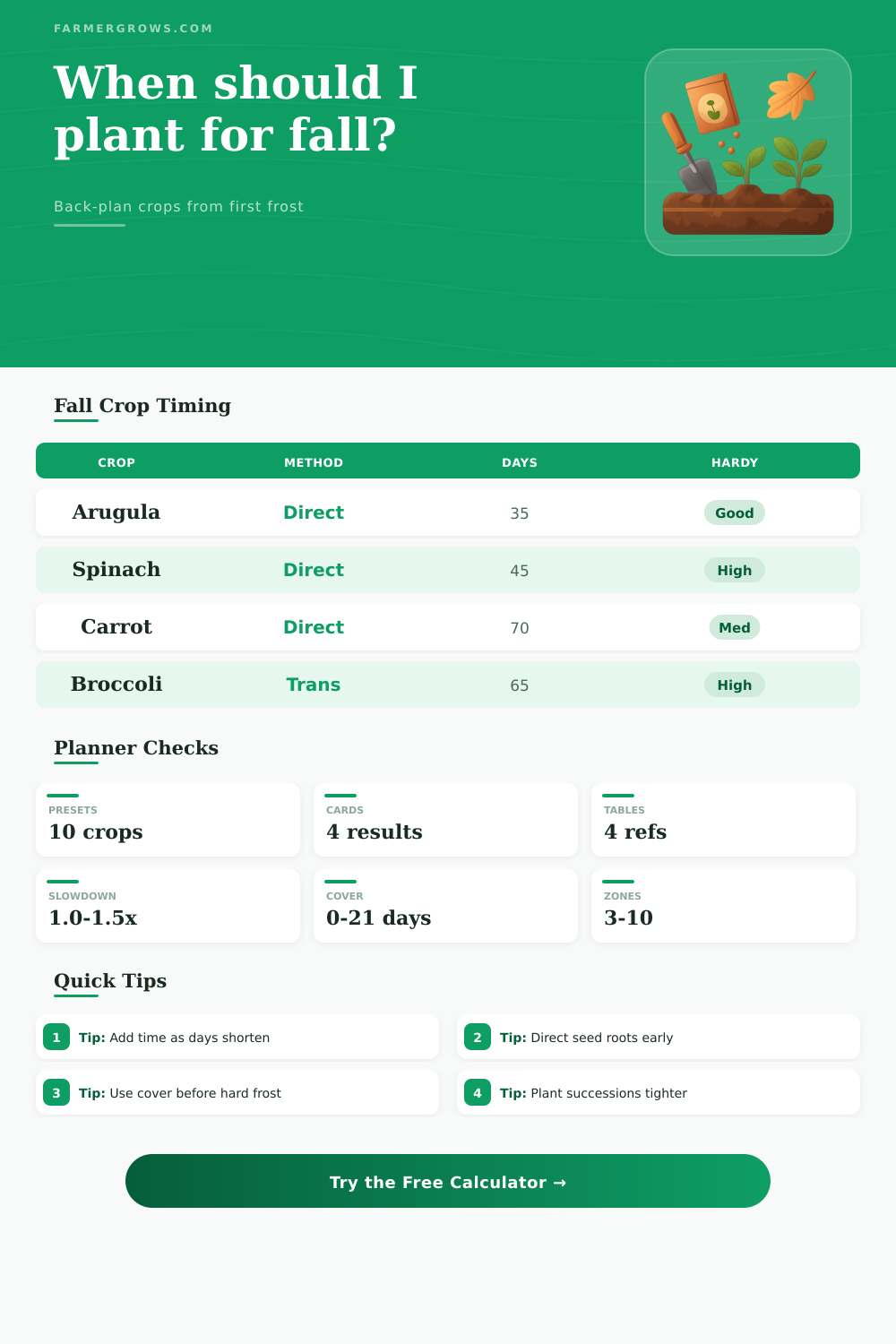
Fall Planting Calculator
Work backward from your first frost date to find the latest fall sowing or transplant date, adjusted for crop maturity, shortened daylight, row cover protection, growing zone, and repeat planting intervals.
Choose a crop preset or enter your seed packet days to maturity. The calculator converts that number into fall-adjusted grow time, then checks whether your planned date finishes before the protected frost deadline.
Fall planting window
Enter your crop and frost date to see the safe planting window.
| Crop | Default method | Typical days | Cold tolerance | Fall note |
|---|---|---|---|---|
| Arugula | Direct seed | 35 days | Moderate | Best for repeated salad sowings. |
| Leaf lettuce | Direct seed | 45 days | Moderate | Use cover for cleaner leaves after frost. |
| Spinach | Direct seed | 45 days | Very hardy | Establish before deep cold for best stands. |
| Kale | Transplant | 55 days | Hardy | Leaves sweeten after light frosts. |
| Radish | Direct seed | 28 days | Light hardy | Useful when only a short window remains. |
| Carrot | Direct seed | 70 days | Moderate | Sow early because root sizing slows late. |
| Slowdown factor | When to use | 45 day crop becomes | 70 day crop becomes | Planning risk |
|---|---|---|---|---|
| 1.00x | Warm early fall | 45 days | 70 days | Low if frost is far away. |
| 1.10x | Mild fall weather | 50 days | 77 days | Good for late summer sowings. |
| 1.20x | Typical shorter days | 54 days | 84 days | Useful default for most gardens. |
| 1.35x | Late cool planting | 61 days | 95 days | Needs hardy crop or protection. |
| 1.50x | Cold short-day window | 68 days | 105 days | High unless crop overwinters. |
| Zone | Rough first frost | Best fall crop type | Cover value | Planning reminder |
|---|---|---|---|---|
| 3 to 4 | Sep 15 to Oct 1 | Fast greens, radish | High | Start most crops in midsummer. |
| 5 | Oct 7 | Greens, roots, brassicas | High | Transplants help long crops finish. |
| 6 | Oct 15 | Greens, roots, broccoli | Medium | Late August is a key sowing window. |
| 7 | Oct 30 | Greens, roots, herbs | Medium | September sowings can still work. |
| 8 to 10 | Nov 15 to Dec 15 | Cool-season beds | Lower | Heat may matter before frost does. |
| Succession buffer | Best crops | Use when | Watch for | Typical plan |
|---|---|---|---|---|
| 5 to 7 days | Radish, arugula | Very fast crops | Overcrowded harvests | Small strips, frequent sowing. |
| 7 to 10 days | Lettuce, cilantro | Steady salad supply | Uneven germination | Repeat until latest safe date. |
| 10 to 14 days | Spinach, turnip | Cooler weather | Slow emergence | Use cover after seedlings emerge. |
| 14 to 21 days | Kale, broccoli | Transplant batches | Limited bed space | Stagger starts before setting out. |
Tip: For direct-seeded fall crops, count on slower germination if beds are dry or the seed is sown during hot late-summer weather.
Tip: Row cover protects leaves and buys time, but it does not replace an early enough planting date for long-season roots and brassicas.
Fall planting require planning when the cold weather arrive. The days is shorter and the soil is more cool in the fall, which will affect the growth of the plants that is planted during this season. Some of the plants that grows well during the fall can tolerate light frost, but still require a period of time to grow to a harvestable size before the plants experience a hard frost.
Thus, gardeners must carefully plan the timing of when plants are to be planted. One way to calculate in what dates the plants should be planted is to work backwards from the date of the first frost in your growing region. In this case, the date of the first frost is the most important date to consider for fall planting, rather than the current date on the calendar.
How to Plan Fall Planting
The date of the first frost can be used to determine how many day the plants will need to grow during the fall season. During the fall, most plant varieties will take longer to grow than the time indicated on the seed packet. For instance, seeds that take 45 days to mature in the spring may need 55 or 60 days during the fall due to the cooler soil temperature that affect the plant growth rates.
The calculator included on this page can help determine the proper number of day for fall planting with the consideration of these variables. Row cover are another tool that can be used to alter the timing of fall planting. For instance, medium weight row covers can provide protection to the plants from light frost, and help to retain warmth within the soil beneath the cover.
However, row covers do not assist in the growing of long season plants, or in altering the natural maturity rate of the plants. Thus, the use of row covers allows for gardeners to compare the maturity rate of fall-planted crops with the protected time before frost arrive. Succession planting allow for the repeated harvest of certain crop from the garden.
Thus, to employ this type of planting method, gardeners must calculate how many different intervals for planting the same type of crop will occur within the time period before the first frost. The number of intervals that can be established for succession planting will depend upon the time period that is allowed between each planting of the same type of crop, as well as the grow period that the plant will take to mature. For instance, fast growing crops like arugula and radish may allow for short period between each successive planting, while crops like broccoli transplants will require more time between each planting of the same type of crop.
The calculator included on this page can assist in determining how many successions of each crop can be planted within the fall season. Your garden zone is another critical factor in fall planting. The different zones contain different amount of daylight and temperatures.
Thus, for instance, a gardener that reside in zone 5 may be able to complete fall planting by early August, while a gardener in zone 8 may still be able to plant certain types of greens in October. These differences between the various zones are primarily due to the different amount of daylight that fall within each zone prior to the plants utilize the energy that they have stored throughout the growing season. Thus, the daylight window that plants experience during fall change with the zone in which the plants are grown.
An error that many gardeners often make is attempting to use the schedule for spring planting for fall planting efforts. Using this schedule result in the planting of too few seed of each type of plant, since the growth of plants is slower in the fall due to the differences in the weather between spring and fall seasons. For instance, while the weather may be mild during the month of September, the plants will grow differently in October due to the cooler temperatures.
Thus, the slowdown factor for fall planting allow for the consideration of these different growth rate in the planning phase for fall planting. Another decision that fall planters must make is whether to directly seed the plants or to use transplants of those plant varieties. Transplants require some time to establish themselves in the soil, but can better tolerate cooler soil temperature than the directly seeded plants.
The fall planting calculator includes a small allowance for such a difference between transplants and direct planting of seeds. Thus, this variation in the time that each type of plant may require will allow for a plant that may be considered to be barely successful with fall planting using direct seeds to potentially become a success if using transplants instead. The reference tables that is provided on this page provide information about the various plant maturity periods for fall planting with the indicated factors for slowdown.
Each table also includes information about the various date for first frost and the garden zones. These tables are a helpful tool for gardeners that need to quickly determine the information for several planting areas, but the information within these tables should be used in conjunction with the specific fall date for each garden bed. Fall planting of certain vegetables will result in the crops having a better taste after experiencing a light frost.
These different tastes are created as a result of the frost allowing the sugar to concentrate within the leaves of the plants. However, if the plants have not grown to an appropriate size prior to exposure to frost, the frost will have no benefit to the plant. For instance, a tiny kale plant that is exposed to a hard frost will not become a lush plant that can be harvested for its beneficial vegetables.
Thus, providing the plants with the proper amount of time to grow to an appropriate size prior to exposure to frost will result in beneficial vegetables. By using the time calculator for fall planting, gardeners can plan their bed to allow for the best harvest of vegetables in November.