Vinyl Fence Calculator
Estimate vinyl fence panels, posts, gates, rails, caps, footing concrete, gravel base, slope allowance, and waste from a planned run length.
Measure every straight fence run, subtract gate openings, and use this as a material planning estimate before ordering. Confirm post depth, wind exposure, frost depth, and code requirements locally.
Vinyl Fence Material Estimate
Results include gate openings, corner posts, slope or racking allowance, waste, rails, caps, concrete volume, and gravel base.
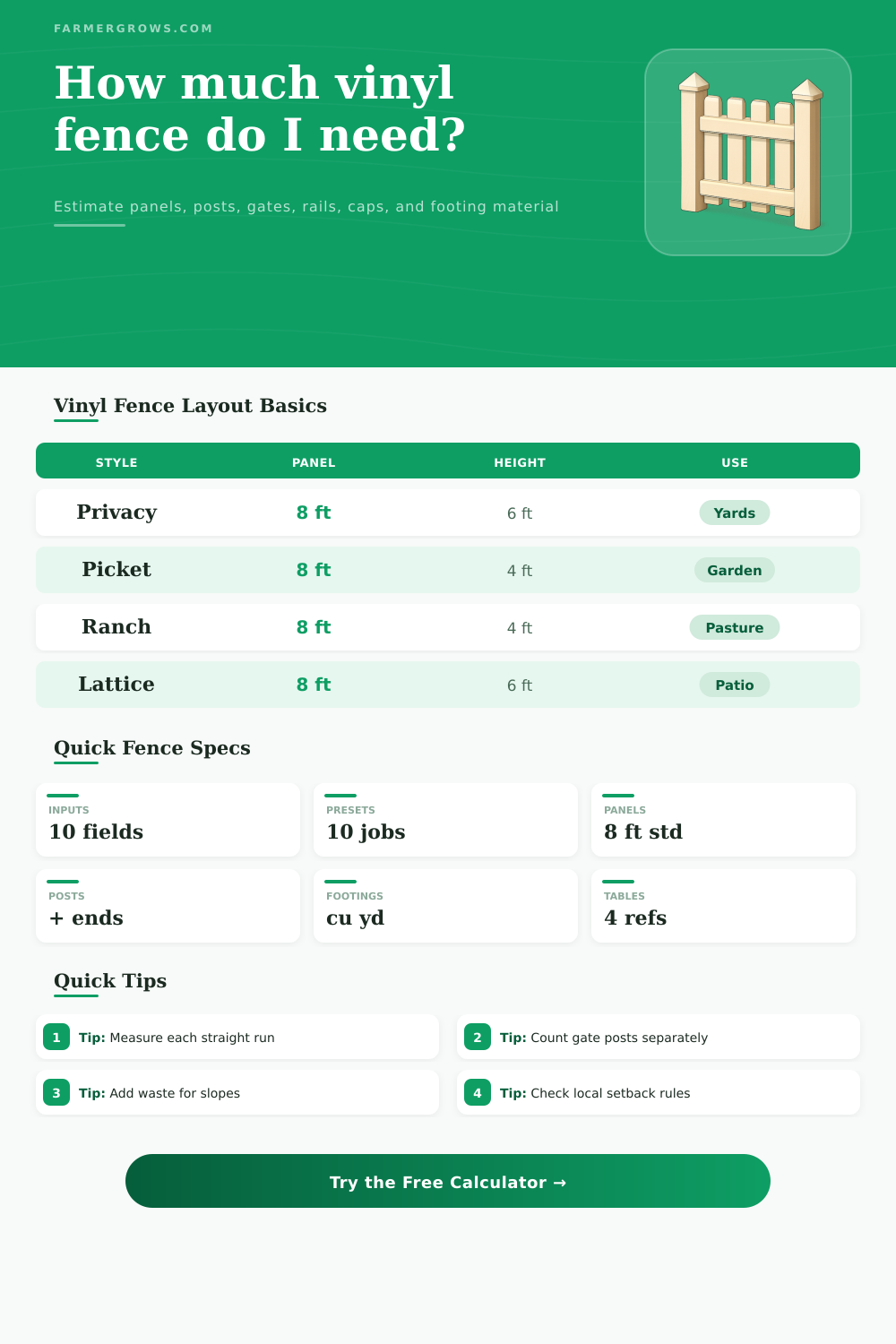
| Vinyl style | Common height | Rails per section | Typical panel width | Planning note |
|---|---|---|---|---|
| Full privacy | 5 to 6 ft | 2 to 3 | 6 or 8 ft | Best for screening; use stronger posts in windy areas |
| Lattice top privacy | 5 to 6 ft | 3 | 8 ft | Add topper inserts and check panel orientation before ordering |
| Spaced picket | 3 to 4 ft | 2 | 6 or 8 ft | Often used around gardens, walkways, and front yards |
| Semi private | 4 to 6 ft | 2 to 3 | 6 or 8 ft | Allows airflow while still softening the view |
| Ranch rail | 3 to 5 ft | 2 to 4 | 8 ft spacing | Count rails by section instead of closed panels |
| Run length | 6 ft panels | 8 ft panels | Line posts | Base assumption |
|---|---|---|---|---|
| 48 ft straight run | 8 panels | 6 panels | 7 or 5 | No gates, one continuous line |
| 96 ft straight run | 16 panels | 12 panels | 15 or 11 | Add one extra post for each end |
| 160 ft yard run | 27 panels | 20 panels | 26 or 19 | Before gate deductions and waste |
| 240 ft perimeter | 40 panels | 30 panels | 39 or 29 | Corners and gates add specialized posts |
| 400 ft estate run | 67 panels | 50 panels | 66 or 49 | Survey long runs for grade breaks |
| Hole diameter | Hole depth | Concrete per post | 80 lb bags per post | Common use |
|---|---|---|---|---|
| 8 in | 24 in | 0.78 cu ft | 1.3 bags | Short picket and light posts |
| 10 in | 30 in | 1.36 cu ft | 2.3 bags | Common privacy fence estimate |
| 10 in | 36 in | 1.64 cu ft | 2.7 bags | Taller fence or deeper frost area |
| 12 in | 36 in | 2.36 cu ft | 3.9 bags | Gate posts or exposed corners |
| 12 in | 42 in | 2.75 cu ft | 4.6 bags | Heavy gates and difficult soils |
| Slope condition | Suggested allowance | Panel handling | Why it matters |
|---|---|---|---|
| Flat or mild grade | 0 to 3% | Standard panels | Few cuts and little rack adjustment |
| Rolling lawn | 4 to 7% | Rackable panels preferred | Extra length covers layout shifts and trimming |
| Stepped hillside | 8 to 12% | Step panels between posts | May need extra posts at grade breaks |
| Sharp grade change | 12 to 18% | Split runs and verify heights | Fence may need custom cuts or shorter sections |
| Gate on slope | 10% plus | Review swing clearance | Gate opening can drive post and panel changes |
Before ordering: Sketch every straight run separately, mark corners, and subtract exact gate openings. Vinyl systems depend on matching rails, posts, brackets, and caps.
Before digging: Confirm utilities, setbacks, frost depth, post size, and gate swing clearance. Slope and racking choices can change both panel count and post placement.
Planning a vinyl fence require a person to determine the amount of vinyl fence material that is required for the project. A person must know the amount of vinyl fence material necessary to cover the distance between the corners of there yard; if there is not enough vinyl fence material for the project, the vinyl fence will be short of covering the distance between the corners, but if there is too much vinyl fence material, there will be excess vinyl fence material. The calculator allow a person to calculate the amount of vinyl fence material that will be necessary for the project once the individual enters various parameter for the fence, such as the length of the run of the fence, the width of the vinyl fence sections, the number of gate openings along that fence, the number of vinyl fence posts and the amount of vinyl fence footings required.
However, the calculator cannot make the judgement calls that is required by a person before entering the various parameters into the calculator. Vinyl fence sections are manufactured in standard widths; the fence manufacturers establish the standard widths in the design of the brackets and fence rails that connect the vinyl fence sections. Additionally, a person must consider these standard widths of vinyl fence sections when measuring the distance between the corners of the yard.
How to Plan and Measure a Vinyl Fence
For instance, rather than simple measuring the distance between the corners of the yard, a person must account for the width of the gates that will be constructed along that fence. The calculator accounts for the width of these gates so that the person orders the vinyl fence panels in a length that will allow the gates to be constructed along the fence. Beyond accounting for gates, vinyl fences are often constructed on slopes in the ground.
In these cases, the vinyl fence panels must rack to step over the slope in the ground. Thus, vinyl fence panels must be accounted for in the planning of the fence build up to the vinyl fence panels needing to be cut to fit the slope; the calculator establishes an allowance in the vinyl fence panel lengths that will provide for coverage of the slope in the ground. Additionally, vinyl fence panels may chipping at the ends of the fence panels during installation, or the vinyl fence panels may arrive damaged in the order; thus, vinyl fence panels should be ordered with a small percentage provided for waste.
In vinyl fences, there are typically vinyl fence posts that is erected into the ground along the fence. The vinyl fence posts must be accounted for in the planning of the vinyl fence to be erected; the posts must account for the various types of vinyl fence posts along the vinyl fence, such as corner posts, gate posts and line posts. The vinyl fence calculator accounts for these different types of vinyl fence posts so that the person orders the vinyl fence posts according to the vinyl fence plans.
Additionally, these posts will require some amount of vinyl fence footings to be erected into the ground; these footings will require some amount of gravel to allow water to drain away from the vinyl fence post, as well as some amount of concrete to provide for the vinyl fence post to resist the load of the wind against the fence. Thus, the number of fence posts will determine the amount of vinyl fence footings required for the vinyl fence build. Additionally, gates can be constructed along the vinyl fence.
Additionally, the various types of gates have different requirements for the number of vinyl fence posts along the gates; double gates will require vinyl fence posts on each side of the gate, but single gates will require only one vinyl fence post to act as a hinge to open and close that vinyl fence gate. The calculator accounts for these differences in the requirements of vinyl fence posts along vinyl fence gates. Additionally, the calculator will track the number of vinyl fence rails that will be required based on the number of rails of the vinyl fence sections that are to be used for the fence.
Additionally, reference tables provide information regarding the number of rails that will be required for the different types of vinyl fences, as well as the sizes of the holes in those vinyl fence posts. These tables are not a replacement for the local building codes; local building codes may require that the depth of vinyl fence posts be different along the fence due to local frost depth or soil types, or even the wind exposure of that vinyl fence. Thus, the vinyl fence calculator is just a start in determining the amount of vinyl fence materials that will be required for the vinyl fence project; a person should also check with the local building department to ensure that they will not have problems with a building inspector after the vinyl fence is constructed.
Calculating the vinyl fence materials that will be required for the vinyl fence before ordering the materials will allow a person to determine various tradeoffs of the different components of the fence. For instance, vinyl fences that are taller will require more privacy, but may require more concrete to be poured around each vinyl fence post to allow for stability in the ground. Vinyl fence panels with lattice toppers will require additional vinyl fence inserts to cover the lattice toppers, but the lattice toppers will not require any changes to the vinyl fence panel spacing.
Thus, calculating these various components will allow a person to make a plan for the vinyl fence construction. Finally, when the vinyl fence calculator is completed, a person should walk the fence line that is to be constructed. A person should walk the fence line to ensure that the drop in elevation of the ground is greater than the percentage allowance that is established for the vinyl fence panels to account for the slope of the ground.
Additionally, a person should walk the fence line to ensure that the direction in which the vinyl fence gate will open will not hit any of the vinyl fence posts along the fence line. Thus, ensuring that the vinyl fence materials will be ordered according to the calculations that the calculator makes, as well as ensuring that the vinyl fence will pass these additional checks, will lead to the plans for the vinyl fence to become a material order for the vinyl fence that is to be constructed.