Vegetable Planting Calculator
Estimate rows, plants, seed or transplant overage, succession dates, and harvest timing from bed size and crop spacing.
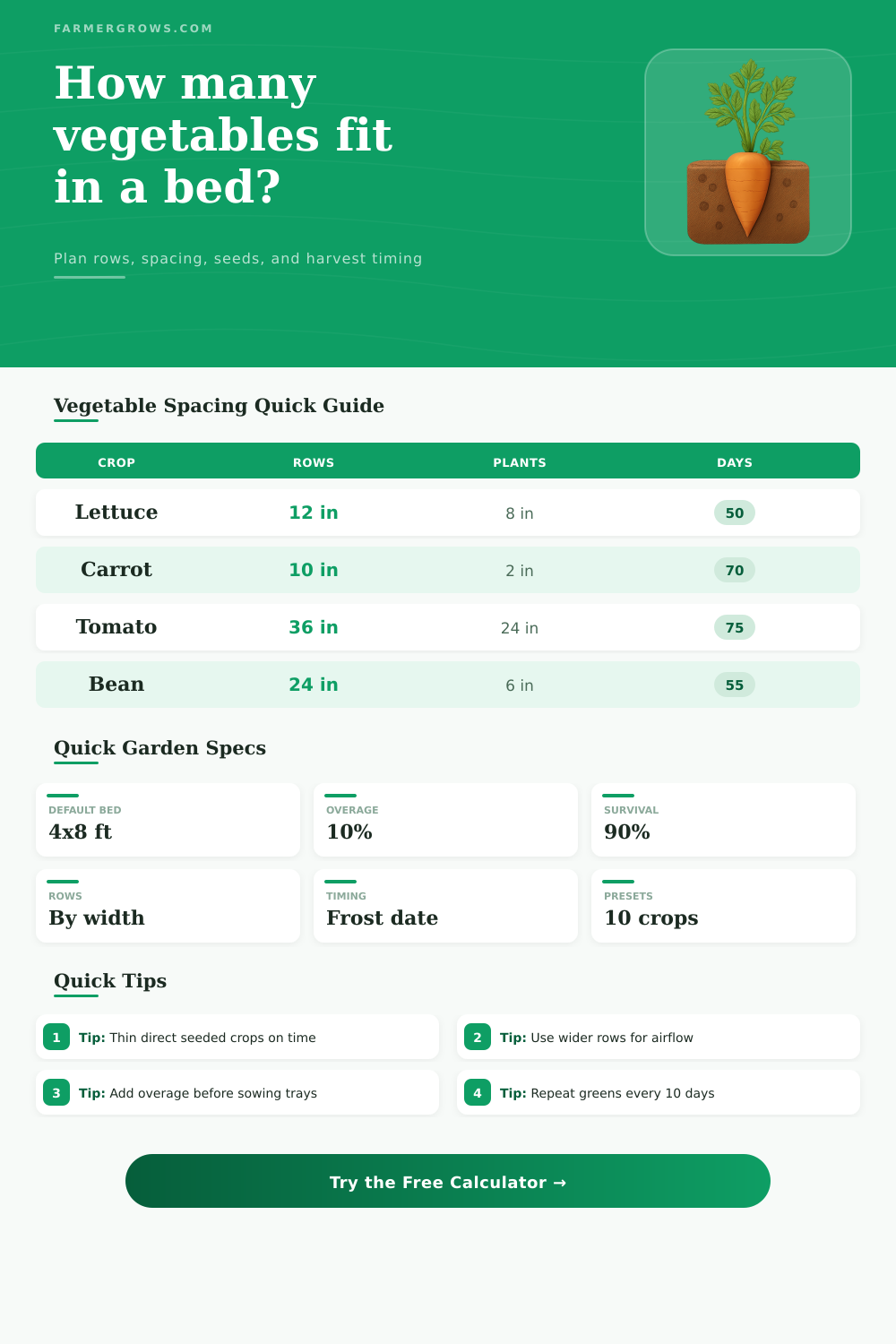
| Crop | Row spacing | Plant spacing | Typical method |
|---|---|---|---|
| Lettuce | 12 in / 30 cm | 8 in / 20 cm | Direct seed or transplant |
| Carrot | 10 in / 25 cm | 2 in / 5 cm | Direct seed |
| Tomato | 36 in / 91 cm | 24 in / 61 cm | Transplant |
| Pepper | 24 in / 61 cm | 18 in / 46 cm | Transplant |
| Kale | 24 in / 61 cm | 18 in / 46 cm | Direct seed or transplant |
| Cucumber | 48 in / 122 cm | 12 in / 30 cm | Direct seed or transplant |
| Bush bean | 24 in / 61 cm | 6 in / 15 cm | Direct seed |
| Broccoli | 30 in / 76 cm | 18 in / 46 cm | Transplant |
| Spinach | 10 in / 25 cm | 4 in / 10 cm | Direct seed |
| Zucchini | 60 in / 152 cm | 36 in / 91 cm | Direct seed or transplant |
| Crop | Direct seed timing | Transplant timing | Indoor lead |
|---|---|---|---|
| Lettuce | 28 days before frost | 14 days before frost | 28 days |
| Carrot | 21 days before frost | Not usually transplanted | 0 days |
| Tomato | After soil warms | 14 days after frost | 42 days |
| Pepper | After soil warms | 21 days after frost | 56 days |
| Kale | 28 days before frost | 21 days before frost | 35 days |
| Cucumber | 7 days after frost | 7 days after frost | 21 days |
| Bush bean | 7 days after frost | Not usually transplanted | 0 days |
| Broccoli | 21 days before frost | 28 days before frost | 42 days |
| Crop group | Good interval | Best season | Planning note |
|---|---|---|---|
| Leaf lettuce | 7 to 14 days | Cool spring, fall | Short intervals keep salad harvests steady |
| Spinach | 7 to 10 days | Cool spring, fall | Stop when hot weather is near |
| Carrots | 14 to 21 days | Spring, late summer | Thin early for even root sizing |
| Bush beans | 10 to 14 days | Warm season | Plant several short blocks |
| Cucumbers | 21 to 28 days | Warm season | Use a second sowing for fresh vines |
| Broccoli | 14 to 21 days | Cool spring, fall | Stagger starts for head maturity |
| Bed size | Lettuce plants | Tomato plants | Carrot positions |
|---|---|---|---|
| 3 x 6 ft | 27 plants | 3 plants | 108 positions |
| 4 x 8 ft | 48 plants | 8 plants | 192 positions |
| 4 x 12 ft | 72 plants | 12 plants | 288 positions |
| 5 x 20 ft | 150 plants | 40 plants | 600 positions |
Planning your vegetable garden requires that you consider the dimension of the garden bed. You must decide how many plants will fit in your garden bed. If you plant too many plants in your garden bed, the plants will crowd each other.
Too few plants will leave your garden bed with empty space. Many gardening enthusiasts can do counting the number of plants that you would like to grow in each garden bed by eye. However, estimating the number of plants that will grow by eye can lead to problem in your vegetable garden such as some of your plants bolting or your garden beds appearing to be empty of vegetable.
Plan your vegetable garden with a planting calculator
Instead, you can use math to determine exactly how many plants will fit into each garden bed. In order to determine how many vegetable will grow in your vegetable garden, you must make several decisions prior to planting any seed in your vegetable garden. First, you must decide upon a planting method for the vegetables that you will grow in your vegetable garden.
You must also determine the distance between the row of vegetables that will be planted in your vegetable garden. Additionally, you must also determine the distance between each individual plant of vegetables that will grow in each row. Finally, you must also consider the survival rate of the vegetable plant that will grow in your vegetable garden.
These factor will allow you to calculate the number of rows of vegetables that will grow in your vegetable garden. Additionally, the survival rate and overage will allow you to calculate the number of additional seed (or starts) that you will have to prepare in order to ensure that you still have the correct number of vegetables growing in your vegetable garden. One tool that can assist in calculating these various factor for your vegetable garden is a planting calculator.
A planting calculator will ask for the distance between the rows of vegetables that will grow in your vegetable garden, the distance between the individual plant of vegetables that will grow within each row, the last spring frost date in your area, and the type of vegetable that you would like to grow in each row of your vegetable garden. Based off these factor, a planting calculator can calculate for you the dates upon which you should begin to sow the seed for the vegetable starts that you will begin to grow in your vegetable garden. Additionally, a planting calculator can calculate for you the date upon which you can expect to begin harvesting vegetable from your vegetable garden.
The date upon which you begin to plant your vegetable starts is important in determining when your vegetables will be harvested because different vegetable require different timeframes to grow to maturity. For instance, vegetable starts such as lettuce need to be planted approximately every ten day in order to provide for a steady harvest of the plants. However, vegetables such as zucchini do not have to be sown every ten day because the vines of zucchini will cover the area around the plant and provide shade to those surrounding plant.
The last spring frost date will allow you to calculate how much lead time you will have for growing indoor plant. For instance, plants such as peppers and tomatoes need to be provided with six to eight week of indoor growth prior to placing these indoor plants outside into your vegetable garden. However, plants such as lettuce and kale will only require three to four week of indoor growth prior to being moved outside into the vegetable garden.
Additionally, you will need to decide when to begin each of these vegetable in order to ensure that the vegetable plant are not transplanted into your vegetable garden too early or too late. Such determination can be made with the assistance of your planting calculator. In addition to calculating when to begin sowing the seeds for your vegetables, the dimension of the vegetable garden can influence the method in which you will garden within that vegetable garden.
For instance, you may have long and narrow vegetable garden bed within your plot of land. These long and narrow vegetable garden bed will allow for more row feet than a group of square vegetable garden bed of the same total area. These long and narrow vegetable garden bed are beneficial for vegetables such as carrots and spinach, both of which grow in dense row within the vegetable garden.
Additionally, a wide vegetable garden bed will allow for easy access to the center of the vegetable garden plot. The wide vegetable garden bed can be helpful for allowing for easy access to the center of the vegetable garden without stepping on the growing vegetable. While the dimension of your vegetable garden will not impact the spacing calculation that must be made for your vegetable starts, the dimension of your vegetable garden may impact the ease with which you can weed your vegetable garden row.
In addition to the consideration of the dimension of your vegetable garden, you must also adjust for the survival rate and the overage of the vegetable start that will be growing within your vegetable garden. For instance, a survival rate of ninety percent may be too high for carrot that will be planted within heavy soil, but a survival rate of ninety percent may be too low for broccoli start that have been transplanted from indoors into the vegetable garden. You can adjust the survival rate for each of your vegetable start within the planting calculator to account for these difference.
Additionally, the overage of the start that you will grow within your vegetable garden will also impact the survival rate calculation that are performed by the planting calculator. For instance, an overage of ten percent may be appropriate for accounting for vegetable start that may be planted directly into the soil within your vegetable garden. However, an overage of twenty percent may be required if you begin to grow those start in an area within your vegetable garden that may dry out unevenly.
When you decide upon the distance between each of your vegetable start, you must also make certain of the consequence of that choice. For instance, if you choose to space the vegetables closely within each row of vegetables, you will be able to sowing more start into your vegetable garden. However, if the vegetables are spaced too closely together, there will be an increase in the development of plant disease within your vegetable garden.
Alternatively, if you space the vegetable start farther apart from one another within each row, you will find it easier to harvest the vegetables from each plant. However, if you space the plant too far apart from one another, you will require more vegetable garden bed or more succession planting of vegetable in order to produce the amount of vegetable that you require. Succession planting is the process of planting vegetable start at different time.
Fast growing vegetable, such as lettuce or spinach, are best sown at regular interval because spinach and lettuce plant will finish growing before the weather within your vegetable garden change. However, slow growing vegetable, such as broccoli or tomatoes, are best planted at longer interval because broccoli and tomatoes will occupy each vegetable garden bed for many month. While many vegetable gardener make mistake, you can avoid these mistake by using your vegetable garden planting calculator.
For instance, one of the mistake that many vegetable gardener make is copying the recommended planting spacing for vegetable start from one gardening resource, yet the vegetable start that are copied from that resource may have been suggested for use within a different soil type or climate than the type of soil and climate within your vegetable garden. Additionally, another mistake is that some vegetable gardener do not consider that the spacing recommendation for vegetable start can change based upon the stage at which the vegetable are to be harvested. For instance, baby leaf lettuce should be planted at a much closer spacing than lettuce start that are to be allowed to grow into full sized plant.
Additionally, many vegetable gardener make another mistake by failing to recognize the difference between direct seeding and transplanting vegetable start. For instance, direct seeded bean need to be planted after the last spring frost date, but transplanted tomato only need to be planted roughly two week after the last spring frost date. In each of these instance, the offset field within your planting calculator will help to prevent the garden mistake of other vegetable garden owner.
If you take the time to carefully calculate the number of plant that will grow in each row within your vegetable garden, you will have a vegetable garden in which your row are even with the number of vegetable that are to be grown in each row. Additionally, you will have a vegetable garden in which the vegetable will be harvested at the time of your choosing. Performing these calculation for each vegetable start that you wish to grow in your vegetable garden will ensure that you do not have to purchase additional start during the growing season.
Additionally, you will not have empty space within your vegetable garden. Finally, you will be able to avoid overcrowding of your vegetable plant, which can lead to thinning or the plant losing the resource that they require in order to grow to maturity. Thus, a vegetable planting calculator can assist in the planning of your vegetable garden so that you can be certain that each of your plant will have even number within each row, your vegetable will be harvested at the time that you would like to eat them, and the timing of your planting effort will be even within your vegetable garden.