Tree Planting Density Calculator
Estimate planted trees, surviving stand, trees per acre, row-foot needs, alley loss, buffer-row effect, canopy fit, and irrigation zone load from a practical orchard, timber, nursery, or windbreak layout.
Use planted acres, not the total farm deed acreage. The calculator treats the block as an approximate square so buffer rows can be estimated from area when exact length and width are not known.
Tree density result
Spacing, alleys, buffers, mortality, and irrigation zones are combined below.
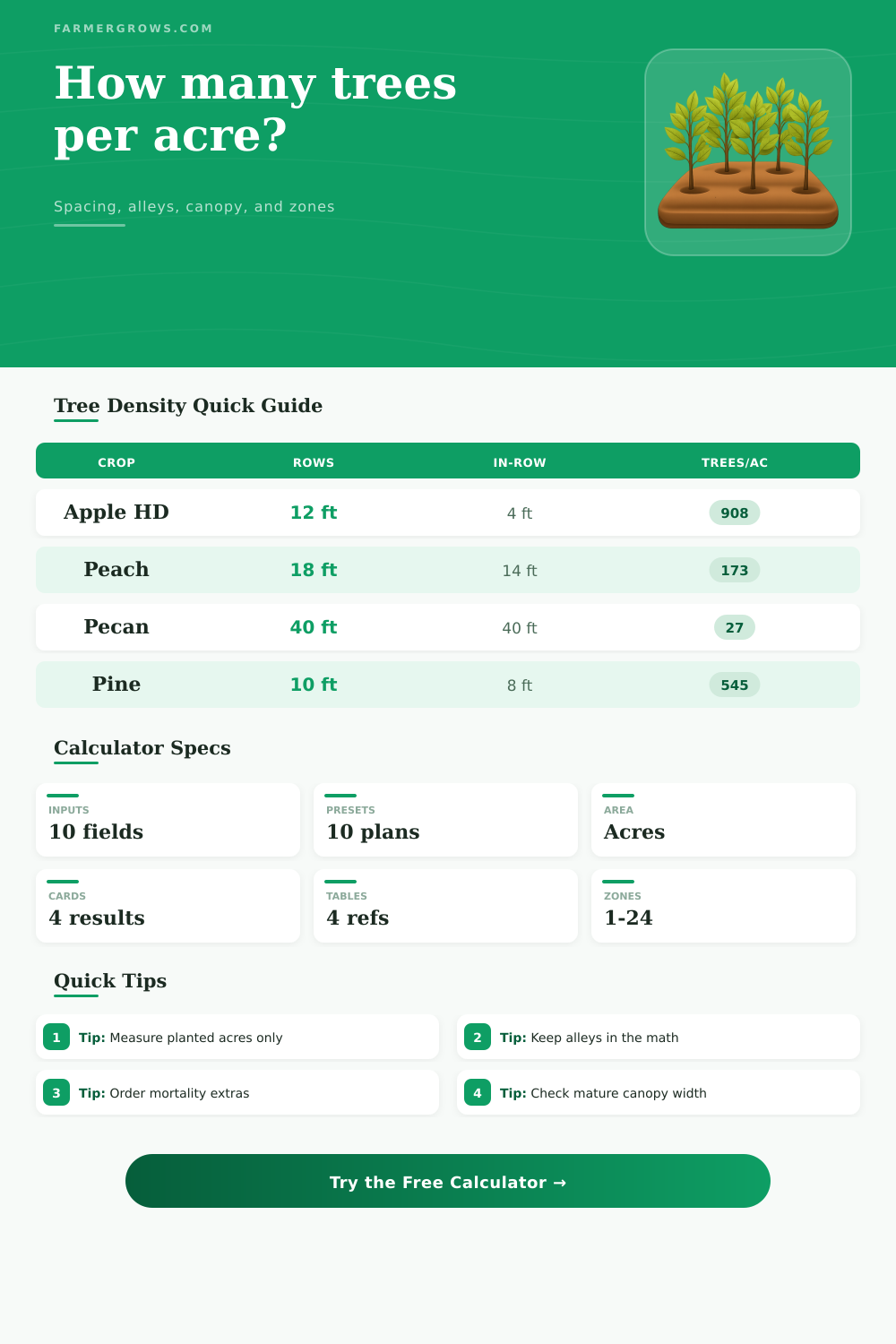
| Tree crop | Typical row spacing | Typical in-row spacing | Planning note |
|---|---|---|---|
| High-density apple | 10 to 14 ft | 3 to 5 ft | Trellis, dwarf rootstock, and drip zones usually drive the layout. |
| Semi-dwarf apple or pear | 16 to 20 ft | 10 to 14 ft | Leave enough access for pruning, harvest, and sprayer turns. |
| Peach or nectarine | 16 to 20 ft | 12 to 16 ft | Open centers need good light on both sides of the row. |
| Citrus grove | 18 to 24 ft | 10 to 16 ft | Canopy management and frost movement often set the final spacing. |
| Pecan, chestnut, large nut trees | 35 to 45 ft | 35 to 45 ft | Wide mature canopy or planned thinning is usually required. |
| Pine or timber hardwood | 8 to 12 ft | 6 to 10 ft | Target surviving stems per acre after establishment losses. |
| Row spacing | In-row spacing | Square feet per tree | Base trees per acre |
|---|---|---|---|
| 10 ft | 4 ft | 40 | 1,089 |
| 12 ft | 4 ft | 48 | 908 |
| 14 ft | 6 ft | 84 | 519 |
| 18 ft | 14 ft | 252 | 173 |
| 25 ft | 20 ft | 500 | 87 |
| 40 ft | 40 ft | 1,600 | 27 |
| Layout feature | Calculator treatment | Why it matters | Field check |
|---|---|---|---|
| Alley width | Adds extra row pitch after the selected row interval. | Service lanes reduce plantable density but protect access. | Measure equipment width plus safe turning room. |
| Alley interval | 0 means alley is already included in row spacing. | Avoids double-counting roads and harvest lanes. | Count planted rows between drive alleys. |
| Buffer rows | Estimated as perimeter width on an approximate square block. | Edges often carry wind, fence, access, or pollinator space. | Use exact block dimensions for final staking. |
| Mortality percent | Reduces expected surviving stand and increases order count. | Young trees can fail from drought, rodents, or poor planting. | Base it on local establishment records. |
| Planting type | Common zones | Watch item | Practical target |
|---|---|---|---|
| Small orchard block | 1 to 3 | Uneven pressure at row ends | Keep similar row lengths in each valve zone. |
| High-density trellis | 4 to 12 | Emitter flow multiplied by many trees | Split by row groups, slope, and water source capacity. |
| Nut orchard | 2 to 8 | Long lateral runs | Use larger zones only when pressure stays even. |
| Timber establishment | 1 to 6 | Temporary watering plan | Size zones for the first two summers if irrigated. |
Tip: Walk the block before ordering trees. Wet corners, gateways, power lines, and turnarounds can remove more trees than the spacing formula suggests.
Tip: Use mature canopy width as a warning flag, not the only rule. Rootstock, pruning system, variety vigor, and equipment access can justify tighter or wider spacing.
When you plan to plant a tree farm, there are several decisions you must make early in the planning process. Your early decisions will determine whether your tree farm project is manageable or becomes expensive. The number of trees you will order based on your calculation will affect your project.
If you calculate the number of trees you will plant correct, the remaining aspects of managing your farm will be easier for you to plan. However, if you calculate the number of trees incorrectly, you may have too few trees in your field. The spacing between the rows of trees and the number of trees within each row is the first factor to consider.
Plan How Many Trees to Plant and How Far Apart
Many individual will overlook the service alleys and other areas that trees cannot be planted. This will affect the number of trees in your farm. The actual area where trees are planted will be less than the theoretical number of trees because of the width of planting equipment required to plant trees within each row.
You must account for the width of your planting equipment when planning your farm. Mortality is another factor that will impact the number of trees you order. Trees will not survive the first two year that they are established within your farm.
Trees may not survive due to drought, rodents, or errors when they are first planted. You must order a certain number of reserve trees in case these die during your first two years. Ordering reserve trees will ensure that when these die, you can replace them with similar nursery stocks.
However, there is a challenge in determining the exact number of trees that will die during these first two years. The buffer rows around the trees in your planting areas will perform several functions. These rows will protect the trees from wind or allow space for tracks to access the trees.
These buffer rows will affect the number of trees that can be planted in your farm. The irrigation zones that you establish in your farm will also impact the number of trees. Several irrigation zone can make it easier to manage the water for your trees.
However, they will fragment the planting areas for growth. Different types of crops require different spacing for optimal growth. For example, apple trees have high-density plantings because they will grow to become small trees when pruned.
However, pecan and walnut trees will grow vigorously and could experience canopy collision if you plant them with tight spacing like pecan or walnut trees. Pinus plantations require high initial planting densities because the goal is to produce large volume of timber early in a plantation. Additionally, peach trees require space for light to reach the sides of the tree rows.
This affects the pruning strategy for the peach trees in the plantation area. You should walk the planting area before you begin to plant trees. A map of the farm will not show features that will prevent the planting of trees.
Features such as wet spots, power lines, gateways, or slope changes will reduce the area in which trees can be planted. By walking the farm, you will determine the number of trees to order for the plantation. You can also determine how many additional reserve trees to order to account for mortality.
The reference tables included with the calculator will show the typical spacing of trees in common crops. These tables are not exact, but they will give you a starting point based on the type of trees you are planting. The alley and buffer planning table will show you how the layout of the farm will impact the number of trees you can grow in your planting area.
The layout features impact the number of trees that can be planted in your field. The canopy width of the trees when they reach maturity can impact the spacing between the trees. For instance, if the trees will spread out twenty feet but only have room for fourteen feet between each tree, there will be conflict between the trees.
These conflicts will lead to shading of the trees and the reduction in production of the lower branches. Additionally, there will be the development of disease in these lower branches. Therefore, adjusting the spacing between the trees when they are young will be easier than fixing the problems caused by overcrowded trees when they begin to overgrow.
The calculator contains mathematical equation that will calculate the number of trees based on the information that you enter into the calculator. The four specific numbers that the calculator will generate are the total number of trees to order, the number of surviving trees, the planting density, and the number of trees per irrigation zone. Using these numbers, you will have a target for the number of trees to be planted in your farm.
You can also use the calculator to test different scenarios for your farm. This calculator cannot account for all variables. For instance, it cannot account for the quality of the soil on your land or the weather patterns in your region.
The equipment that you use to plant trees may impact whether the number of trees calculated by the calculator will work on your farm. The numbers generated by the calculator will give you a starting point for planning your tree farm. However, you can adjust these numbers after you visit the plantation area.
Combining the numbers with your observation of the area will allow you to create a successful plan for your tree farm.