Cotton Seeding Rate Calculator
Estimate cotton seed drop, pounds of seed, bag needs, row-foot spacing, and expected stand from field acres, seed quality, and variety type.
Cotton Seeding Plan
| Final stand | Establishment | Seed per acre | Use case |
|---|---|---|---|
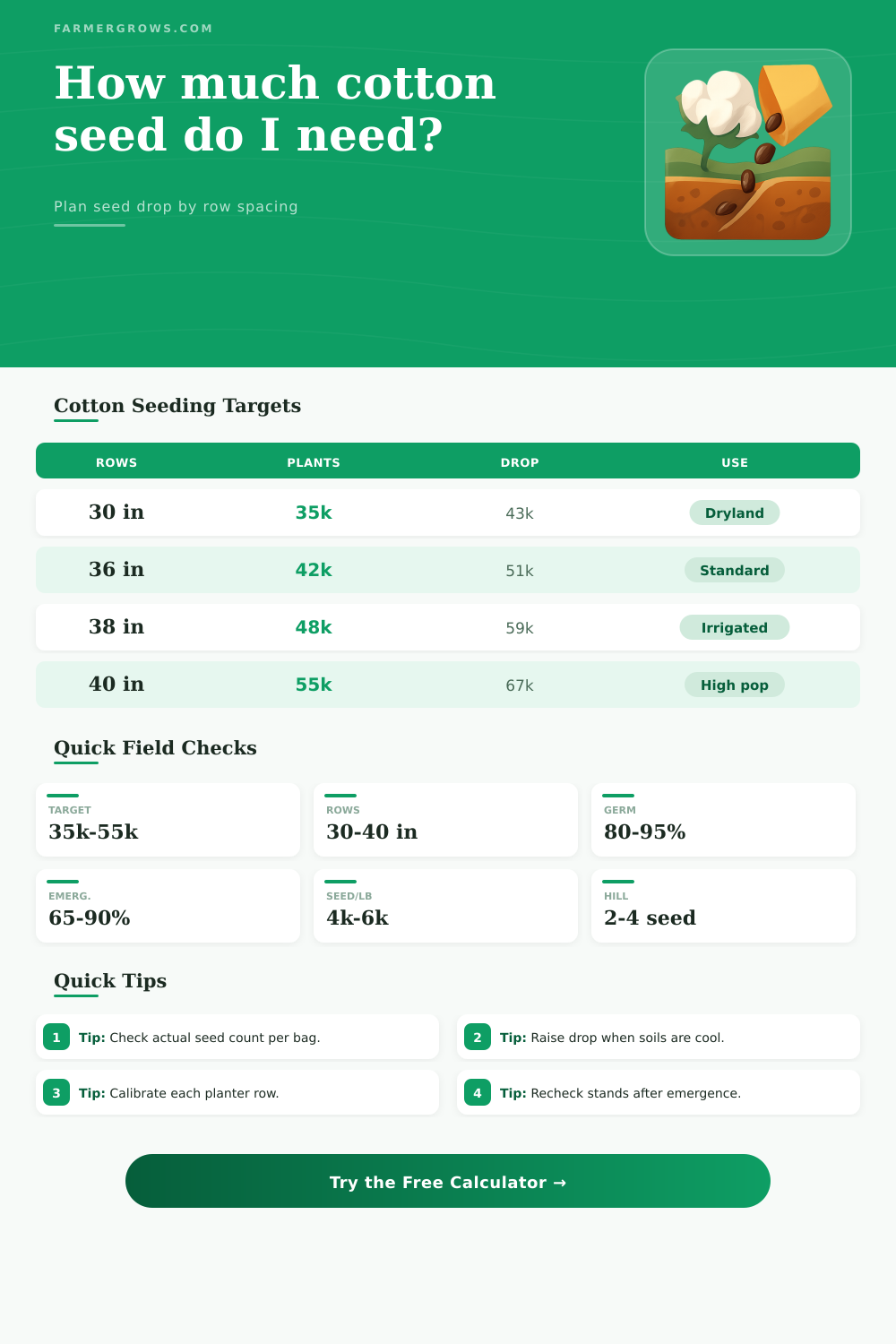
| 30,000 plants/ac | 72% | 41,700 seed/ac | Conservative dryland or skip-row fields |
| 38,000 plants/ac | 76% | 50,000 seed/ac | Moderate dryland with good moisture |
| 45,000 plants/ac | 78% | 57,700 seed/ac | Typical full-season picker cotton |
| 52,000 plants/ac | 80% | 65,000 seed/ac | Irrigated or narrow-row management |
| 60,000 plants/ac | 82% | 73,200 seed/ac | High population or replant rescue target |
| Row spacing | Row feet per acre | 2.5 seed/ft spacing | 3.5 seed/ft spacing |
|---|---|---|---|
| 30 inches | 17,424 row ft | 4.8 inches | 3.4 inches |
| 32 inches | 16,335 row ft | 4.8 inches | 3.4 inches |
| 36 inches | 14,520 row ft | 4.8 inches | 3.4 inches |
| 38 inches | 13,756 row ft | 4.8 inches | 3.4 inches |
| 40 inches | 13,068 row ft | 4.8 inches | 3.4 inches |
| Seed per pound | Seed in 50 lb bag | Pounds for 60k/ac | Acres per 50 lb bag |
|---|---|---|---|
| 4,000 seed/lb | 200,000 seed | 15.0 lb/ac | 3.3 acres |
| 4,500 seed/lb | 225,000 seed | 13.3 lb/ac | 3.8 acres |
| 5,000 seed/lb | 250,000 seed | 12.0 lb/ac | 4.2 acres |
| 5,500 seed/lb | 275,000 seed | 10.9 lb/ac | 4.6 acres |
| 6,000 seed/lb | 300,000 seed | 10.0 lb/ac | 5.0 acres |
| Check point | Field measurement | Calculator link | Adjustment signal |
|---|---|---|---|
| Seed drop | Count seed in 10 row feet | Seed per row foot | Meter or vacuum change needed |
| Seed spacing | Measure distance between seed | In-row seed spacing | Too tight raises doubles risk |
| Hill-drop | Count seed per hill and hill gap | Hill equivalent | Hill count must match acre target |
| Emergence | Count live plants after stand set | Expected stand | Compare actual stand to target |
| Bag use | Track bags by field acres | Total pounds and bags | Large gap may show calibration drift |
Achieving a correct cotton populations for your fields is a necessary step in managing your crop. The cotton population that you establish in your fields will determine your eventual yields. If the population levels are too low, your cotton yield will be lower then the maximum possible yield.
If the population levels are too high, the cotton stands will compete with one another for light and moisture resources, and you will spend more moneys on seed than necessary. Thus, you must calculate the proper amount of cotton seed to plant based off your target cotton population. Row spacing will have an effect on the cotton population that develops in your fields.
How to Calculate Cotton Seeding Rates
Row spacing will determine how many cotton plant are growing in each foot of row. If the rows are wider than others in the field, there will be fewer “row feet” in a given acre of field area. Thus, each foot of row will have to contain more plants in order to achieve the same final stand of cotton plants.
If the row spacing is narrower in the field, there will be fewer individual cotton plants in each row. Narrower rows can help the cotton plants if there is less moisture available in the soil. You must ensure that your soil can handle the cotton population that you would like to establish in your fields.
The row spacing and soil conditions will determine if your targeted cotton population are successful in your fields. The size of the cotton seed will have an impact upon the total number of seeds that are contained within each bag of seed. If bags contain 4,000 seeds per pound of cotton seed, there will be fewer seeds within the bag than bags of 6,000 seeds per pound.
Thus, the bag of 4,000 seeds per pound will allow you to plant fewer acres of cotton than bags of 6,000 seeds per pound. You should check the tag of the bag of cotton to determine the actual number of seeds in the bag. If you dont check the number of seeds in each bag, you may find that you deplete your bag of seed prior to completing planting of your fields.
You must calculate two different measurements of cotton emergence rates to determine the proper amount of seed to plant in your fields. Germination rates are calculated based upon the ability of the cotton seed to germinate under ideal conditions. Field emergence rates are calculated based upon how well the cotton seed can emerge in the actual field conditions.
Several factors can affect field emergence, including soil temperature, soil crusting, soil insects, and planting depth. Each of these variables can reduce the emergence rate of the cotton in the fields. Both emergence measurements must be used in calculating the proper amount of cotton seed to plant in your field.
Hill-drop planting methods involve dropping several seeds at wide intervals rather than planting individual seeds in each portion of the field. The goal of hill-drop planting is the same as other cotton planting methods. However, hill-drop planting methods differ from others in the planter settings that are used for hill-drop planting methods, and in the advantages and disadvantages of hill-drop planting methods.
Hill-drop planting methods can be preferred in fields with cool soil temperatures, as dropping several seeds into each planting hill will ensure that at least one of the seeds will germinate. However, people sometimes avoid hill-drop planting methods because they are difficult to visually inspect the rows for skipped or doubled planting points. A calculator can help you to compare hill-drop planting methods to others in your fields to determine which is best for your field.
The type of cotton that you plant can impact the population that should be planted in each field. For example, stormproof cotton varieties can handle higher populations than varieties that are not stormproof. Pima cotton varieties may have to be spaced differently from other varieties due to the requirement of maintaining the length of the cotton fiber.
Early maturity varieties of cotton may require higher rates of seed to be planted due to the potential emergence issues with planting in cooler soil during the spring. Thus, cotton variety influences the cotton population that develops in the fields. Tables exist that show the relationship between the number of seeds in a pound, row spacing, and the number of acres that can be covered with a bag of cotton seed.
These tables are helpful in determining whether you need to order additional bags of cotton seed. Additionally, these tables can help you to determine the total pounds of seed that you will need to plant all of the acres within your fields. Understanding how the size of cotton seed and the width of the rows impact the total pounds of cotton seed that is required for your fields is essential knowledge for managing your costs.
Fields are not often the same as the models that calculate cotton populations. Some parts of a field may have heavier soil types than others, and the soil crusting can prevent emergence of some of the planted cotton. Other areas of the field may have sandy soil that dries out quickly.
The wind may impact the emergence of cotton stands in particular areas of the field. Because fields are often not the same, it is important to count the number of cotton plants that emerge in each portion of the field. Thus, you should use the calculator to determine an initial cotton population to be planted in the field.
However, the actual count of cotton plants in each part of the field will help adjust your plans for future planting areas. You should consider your seeding rate a deliberate decision. To calculate your cotton seeding rate, you will need to know the population goals for your fields, the row spacing for your fields, the count of the cotton seeds in each bag of seed, and the emergence rate of your planted cotton.
The actual calculation of these variables is relatively easy. However, you will need to establish an honest emergence rate for your fields. An honest emergence rate will allow you to prepare for the actual conditions in which the cotton will germinate, rather than preparing according to ideal conditions.