Oats Seeding Rate Calculator
Set an oats planting rate from target plants per square foot, seeds per pound, germination, purity, expected emergence, row spacing, drill loss, acres, and use type.
Choose a preset or enter your seed tag numbers. The calculator treats the target as established plants, then backs into seeds and pounds using germination, purity, field emergence, and drill loss.
Moderate stand with enough tillering space for headed oats and harvestable grain.
Thicker canopy for hay, silage, or green chop where stem count matters more than tiller size.
Quick soil cover and fall biomass. Increase for late planting or broadcast establishment.
Lower competition while alfalfa, clover, or pasture seedlings establish underneath.
Oats seeding result
The target stand and seed quality drive the final pounds per acre.
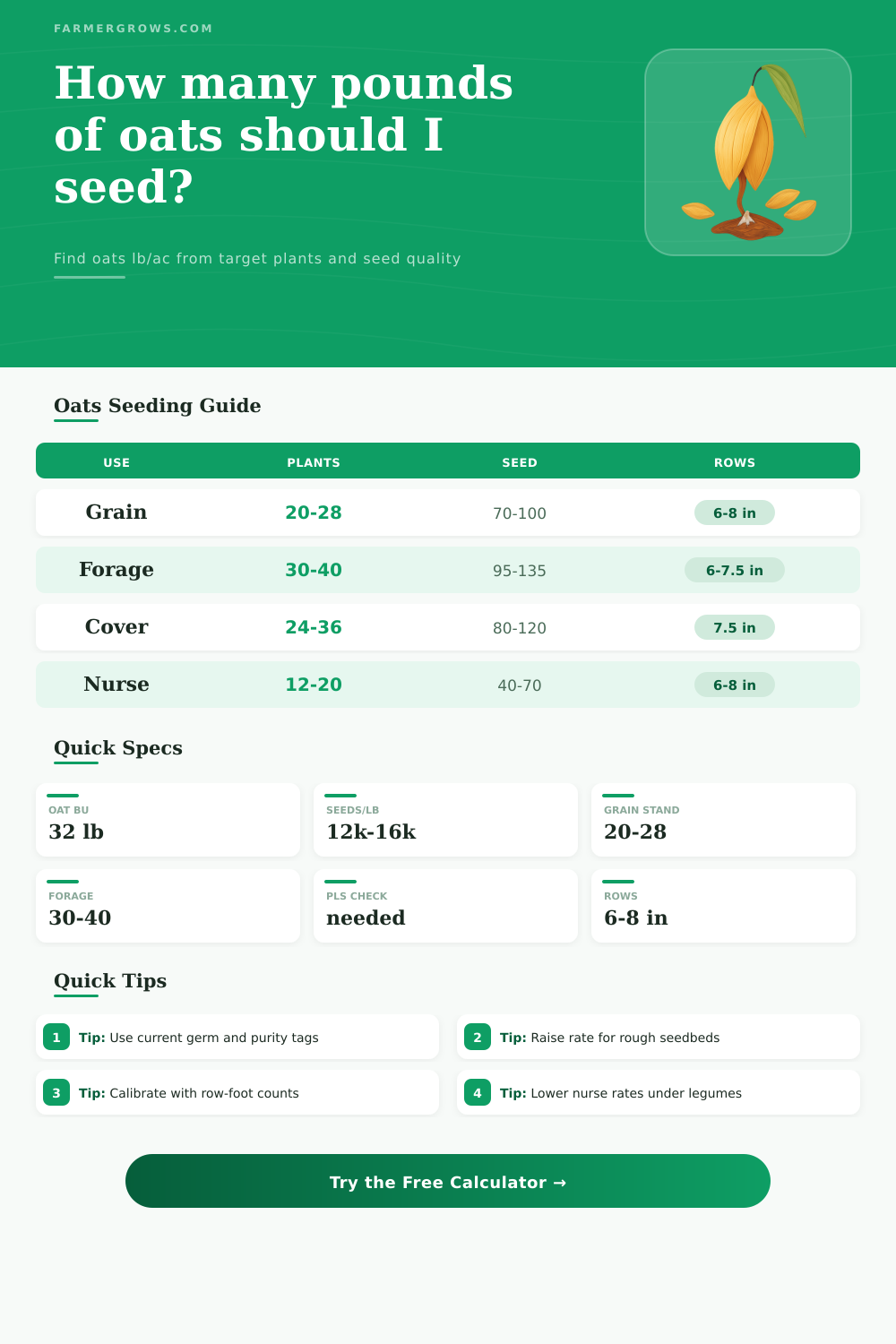
| Oats use | Target plants per sq ft | Typical lb/ac range | Stand note |
|---|---|---|---|
| Spring grain | 20 to 28 | 70 to 100 | Lower end where tillering is strong and seedbed moisture is good. |
| High yield grain | 24 to 32 | 85 to 115 | Use with quality seed, firm seedbed, and timely planting. |
| Forage hay or silage | 30 to 40 | 95 to 135 | Thicker stems close canopy faster for forage harvest. |
| Cover crop | 24 to 36 | 80 to 120 | Increase for late planting, rough residue, or broadcast seeding. |
| Nurse crop over legumes | 12 to 20 | 40 to 70 | Reduced rate limits competition with alfalfa or clover seedlings. |
| Seed lot condition | Seeds per lb | Germ and purity example | Calculator effect |
|---|---|---|---|
| Large plump oats | 10,000 to 12,500 | 92% germ, 98% purity | Fewer seeds per pound raises lb/ac for the same plant target. |
| Average cleaned oats | 12,500 to 15,500 | 90% germ, 97% purity | Good default range when the seed tag is not unusually large or small. |
| Small light seed | 15,500 to 18,500 | 85% germ, 96% purity | More seeds per pound can lower lb/ac, but poor vigor may reduce emergence. |
| Bin-run or farm-saved | Variable | Test before planting | Use a lab germination and cleanout estimate before setting the drill. |
| Row spacing | Row feet per acre | Seeds per row ft at 1,000,000 seed/ac | Calibration use |
|---|---|---|---|
| 6 in | 87,120 | 11.5 | Narrow grain drills spread oats evenly and close rows fast. |
| 7.5 in | 69,696 | 14.3 | Common small-grain drill spacing for oats and cover crops. |
| 8 in | 65,340 | 15.3 | Slightly higher row-foot count is expected than 7.5 inch rows. |
| 10 in | 52,272 | 19.1 | Watch in-row crowding if pushing high forage or cover rates. |
| Scenario | Rate tendency | Emergence assumption | Field adjustment |
|---|---|---|---|
| Early spring, firm seedbed | Normal | 85% to 92% | Use tested germination and modest drill loss. |
| Cold or crust-prone soil | Higher | 70% to 85% | Lower the emergence field so the seed rate rises transparently. |
| Broadcast and pack | Higher | 65% to 82% | Use more drill loss because seed placement is less uniform. |
| Nurse crop over legumes | Lower | 80% to 90% | Reduce the plant target so oats do not smother the new legume. |
| Late fall cover crop | Higher | 60% to 80% | Raise target or reduce emergence if cold days limit tillering. |
Oat flow changes with seed size, treatment, and humidity. Catch seed from several openers, count row-foot drop, and compare it with the calculator output.
Germination and purity describe the bag. Emergence and drill loss describe the field pass, so keep both sets of numbers visible when adjusting rates.
This tool estimates agronomic seeding rate only. Local variety, disease pressure, planting date, and extension recommendations can shift the best target for a specific farm.
To determine the correct seeding rate for oats, a grower must begin the process of calculating the seeding rate prior to utilizing the drill to plant the oats within a field. The seed tag for the selected variety of oats contain information regarding the seeding rate for those specific oats; however, many growers dont utilize the information on the seed tag correctly, instead utilizing the seeding rate that was utilized the previous growing season for oats. The seeding rate for that type of oat in the previous year may have been established under different weather conditions, with different sized oats, or even for different intended uses for those oats.
Each of these factors can potentially lead to either a thin stand of oats or an overcrowded stand of oats, both of which will negatively impact the quality of the forage that can be obtained from those acres of planted oats. The first step in calculating the correct seeding rate for oats in a field is to determine the purpose for which the oats will be used. If the oats will be used to produce grain, the stand of oats will need to have enough space to allow for each oat plant to mature and produce grain.
How to Decide How Much Oat Seed to Use
If the oats will be used as forage for livestock, it is necessary to establish a thick stand of oats that will provide adequate forage for the animals. Additionally, cover crops may require a different seeding rate for oats than forage crops, and nurse crops are typically established at a lower rate than the other types of oats because the nurse crop will be used to provide light to other crops, such as legumes. Beyond determining the purpose of the oats, other factors affects the seeding rate of oats.
For example, the size of the seeds can impact the seeding rate. Each lot of oats has a germination rate of around 92%, for instance, but the pounds of oats that is required to achieve the necessary stand may be different from another lot of oats with the same germination rate due to the fact that one type of oat may be larger than the other. In this case, the grower should enter the actual number of seeds per pound from the seed tag into a calculator to determine the seeding rate rather than using an average number of seeds per pound for oats.
In addition to the size of the seeds, another factor that can influence the seeding rate is the germination and purity rate of the oats. The germination and purity rate allows for the estimation of the number of pure live seeds for those particular types of oats; however, this does not account for all of the different factors of the field. For instance, the germination and purity rate only accounts for the number of pure live seeds in the bag, but not for how the condition of the field in which they are to be planted may impact the emergence of those oats.
Factors like emergence percentage and drill loss can be utilized to adjust for the germination and purity percentage rates to provide an estimation of the actual number of oats that will emerge from the field. Additionally, the row spacing in which the field will be planted can impact the seeding rate. For instance, if the rows are narrower than the acres in which the oats are to be planted, each pound of oats will result in fewer oats per foot of row.
Thus, the grower can calculate the rate of oats that are to be planted in relation to the number of oats per foot of row, which allows the grower to simply count the number of oats that emerge from the drill openers. Another factor to consider when calculating the rate at which oats are to be seeded into the field is the total acres that will be planted with oats and the size of the bags of oats that is to be used. Determining the total amount of oats that are required for the field will prevent the situation where the grower runs out of seed prior to planting all of the acres of oats that are to be planted.
Similarly, calculating the amount of seed that is required will prevent the situation where there are extra bags of oats to be stored after the planting of those acres. In addition to field conditions, other factors that impact the rate at which the oats are to be planted into the fields include the use of those oats. For instance, if the oats are to be used as a nurse crop for alfalfa plants, fewer oats will be planted than if those oats were to be used as forage for livestock.
Although the type of oats is the same, the target stand that the planting of the oats into the field is to be established by and the use of the alfalfa can change the seeding rate of those oats. Thus, the seed quality and the stand that is to be planted are two separate concepts that the grower should consider, as the rate of oats to be planted should not be based off the goals that the grower may have utilized during the previous year. Another consideration in determining the seeding rate for oats is in the calibration of the drill that is to be used to plant the acres of oats.
While calculators can provide an estimation of the rate at which the oats are to be planted, the calculator cannot account for issues like the drill becoming out of adjustment, or various types of oats having different rates of movement through the drill. By catching the oats that emerge from the drill openers, they can be weighed to ensure that the seeding rate that emerges is similar to that calculated by the calculator. By comparing the two quantities, the grower can save time by avoiding replanting the field with a thin stand of oats or by spraying an overly thick stand of oats.
Overall, to determine the seeding rate for oats in a field, the grower can begin by establishing a target stand of oats for the field. That target stand can then be adjusted according to the use of the oats. The rate of oats in the bag can be translated into the amount of pure live seed in each bag.
Additionally, allowances can be made for the different field conditions. Finally, the grower can calibrate the drill to ensure that the amount of oats that emerge from the drill is similar to that calculated by the calculator.