🐄 Livestock Weight Calculator
Estimate livestock tape weight from heart girth, body length, hip height, frame score, body condition, age class, sex class, species formula, and handling shrink.
Choose a realistic animal profile to seed the measurements, then adjust the tape readings, frame score, condition, age class, sex class, and shrink for the animal in front of you.
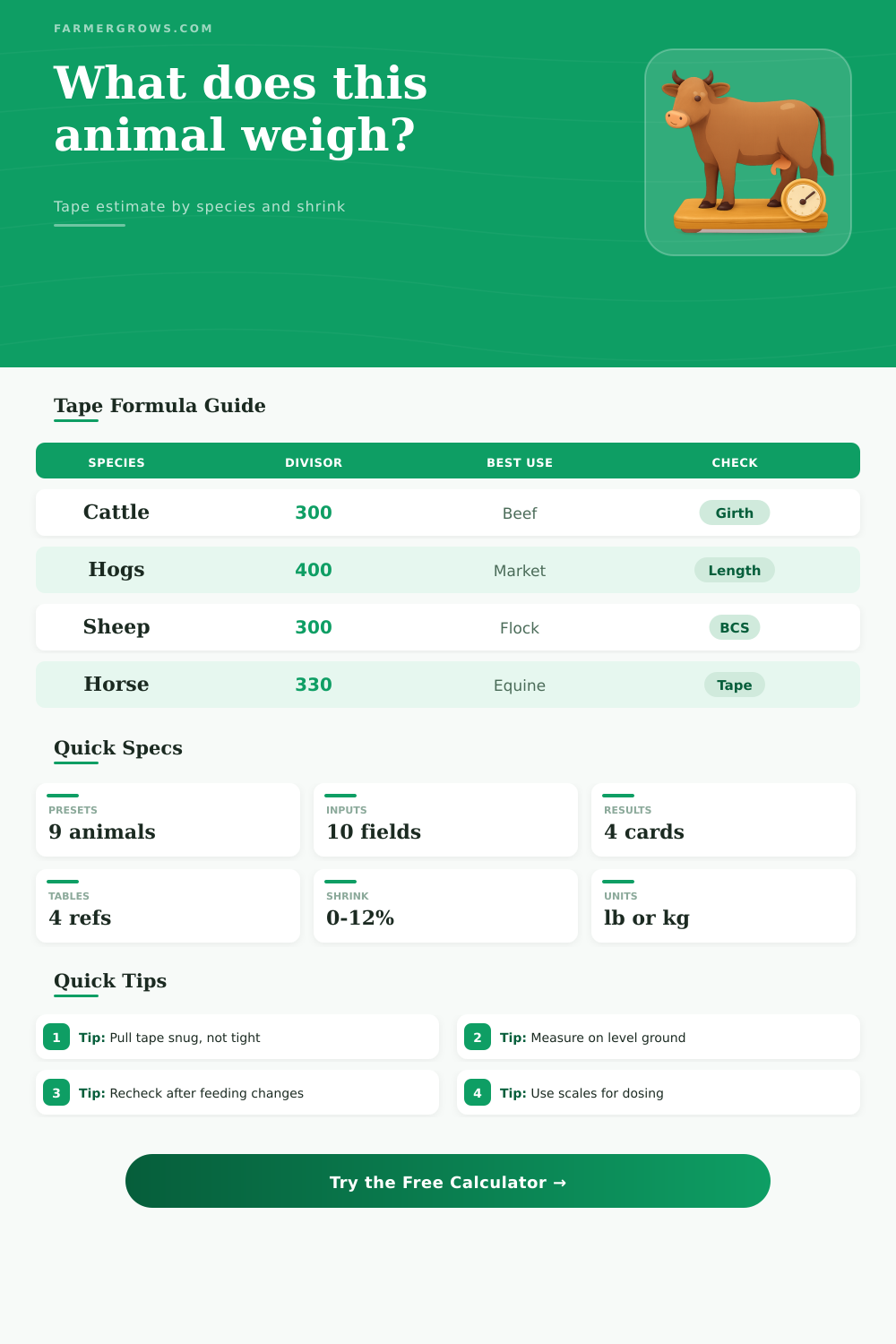
lb = HG² x BL / 300Best for cattle measured behind the front legs and from shoulder point to pin bone.lb = HG² x BL / 400Uses a larger divisor because hogs carry depth and length differently than ruminants.lb = HG² x BL / 300Works as a flock screening estimate; fleece, pregnancy, and gut fill can move the result.lb = HG² x BL / 330Included for mixed farms that use weight tape checks on equine or alpaca-style frames.Estimated Tape Weight
Tape-based estimate with species formula, condition adjustment, frame check, and shrink allowance.
| Species group | Heart girth point | Body length point | Common tape issue |
|---|---|---|---|
| Cattle | Immediately behind front legs and over withers | Point of shoulder to pin bone | Tape too loose behind elbow |
| Hogs | Behind front legs at the widest heart girth | Between ears to tail base, following top line | Short length on arched hogs |
| Sheep | Behind front legs, compressing fleece lightly | Shoulder point to dock or pin area | Fleece and pregnancy inflate girth |
| Goats | Behind front legs over the heart girth | Shoulder point to pin bone or tail-set | Deep-bellied dairy does read heavy |
| Horse or camelid | Behind elbow over the highest wither point | Shoulder point to buttock or rump point | Very refined frames can read light |
| Class | Typical adjustment | Why it matters | Best use |
|---|---|---|---|
| Young growing | -2% to +0% | Less mature muscle and frame fill | Calves, lambs, kids, feeders |
| Yearling or replacement | -1% to +1% | Frame and depth are still changing | Replacement heifers, gilts, ewe lambs |
| Mature female | 0% to +2% | Depth, pregnancy, and rumen fill vary | Cows, ewes, does, sows |
| Breeding male | +2% to +5% | Neck, shoulder, and muscle mass add weight | Bulls, rams, bucks, boars |
| BCS on 1-9 scale | Condition class | Calculator adjustment | Field note |
|---|---|---|---|
| 1.0 to 3.0 | Thin | -5% to -2% | Tape formula can overstate usable weight |
| 3.25 to 5.0 | Moderate | -2% to 0% | Good range for routine herd sorting |
| 5.25 to 7.0 | Good to fleshy | 0% to +3% | Often closest to tape expectations |
| 7.25 to 9.0 | Over-conditioned | +3% to +6% | Fat cover increases girth quickly |
| Situation | Typical shrink | Use in calculator | Watch point |
|---|---|---|---|
| Quiet pasture check | 0% to 2% | Use low shrink for same-day sorting | Gut fill may be high after feeding |
| Held off feed briefly | 3% to 5% | Common planning value for farm handling | Water access changes the result |
| Sorted, loaded, and hauled | 5% to 8% | Use for sale barn or haul estimates | Heat and stress add variation |
| Long stand or rough haul | 8% to 12% | Use only when conditions justify it | Rehydration rebound can be large |
Tape formulas are planning estimates. Use a calibrated scale for medication dosing, legal sale weights, show entries, transport paperwork, or any decision where exact weight is required.
Stand the animal square on level ground and measure the same anatomical points each time. A one-inch girth difference can move large-animal estimates by many pounds.
Hair, fleece, mud, pregnancy, gut fill, and posture all affect tape readings. Compare the center estimate with the low and high range before sorting animals.
In order to complete many tasks on the farm, it is necessary to have an accurate weights for each of the livestock on the farm. Tasks like sorting livestock for sale, providing feed to the livestock, or determining if a heifer is ready to breed all require that an accurate weight be obtain for each of the animals on the farm. Many farms dont have a scale for every animal on the farm, and the daily handling of the animals can alter the weight of those animals.
You can estimate the weight of the animal by taking the tape measurement of the animal both around the heart girth and along the length of the animal. Each of these measurements can be entered into a calculator that will provide an estimate of the weight of the animal, as well as account for some of the factors that can make an estimated formula inaccurate. The farmer will measure the heart girth of the animal behind the front legs of the animal, and the heart girth will provide a measurement of the depth and frame of the animal.
How to Estimate Farm Animal Weight
The length of the animal will be measured from the shoulder of the animal to the pin bone or tail set of the animal. Each of these measurements will contribute to the calculation of the weight of the animal, but that base weight will need to be adjusted according to the frame of the animal, the condition of the animal, the age of the animal, and the sex of the animal. The frame score of the animal is important in that an animal that is tall and has a long body may have the same heart girth as an animal that is shorter and has a shorter body, but the tall, long-bodied animal may weigh more or less then the shorter animal.
The condition score of the animal is also important in that an animal that has extra fat may have a larger heart girth than an animal that does not have as much fat, but the two animals may have the same body weight. The age and sex of the animal may also require adjustment to the base weight; young animals may weigh less than an animal of the same frame that is more mature, and breeding males will have more muscle in the neck and shoulder area than a female of the same age. In addition to these factor, the weight of the animal will shrink with time.
An animal can lose three to eight percent of its weight while being held off feed, while being sorted, or while being transported to another location on the farm. The calculator that utilizes these variables will account for shrink percentage, which will reflect the distance that the animal will travel and its reason for being move. The shrunk weight will provide a more accurate weight of the animal, which can then be utilized to make management decisions about the animal.
These reference tables are included in the calculator to provide information about the different ways in which the tape measure can vary according to the animal species. For instance, you must pull the heart girth behind the elbow of a cow to account for the muscle of that area, but a hog will be deeper at the girth point. For sheep and goats, there are variables associated with the fleece or pregnancy of the animal.
These variables will affect the heart girth measurement of the animal, but not the body weight of the animal. These tables will remind the farmer of these difference in animal species. By using the weight estimation process regularly, farmers can begin to notice patterns in the weight of their animals.
By becoming aware of the weight of each animal, farmers can make more informed decision about the care of those animals. For instance, a farmer may notice that some of the cows have a heart girth that indicates that they weigh more than others, but their actual weight is less. Through these observations, farmers are able to manage their animals more effective over time.
It is also important to provide a range of weights on the calculator, as opposed to providing a single weight estimate for each animal. A one-inch increase in heart girth can indicate a twenty to thirty pound increase in the animals body weight. An animal with mud on the body, with a fleece, or with poor posture will have significant difference in its body weight, especially when the body weight is determined by tape measurements.
The range of weight will account for these differences. A range of weight is more realistic than a single weight estimate according to the body measurements. Depending on the task for which the animal will be utilized, the tolerance for the weight estimate may change.
For example, if the animals are being sorted for sale, the range for the estimated body weights may be more acceptable than if the body weight would be used to calculate the dosage of some medication for the animal. In that situation, it is better to use a scale to determine the body weight of the animal. While the calculator may reduce the number of times that an animal must be moved through the chute to the scale, the calculator should not be used as a replacement for a scale when determining the body weight of an animal for medication calculations.
The frequency with which the animals may be re-measured will also impact the use of this calculation process. For instance, the gut fill of each animal can change over time. An animal that becomes pregnant will have a different heart girth than an animal that is not pregnant, and animals will gain or lose seasonal hair or fleece.
These factor will impact the body weight calculations based on body measurements. Therefore, each animal should be measured with the tape measure every few week. The body weight estimate will be just one data point in the evaluation of each animal on the farm.
While the math-based estimate will provide a starting point for evaluating the animals, the visual observation of the animal will account for factors that the formula cannot account for. By utilizing both the weight estimate and an understanding of each animal on the farm, management of the animals will become a better process on the farm. Finally, each of the factors that are included in the body weight calculation can help to reduce error in the process.
The tape measurement can account for the variables in each animal species. The adjustments to the base weight will account for variables in that animals body composition. The experience that the farmer has with the animals will also help to ensure that the body weight estimate are utilized in the best possible manner.