🌾 Least Cost Ration Calculator
Find the lowest-cost dry matter ration that meets target crude protein, TDN energy, forage minimum, ingredient max inclusion, animal intake, head count, and feeding days.
Load a practical feed scenario, then edit local ingredient costs, feed-test protein, TDN energy, maximum inclusion caps, forage tags, dry matter intake, head count, and feeding period.
Least-Cost Ration Result
The optimizer searches ingredient percentages and keeps the lowest-cost feasible blend.
| Ingredient | Ration % | DM lb/head/day | DM tons total | Cost total | CP lb/head | TDN lb/head |
|---|
Enter six available feeds. Cost, crude protein, TDN, maximum inclusion, and forage classification are all editable. The optimizer may use zero of any ingredient unless needed.
| Ingredient | Cost $/ton | CP % | TDN % | Max % | Group |
|---|---|---|---|---|---|
Reference numbers are starting points only. Local feed tests, shrink, moisture, palatability, minerals, and veterinary nutrition advice should guide final rations.
| Ingredient | Typical CP | Typical TDN | Common Max |
|---|---|---|---|
| Grass hay | 7-12% | 50-58% | 60-100% |
| Alfalfa hay | 16-22% | 55-62% | 20-60% |
| Corn silage | 7-9% | 65-72% | 20-60% |
| Corn grain | 8-10% | 86-90% | 10-75% |
| Soybean meal | 44-49% | 80-86% | 5-18% |
| Distillers grains | 26-32% | 82-92% | 10-35% |
| Animal Class | DMI Guide | CP Target | TDN Target |
|---|---|---|---|
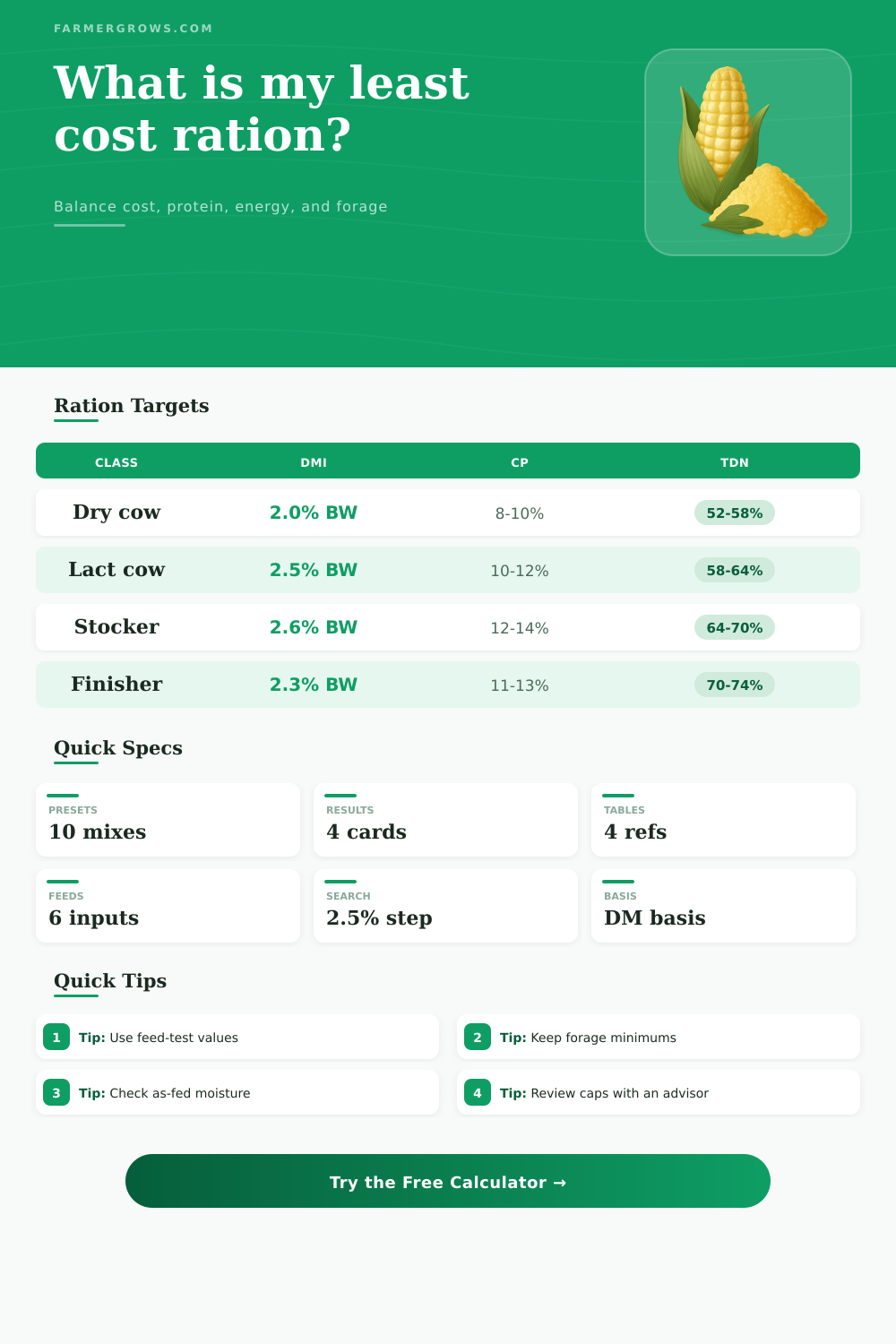
| Dry beef cow | 1.8-2.2% BW | 8-10% | 52-58% |
| Lactating beef cow | 2.3-2.8% BW | 10-12% | 58-64% |
| Growing stocker | 2.4-3.0% BW | 12-14% | 64-70% |
| Finishing cattle | 2.0-2.5% BW | 11-13% | 70-74% |
| Constraint | Why It Matters | Common Range | Calculator Field |
|---|---|---|---|
| Forage minimum | Maintains fiber and rumen function | 5-80% | Minimum forage |
| Ingredient max | Controls risk, intake, sulfur, starch, or fat | 2-100% | Max % |
| Protein floor | Meets microbial and animal protein needs | 8-18% | Target CP |
| Energy floor | Supports maintenance, gain, milk, or finish | 52-74% | Target TDN |
| Planning Conversion | Formula | Example | Use |
|---|---|---|---|
| Cost per lb DM | $/ton divided by 2000 | $200 = $0.10 | Daily cost |
| Total DM feed | DMI x head x days | 24 x 40 x 90 | Feed needs |
| Ingredient tons | Total lb x ration % / 2000 | 86400 x 40% | Buying list |
| Nutrient lb | DMI x nutrient % | 24 x 10% | CP or TDN lb |
Least-cost results only compare fairly when every ingredient cost and nutrient value uses the same dry matter basis. Convert wet feeds before using the buying list.
Maximum inclusion limits help the calculator avoid unrealistic cheap blends. Set caps from feed tests, sulfur and fat risk, fiber needs, equipment limits, and local nutrition guidance.
A least cost ration calculator is an tool that enables a person to balance the cost of the feed for they livestock with the nutritional requirements of the livestock. A person must make many small decision each day regarding the feed for their livestock. These small decisions each may have a large impact on the total cost of the feed that must be purchased over time.
A person desires to make decision that will allow the person to spend the least amount of money on feed; however, the person also cant make decision that do not provide the livestock with enough protein and energy to meet their requirement. A least cost ration calculator can take the prices and nutrient values of different feed ingredient to determine the blend of ingredients that will be the cheapest blend that still meets the nutritional requirements of the livestock. Many livestock producer understand that the livestock require a certain amount of dry matter.
Find the cheapest feed that meets livestock needs
However, the way that dry matter is provide to the livestock can be different. For instance, a person may be able to purchase hay at a cheaper price than another load of hay, but the cheaper hay may contain less protein. Corn grain contain alot of energy, but very little fiber.
Furthermore, supplement can provide the necessary protein, but increase the cost of the ration. Therefore, the livestock producer can utilize a least cost ration calculator to input each of these different ingredient, and to see which blend of these ingredients will meet the requirements for the livestock without spending too much money on purchasing the feed. A person must input a few specific constraint into the least cost ration calculator to obtain the correct result.
For instance, a person must input the number of head of livestock that must be fed, as well as the number of day over which the livestock must be fed. The calculator can calculate the cost of the feed each day, but the person must enter the number of days that the feed must be provided to the livestock into the calculator. Additionally, a person must enter the target percentage of the crude protein and TDN that is required by the livestock.
Finally, the forage level must be set to a minimum required level; if it isnt, the least cost ration calculator may suggest a ration blend that contains mostly concentrates, which can lead to health problem in the livestock if provided to them for long periods. Another step that a person should take before utilizing the least cost ration calculator is to set a maximum inclusion level of each ingredient to the calculator. For instance, an ingredient may be very inexpensive; however, a person cannot feed too much of that ingredient to the livestock due to potential health problem.
For instance, if too much distillers grains are fed to the livestock, the sulfur level in the livestock can rise too high. Additionally, if a person feeds too much corn to the livestock, the fiber level in the livestock can drop too low. By setting each of these ingredient caps, the least cost ration calculator will output a ration blend that does not include any ingredient in amounts that may lead to health problem in the livestock.
Another requirement for utilizing the least cost ration calculator is that a person use a dry matter basis with all feed ingredient. The dry matter basis of feeds allow a person to compare the nutritional values of each ingredient. Feeds that contain water, such as silage, have a lot of water in their feed, and water does not have any nutritional value.
A dry matter basis allow a person to compare feeds with different level of moisture; if a person enters just one ingredient on an as-fed basis, and another ingredient on a dry matter basis, the least cost ration calculator will not output an accurate result. Therefore, the least cost ration calculator can make correct calculation. A least cost ration calculator typically include reference table that can assist a new user of the calculator.
These table may include the protein range of different type of feeds, the energy range of different type of feeds, and the intake level of different type of feeds for different type of cattle. These reference table are not strict rule for livestock feeding. However, if a person sets target for protein or energy that fall outside of the suggested range for each type of livestock, the least cost ration calculator may output an incorrect blend of ingredient.
Furthermore, if a person has new result for the test of one or more of the ingredient, the person can update those row within the least cost ration calculator with the new value. A least cost ration calculator cannot take into account the cost of providing too little protein, too little energy, or too much of either nutrient for the livestock. A lack of protein will impact the livestocks ability to gain weight; however, the impact may not be seen for several week.
An overfeeding of expensive protein will lead to an increase in the cost of the feed ration for the livestock; however, the livestock may not gain any visible change from the overfeeding. Therefore, the least cost ration calculator will provide the minimum cost of feeding the livestock the amount of protein, energy, and forage that is set as a target. However, the calculator does not provide any information as to whether those target are the correct amount for that individual livestock and weather.
When utilizing the least cost ration calculator, a person should also consider the moisture content of the feeds. When a person purchase feed, such as silage, they are also purchasing water. Water does not provide nutrient to the livestock.
For instance, silage contains alot of moisture, so there is less dry matter provide to the livestock compared to hay. A person should always check the as-fed weight of the feeds against the dry matter percentage to make sure that they do not purchase more feed than they recieve. A least cost ration calculator can change over time.
The availability of feed ingredient may change; for instance, a person may find a new type of feed ingredient that cost less than any other ingredient. In this case, a person can update the least cost ration calculator to include that new ingredient. Additionally, if any of the ingredient that are currently input into the calculator dissapears from the farm or change quality, the least cost ration calculator should also be updated with these change.
Updating the least cost ration calculator takes very little time, so people should make such update as often as the change occur. A least cost ration calculator does not take into account the palatability of the feeds. For instance, a ration may be calculate that includes an ingredient that has an off flavor.
In this situation, the livestock may refuse to eat the feed ration that the calculator calculated. Therefore, a person must monitor the intake of the livestock to ensure that they are eating the ration that was calculate by the least cost ration calculator. A least cost ration calculator typically does not calculate the need of mineral and vitamin.
A low cost ration may lack mineral or vitamin if the feeds that are used do not contain these nutrient. To combat this, many livestock producer supplement the diet of their livestock with a mineral package. This ensure that the livestock contain the mineral that their body require to perform their biological function.
A least cost ration calculator calculate the cost of the ration, as well as the protein, energy, and dry matter content of the ration. However, the mineral program calculate the amount of mineral and vitamin that are needed for the livestock. A person gain value in using the least cost ration calculator each time that the calculator is used.
A least cost ration calculator enable a person to change the price of each ingredient, the quantity of each ingredient, and to make change to any setting within the calculator. Additionally, the price for feed change over time, as do the individual harvest of feed from a farm. A least cost ration calculator allow a person to try each of these change within the tool to see if the livestock can be fed at a lower cost.
A least cost ration calculator that is used regularly will ensure that the livestock are provide with the nutrient that they require, and that the person has a feed bill that accurately reflect the cost of the ration for the livestock.