Mulch Depth Calculator
Estimate mulch volume for garden beds, landscape islands, paths, play areas, and tree rings while accounting for existing mulch, target depth, compaction, bag size, coverage, and overage.
Load a common landscape job, then fine-tune the shape, existing mulch layer, target depth, material, compaction, bag size, and overage buffer.
Mulch Order Estimate
Your mulch volume and bag count will appear here.
Compare common mulch materials by approximate bulk density, settling behavior, and the jobs where each material usually performs best.
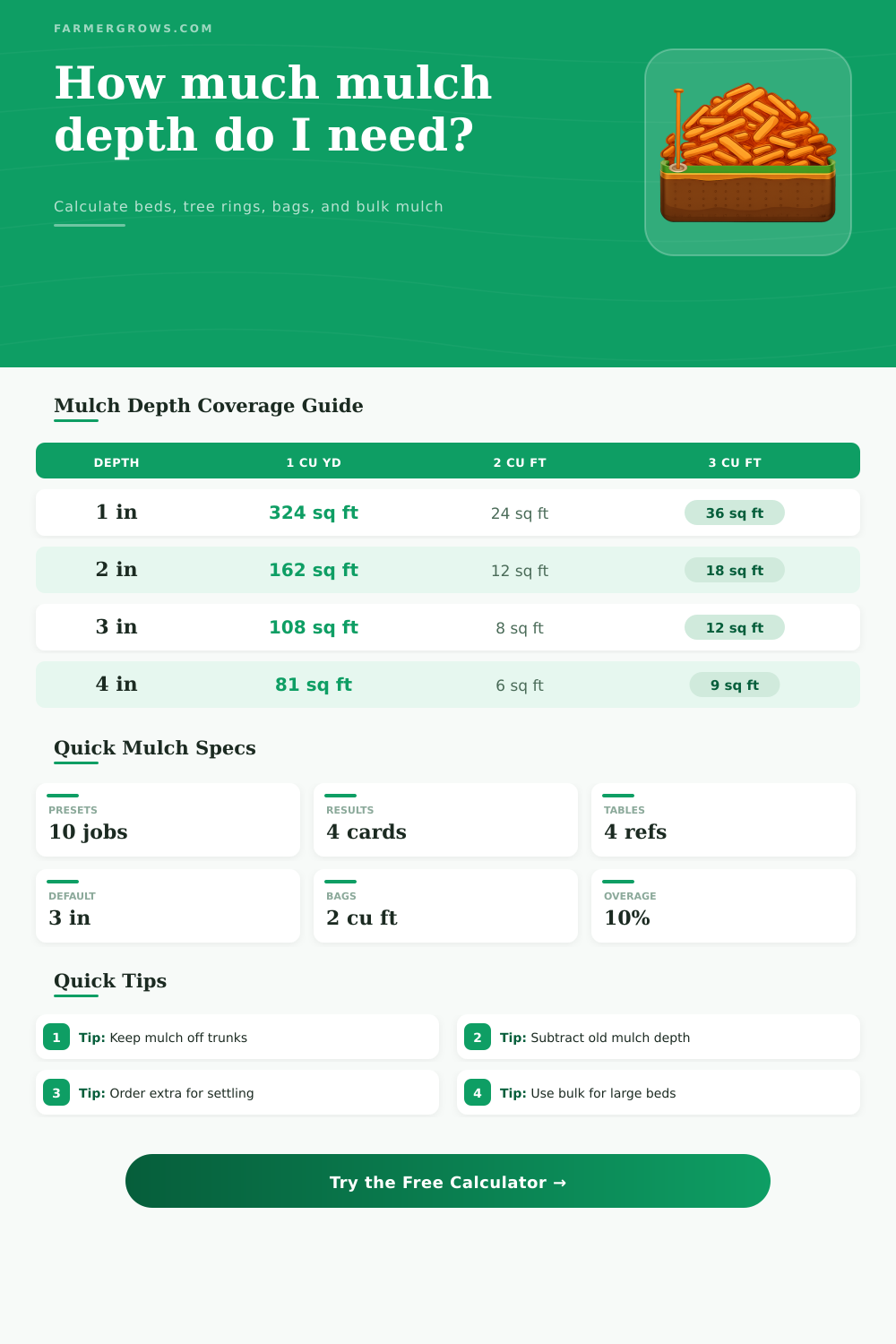
| Target depth | Coverage per cubic yard | Coverage per 2 cu ft bag | Coverage per 3 cu ft bag | Metric equivalent |
|---|---|---|---|---|
| 1 inch | 324 sq ft | 24 sq ft | 36 sq ft | 30.1 sq m per yd3 |
| 2 inches | 162 sq ft | 12 sq ft | 18 sq ft | 15.1 sq m per yd3 |
| 3 inches | 108 sq ft | 8 sq ft | 12 sq ft | 10.0 sq m per yd3 |
| 4 inches | 81 sq ft | 6 sq ft | 9 sq ft | 7.5 sq m per yd3 |
| 6 inches | 54 sq ft | 4 sq ft | 6 sq ft | 5.0 sq m per yd3 |
| Package size | Volume per bag | Bags per cubic yard | Coverage at 3 inches | Best use |
|---|---|---|---|---|
| 1.5 cu ft bag | 0.0556 cu yd | 18 bags | 6 sq ft | Small touch-ups and containers |
| 2 cu ft bag | 0.0741 cu yd | 14 bags | 8 sq ft | Home beds and border refreshes |
| 2.5 cu ft bag | 0.0926 cu yd | 11 bags | 10 sq ft | Medium beds with fewer trips |
| 3 cu ft bag | 0.1111 cu yd | 9 bags | 12 sq ft | Larger bed work where bags still fit |
| Bulk cubic yard | 27 cu ft | 1 yard | 108 sq ft | Big beds, paths, islands, and delivery |
| Planting type | Typical target depth | Trunk or crown gap | Common ring width | Mulch note |
|---|---|---|---|---|
| Young tree | 2 to 3 inches | 6 to 12 inches | 3 to 4 ft radius | Keep the root flare visible and dry. |
| Established shade tree | 3 to 4 inches | 12 inches or more | 4 to 8 ft radius | Wider rings reduce mower damage. |
| Fruit tree | 2 to 3 inches | 8 to 12 inches | 3 to 5 ft radius | Pull mulch back before trunk checks. |
| Shrub ring | 2 to 3 inches | 3 to 6 inches | 1.5 to 3 ft radius | Avoid burying low crowns or stems. |
| Playground tree area | 4 to 6 inches | 12 inches or more | As designed | Use impact material guidance separately. |
| Project | Area | 3 inch volume | 2 cu ft bags | Bulk ordering note |
|---|---|---|---|---|
| Small bed 10 x 20 | 200 sq ft | 1.85 cu yd | 25 bags | Two yards usually covers edges and settling. |
| Tree ring 6 ft outer, 1 ft gap | 27.5 sq ft | 0.25 cu yd | 4 bags | Use bags unless many rings match. |
| Playground 15 x 15 | 225 sq ft | 2.08 cu yd | 29 bags | Depth requirements may exceed landscape mulch. |
| Front border 3 x 60 | 180 sq ft | 1.67 cu yd | 23 bags | Curves and plant bases often need 10% extra. |
| Full yard 50 x 50 | 2500 sq ft | 23.15 cu yd | 313 bags | Bulk delivery is the practical route. |
Rake a few small spots open before ordering. If the old layer is still loose and clean, subtract it from the target depth; if it is matted, thin, or soil-mixed, count only part of it.
Keep mulch pulled back from tree flares, shrub crowns, and vegetable stems. A donut-shaped ring gives moisture control without creating the wet collar that causes rot and pest problems.
Mulch depth is an important factor in the maintenance of any gardens. The depth of the mulch will determine how well the garden perform and how the garden look. If the mulch is too shallow, weeds will grow through the mulch and the soil will lose moisture to evaporation.
If the mulch is too deep, it will smother the roots of the plants or it will create a soggy area against the trunks of the trees. In order to determine the correct depth for the mulch in the garden, it is first important to determine the area that should be mulched and the layers of material that is currently within the garden. Many people calculates the volume of the mulch that they will need by measuring the area of their garden beds and guessing at the depth that the mulch should be applied.
How to Measure Mulch Depth and Order the Right Amount
Guessing at the depth, however, can create error in the estimation of the amount of mulch that is needed. Different type of garden beds have different shapes that you must account for when calculating the volume of the mulch that is needed. For instance, mulch should not be applied to the entire area around the trees, rather, it should only cover the donut shape area around the trees.
In order to avoid performing these calculations of the areas, mulch calculator allow for the user to account for these geometric shapes. Two different measurements must be accounted for in the calculation of the volume of mulch that is needed in the garden. These two measurement are the target depth for the mulch and the existing depth of the mulch in the garden.
These two measurements must be distinguished from one another. For example, if there is an old layer of mulch in the area that is to be mulched, that depth should be subtracted from the target depth. However, if there is an old layer of mulch in the area that is to be mulched, but that mulch is matted and mixed with the soil, the depth of the existing mulch should be accounted for as zero.
These two depths can be accounted for in the mulch calculator. The type of mulch that is used in the garden will also impact the volume of the mulch. For instance, shredded hardwood mulch settles at a more different rate than coarse wood chips or straw.
Because of this difference in settling rates, a compaction setting must be accounted for in the calculation. The mulch will settle to a thinner depth over time, so accounting for the density of the mulch will allow for the determination of the total weight of the mulch. The total weight of the mulch will help the gardener to determine whether bags of mulch should be purchased or if bulk mulch should be ordered.
The mulch calculator allow for the inclusion of a buffer percentage to the calculations that are made. This buffer percentage will allow for extra mulch to be ordered to account for curves, slopes, and edges in the garden beds that may otherwise be covered in mulch but that may not be accounted for in the calculations of the area to be mulched. Using a buffer percentage to the calculations allows for the mulch order to include enough mulch to cover all areas of the garden beds.
Reference tables are also provided for the mulch calculator. These tables show the amount of mulch of different depths. These reference tables also show the number of bags of mulch that are contained within one cubic yard of mulch.
These tables can be used to compare the cost of bags of mulch to bulk mulch. However, the calculator will provide the most accurate measurement of the amount of mulch that is needed. Many people make mistake when calculating the volume of the mulch that is needed.
Two of the most common errors are in the measurement of the existing mulch depth and the area around trees. For instance, some people do not account for the depth of the existing mulch in the garden beds; instead, they order three inches of mulch to be spread into the existing mulch. Additionally, some people do not account for the differences in compaction among different types of mulch.
For instance, mulch such as pine straw will settle at a different rate then mulch such as wood chips. Finally, some people may make the mistake of measuring the entire area around the trees rather than the donut shaped area that should be covered in mulch. The mulch calculator will not make any aesthetic decision for the user regarding the garden.
Instead, the calculator will help the user to make decisions regarding the number of bags of mulch or the bulk order of mulch that is needed. Once the user is aware of the number of bags or bulk orders of mulch that are needed, they will know how many bags will fit into their vehicle and whether bulk mulch should be ordered. Additionally, determining the correct number of bags or bulk orders of mulch will simplify the project of mulching the garden beds; knowing the weight and volume of the mulch will allow for the user to begin the mulching process with certain.