🌾 Feed Ration Calculator
Estimate dry matter intake, forage, concentrate, protein supplement, mineral salt, crude protein, energy density, and period feed needs for common farm livestock.
Pick a working starting point, then adjust body weight, feed class, dry matter intake, protein target, energy target, forage share, supplement share, mineral salt, days, and head count.
Feed ration results
Run the calculator to estimate dry matter, as-fed ingredients, protein, energy, mineral salt, and total feed for the planning period.
Body weight x DMI% = lb DM per head daily.Ingredient DM pounds / ingredient dry matter fraction.Sum of ingredient nutrient pounds / total ration DM.Daily as-fed x head count x days x shrink allowance.| Feed ingredient | Dry matter | Crude protein | TDN equivalent |
|---|---|---|---|
| Grass hay | 88 percent | 9 percent | 56 percent |
| Legume hay | 88 percent | 17 percent | 58 percent |
| Mixed hay | 88 percent | 12 percent | 57 percent |
| Fresh pasture | 25 percent | 16 percent | 63 percent |
| Corn silage | 35 percent | 8 percent | 68 percent |
| Straw or residue | 90 percent | 4 percent | 42 percent |
| Species | Typical DMI | Common protein target | Ration focus |
|---|---|---|---|
| Beef cattle | 1.8 to 2.8 percent of body weight | 8 to 14 percent CP | Match forage quality to growth, finishing, cow stage, and weather. |
| Dairy cattle | 3.0 to 4.0 percent | 15 to 18 percent CP | Support milk yield with high intake and balanced effective fiber. |
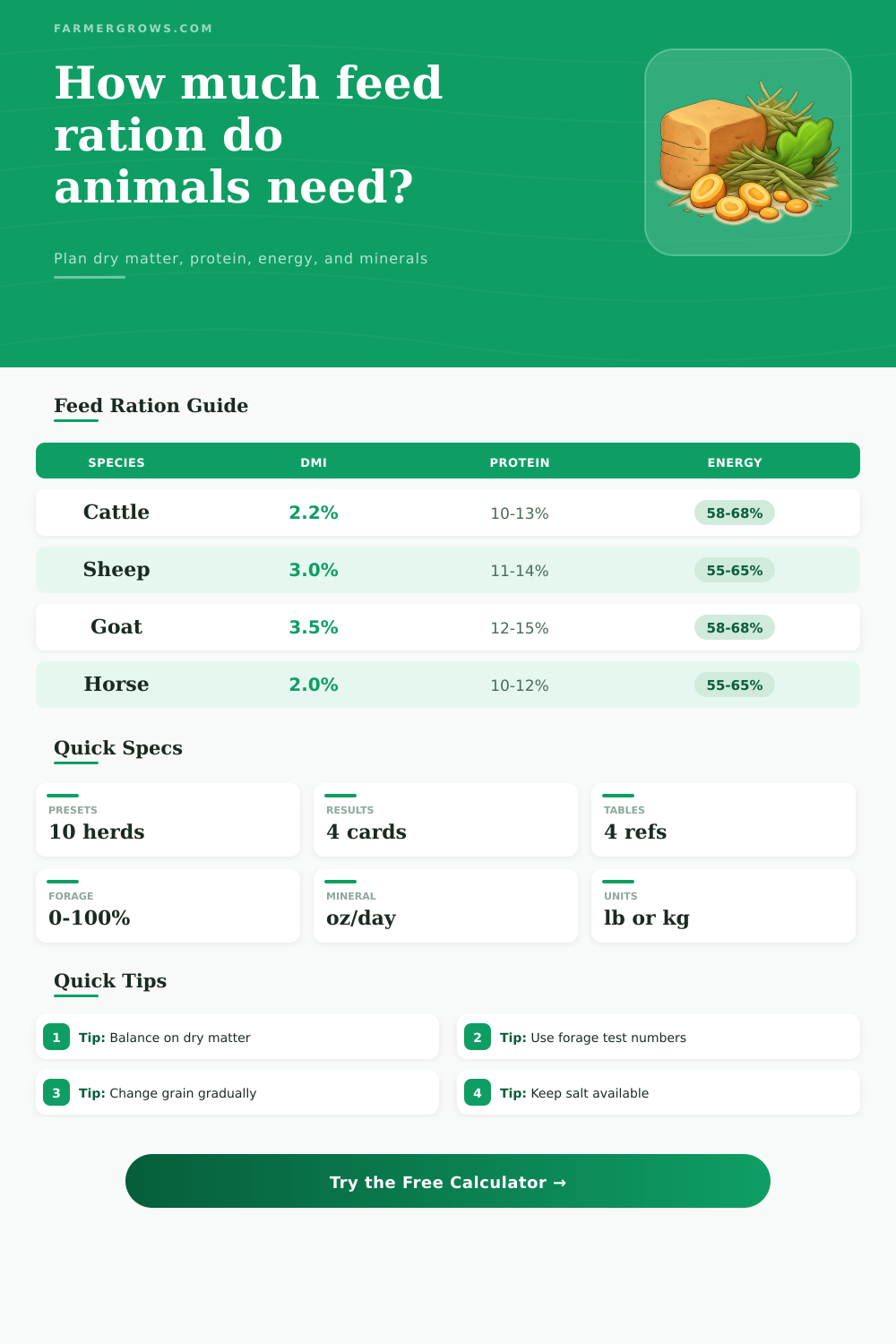
| Sheep | 2.5 to 4.0 percent | 10 to 16 percent CP | Adjust for ewes, lamb growth, flushing, and late gestation. |
| Goats | 3.0 to 4.5 percent | 11 to 16 percent CP | Higher browsing intake and milk production can raise targets. |
| Horses | 1.5 to 2.5 percent | 9 to 14 percent CP | Keep forage adequate and limit rapid concentrate changes. |
| Pigs and poultry | 4.0 to 7.0 percent | 14 to 24 percent CP | Use complete feeds or tightly balanced formulas. |
| Ingredient | Dry matter basis | As-fed equivalent | Planning note |
|---|---|---|---|
| Hay at 88 percent DM | 10 lb DM | 11.4 lb as-fed | Dry feeds stay close to dry matter pounds. |
| Pasture at 25 percent DM | 10 lb DM | 40.0 lb as-fed | Wet forage looks heavy because most weight is water. |
| Silage at 35 percent DM | 10 lb DM | 28.6 lb as-fed | Use current moisture tests for accurate delivery. |
| Grain at 88 percent DM | 10 lb DM | 11.4 lb as-fed | Grain and pellets are usually similar to hay dry matter. |
| Protein meal at 90 percent DM | 2 lb DM | 2.2 lb as-fed | Small supplement changes can move protein quickly. |
| Animal group | Common salt or mineral intake | Calculator field | Management note |
|---|---|---|---|
| Beef cow or stocker | 2 to 4 oz per head daily | Mineral salt | Use label directions and monitor consumption. |
| Dairy cow | 4 to 8 oz per head daily | Mineral salt | Balance calcium, phosphorus, magnesium, and trace minerals. |
| Sheep or goat | 0.25 to 1 oz per head daily | Mineral salt | Choose sheep-safe copper levels when feeding sheep. |
| Horse | 1 to 2 oz salt daily | Mineral salt | Salt needs rise with sweat, heat, and work. |
| Poultry or rabbits | Use complete-feed premix | Low oz input | Do not free-formulate mineral levels without guidance. |
Pasture, silage, hay, grain, and pellets can look very different as-fed. Dry matter removes water weight so forage share, protein, and energy are compared cleanly.
This calculator screens ration size and nutrient density. Final mineral programs, medicated feeds, copper-sensitive sheep diets, and high-grain rations need feed tags, forage tests, and qualified guidance.
Feed values are planning estimates. Actual feed tests, animal condition, weather, health, water, palatability, pregnancy stage, lactation level, and local extension recommendations should guide final ration decisions.
Feed selection is important for farm animals because the feed impacts there performance. Many people guess at how much feed to provide to their animals each day, rather than calculating the requirements of the animal in question. The amount of feed that contains nutrients and water can differ between animals, so it is hard for people to accurately provide animals with feed that contains the nutrients that they require.
If animals is provided with too little feed and not enough nutrients to support their weight, milk yields, or do not waste feed, there can be negative impacts on the farm and its output. To provide feed to animals with the proper amount of nutrients, individual must consider the requirements of the animal and provide the appropriate feed. Dry matter intake is the starting point for feed planning because dry matter allows individuals to disregard the water content in the feeds.
How to Plan Feed for Farm Animals
Dairy cows, sheep, goats, horses, and pigs consumes a percentage of their body weight each day. Each of these species consumes differently, however, based on the age, weight, pregnancy status, health, and activity of the animal. For instance, dry cows consume around 2% of their body weight in dry matter, while milking cows can consume 4% of their body weight in dry matter.
Knowing the percentage of dry matter that the animal must consume allows an individual to calculate the other feed requirements for that animal. The calculator can make this calculation for an individual to save them from having to perform the calculation in there head. The forage that the animal consumes is usually the biggest portion of the dry matter that the animal consumes.
However, the nutrients in the forage can differ. For instance, grass hay can contain 9% of protein, but legume hay can contain 17% of protein. By selecting the type of forage that will be fed to the animals, as well as the percentage of the diet that the forage will cover, the calculator will display if the protein and energy content of the forage meet the requirements of the animal.
If not, an individual can adjust the type and the percentage of forage that is fed to the animals to ensure that the protein and energy content of the forage cover the needs of the animal. Concentrate feeds are used to cover the remaining gap in the ration that the calculator calculates after the forage and supplement feeds are accounted for. Concentrate feeds contain energy and protein, but if fed in excess to animals like horses and small ruminant can upset the digestion of those animals.
The calculator will determine the concentrate percentage after the forage and supplement feed percentages are calculated, and will display it to the individual in the calculator. An individual can change the percentage of forage that is fed to the animals to simulate an altered percentage of concentrate feed. The same can be done with changing the protein supplement percentage to see the impact of that alteration on the ration.
The final category of feed to consider is the amount of mineral salt to feed to the animals. Because the amount of mineral salt that is fed to the animals is usually small, the mineral salt portion of the ration can usually be ignored. However, if incorrect amount of mineral are fed to the animals, the animals can experience significant issues.
For instance, free choice mineral is beneficial to some groups of animals, but not beneficial to others, such as sheep. The amount of mineral salt that can be fed to animals is asked for in ounce of mineral per head of animal per day. A reference table displays the ranges of mineral salt requirements for each of the species of animals described in the feed calculator.
This reference table allows individuals to determine if the amount of mineral that is included in the bag of feed will meet the requirements of the animals that are to be fed. Planning feed requirements over a period of time is a different calculation than planning for only one day for the animals. A thirty-day period of time will have different requirements for the animals than a period of time of one day alone.
For instance, in a thirty-day period of time, additional allowances must be made for the weight of the animals to shrink, as well as for the animals to refuse some of the feed that is provided. The calculator can calculate these figures for the individual, allowing the individual to more accurately calculate how much feed must be purchased for a thirty-day period. This final number will ensure that the animals will have enough feed to eat over a thirty-day period.
Many farms are not similar in their requirements of the animals, and there are often changes to the type of feed that is provided to the animals over time. For instance, weather can alter the feed intake of the animals, and the animals may choose to eat one type of feed over another. A load of hay may have a different protein content than the previous load of hay that was purchased.
While the feed calculator cannot provide the same analysis as a test for the forage that will be fed to the animals, individuals can use the calculator to compare the requirements of two different type of hay, for instance. An individual can use the calculator to determine if purchasing hay of a higher quality would be more beneficial than purchasing an additional meal to feed to the animals. The same calculator can be used to determine the requirements of different types of animals.
For instance, a person can create a ration feed plan for a group of stocker calves and a group of late-gestation ewes. Each of these animals has different requirements for feed, but the calculator allows individuals to switch the type of animal and the type of feed that the farmer provides to each animal. The calculator will automatically change to the feed requirements of the new animal groups.
This feature makes it easy for individuals to compare two situations to decide which is better for the animals and the farmer. Using the calculator to determine the requirements of the animals will become second nature to individuals over time on the farm. They will eventually be able to recognize situations in which an animal will require less supplement feed if certain forage feed is used, or when altering the rate of mineral feed will help to balance the ration.
The calculator will be the place where individuals find answers to these types of questions.