🐄 Total Mixed Ration Calculator
Balance a dairy total mixed ration from as-fed ingredient percentage, moisture, dry matter intake, forage share, crude protein, NDF, energy density, cow count, and feed shrink.
Pick a dairy group to load a realistic starting mix, then tune ingredient as-fed percentages, moisture, CP, NDF, NEL, DMI target, cow count, and shrink.
Enter each ingredient as a percent of the as-fed mix. Moisture is converted to dry matter; CP, NDF, and energy are weighted on a dry matter basis.
| Ingredient | Type | As-fed % | Moisture % | CP % DM | NDF % DM | NEL Mcal/lb |
|---|---|---|---|---|---|---|
TMR Mix Results
Results are normalized to the entered as-fed mix and weighted on a dry matter basis.
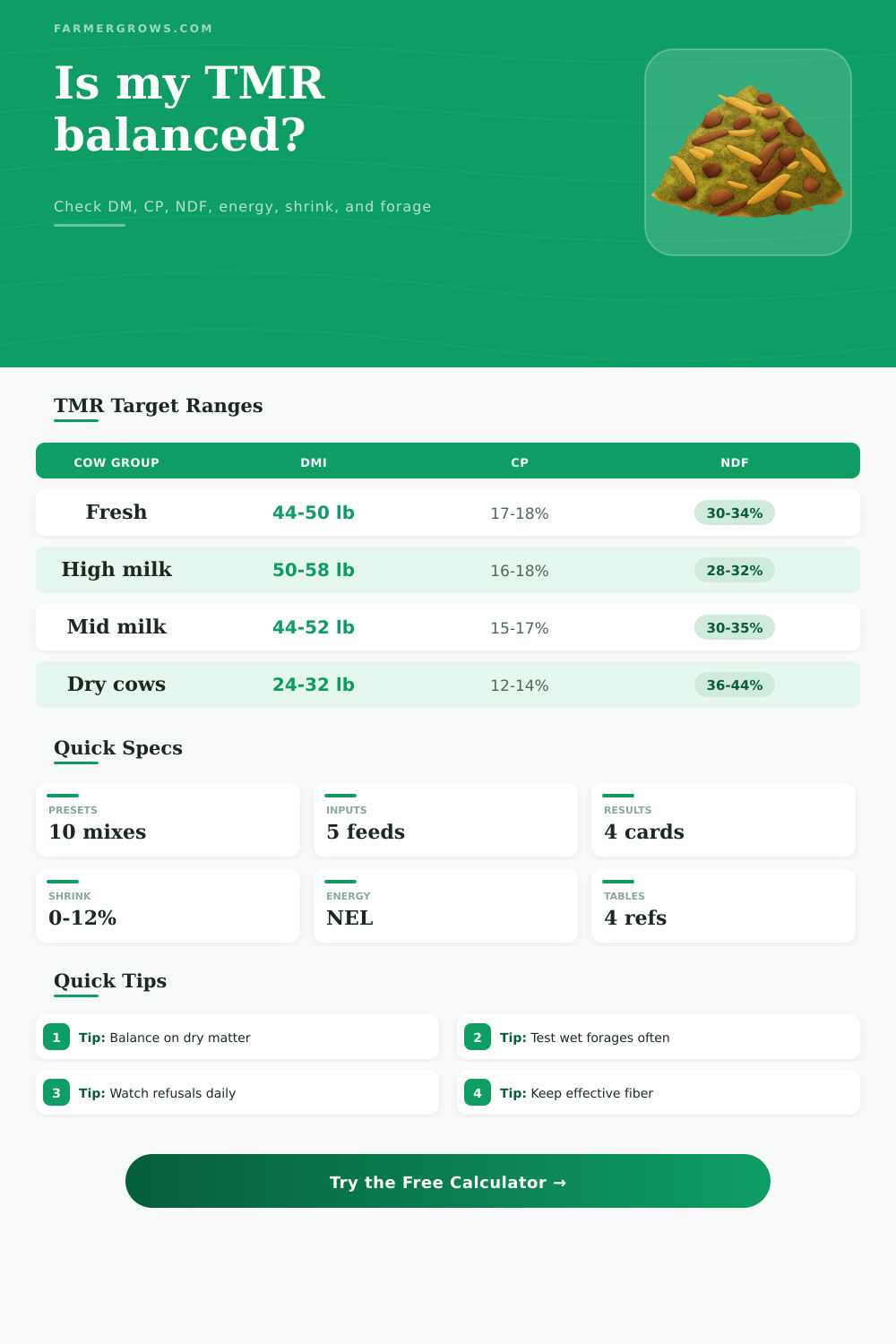
| Cow group | DMI target | Typical mix DM | Useful check |
|---|---|---|---|
| Fresh cows | 44 to 50 lb DM | 47 to 52% | Steady intake is more important than a sudden push. |
| High milk cows | 50 to 58 lb DM | 48 to 55% | Check bunk space, sort risk, and water access. |
| Mid lactation cows | 44 to 52 lb DM | 45 to 55% | Keep energy matched to milk and body condition. |
| Dry cows | 24 to 32 lb DM | 42 to 50% | Lower energy, adequate fiber, consistent minerals. |
| Group | CP % DM | NDF % DM | NEL Mcal/lb DM |
|---|---|---|---|
| High producing dairy | 16.5 to 18.0 | 28 to 32 | 0.74 to 0.80 |
| Moderate milk dairy | 15.0 to 16.5 | 30 to 35 | 0.69 to 0.75 |
| Growing heifer | 13.5 to 15.5 | 34 to 40 | 0.62 to 0.69 |
| Far-off dry cow | 12.0 to 14.0 | 36 to 44 | 0.56 to 0.63 |
| Ingredient | Moisture | CP % DM | NDF % DM |
|---|---|---|---|
| Corn silage | 60 to 70% | 7 to 9 | 38 to 46 |
| Alfalfa haylage | 45 to 60% | 17 to 22 | 35 to 45 |
| Grass hay | 8 to 15% | 8 to 14 | 55 to 68 |
| Ground corn | 10 to 14% | 8 to 10 | 8 to 12 |
| Soybean meal | 9 to 12% | 44 to 49 | 7 to 12 |
| Shrink level | Where it fits | Extra feed factor | Manager check |
|---|---|---|---|
| 1 to 2% | Tight commodity handling | 1.01 to 1.02 | Clean pads, covered storage, accurate scales. |
| 3 to 5% | Typical dairy TMR | 1.03 to 1.05 | Include refusals, wind loss, and loader variation. |
| 6 to 8% | Wet feed or long route | 1.06 to 1.08 | Watch spoiled faces and inconsistent delivery. |
| 9 to 12% | High loss conditions | 1.09 to 1.12 | Separate true shrink from intentional refusals. |
When silage moisture shifts, the same loader bucket can deliver a very different dry matter amount. Recheck wet feeds and update as-fed percentages before blaming the ration formula.
A balanced paper ration can fail at the bunk if long forage, dry fines, or uneven mixing lets cows sort. Compare refusals to the mixed ration when intake or milk changes.
Use this calculator as a ration math check alongside forage tests, nutritionist formulas, milk records, manure scores, and cow observations.
Balancing an total mixed ration for dairy cows requires your attention continuous because the total mixed ration will have an impact on the milk that the cows produce, the health of those cows, and the cost of the feed for the cows. The goal is to provide each cow with the correct amount of dry matter and to provide each cow with the correct nutrient profile from the total mixed ration. If the total mixed ration are balanced correctly, each cow will receive the nutrients that it require to produce milk, and the cows will not lead to waste or sorting of that ration by the cows.
Each feed that is provided to the cows is wet and variable in the component of each feed, so the total mixed ration cannot account for perfect consistency among each load of feed. One of the first factors to consider in balancing the total mixed ration is the moisture content of the ration. Moisture content is one of the factors that can lead to errors in the total mixed ration if it isnt measure prior to feeding the feeds to the cows.
How to Balance Feed for Dairy Cows
For instance, each load of forage may appear the same to the loader, but a five point change in dry matter will impact the amount of dry feed that the cows receive. Consequently, the user will need to enter the moisture content of each ingredient into the calculator for the total mixed ration balancing calculator. The moisture content will allow the calculator to determine the dry matter mix and percent of each nutrient in the ration.
Without enter the moisture content, the amounts of crude protein and fiber will be incorrect. Crude protein and neutral detergent fiber are two important component of the total mixed ration. Crude protein is required for the cows to produce milk and to perform the maintenance of their bodies.
Neutral detergent fiber is required for the proper functioning of the rumen of the cows. The target levels of crude protein and neutral detergent fiber will vary according to the cows in the herd, such as fresh cows will require more crude protein than far off dry cows. The calculator will calculate the amount of each ingredient based off the dry matter of each ingredient, and will account for each nutrient in the ration in the total mixed ration calculation.
Energy density is another important measurement for a total mixed ration. Energy density will determine if the total mixed ration will supply the cows with enough energy to produce the amount of milk that is expected from each cow. Energy content is provided mainly by the concentrate in the ration, so small change in energy content will impact the total amount of energy that is supplied to each cow.
The calculation of energy density will occur in the total mixed ration calculator once the ration balancer enters the net energy for lactation values of each ingredient. Another important component of a total mixed ration is the forage share of the ration. A forage share that is too low can lead to sorting of the ration by the cows, as well as can create an unstable environment within the rumen of the cows.
A ration that is balanced to contain at least forty percent of the dry matter from forages is recommended for the total mixed ration for high producing dairy cows. The exact percentage of forage require in the total mixed ration will depend upon the type of forage that will be offered to the cows and the amount of non-fiber carbohydrates that are include in the concentrates. The total mixed ration calculator will calculate the forage to concentrate split in the total ration, and present that split to the hay farmer prior to the feeding of the ration.
Two additional factor to consider in creating a total mixed ration are the shrink and refusal of the ration. Some feed will be lost due to wind, spoiling, and the cows pushing the feed out of the feeding bunk. This loss is referred to as shrink.
The percentage of shrink will allow for each ton of total ration to account for shrinkage in the delivered ration, which will avoid underfeeding of the cows. An allowance of four or five percent for shrinkage is common, but forages that are high in moisture or that are transported long distance to the dairy farms may require higher percentage of shrink allowance. The total mixed ration calculator will account for shrinkage of the ration, and will calculate the total amount of ration to prepare with that calculated percentage of shrinkage.
The reference table for the total mixed ration will allow for the confirmation of the total mixed ration that is calculated for the herd. The tables will have the typical dry matter intake of cows that are provided with the ration, as well as the target number for nutrients in each ration. These tables will allow the farmer to understand if the total mixed ration that is calculated is correct without memorize the numbers.
The reference tables will also have the common moisture and nutrient ranges for common feeds, allowing the hay farmer to recognize if the test results of the feeds are incorrect. There are many other variable to the total mixed ration that can have an impact upon the total amount of feed that is delivered to the cows, but that can be accounted for in the total mixed ration calculator. These variables include the amount of space in the bunk for the ration to sit, the availability of water for the cows, the order in which the feed is loaded into the bunk, and the consistency of the individual that load the feed.
These variables will impact how the ration can reach the cows. Checks for the refusals of the ration can be performed on a daily basis, as can tests for the forage ration level each week. If the total mixed ration appears incorrect, the actual total mixed ration that is fed to the cows can be tested.
Getting the total mixed ration correct will result in the cows consume the ration, avoiding metabolic issue, and providing a predictable amount of milk from each cow. Additionally, getting the total mixed ration correct will result in a reduction of feed waste, which is important to consider in relation to feed cost and the price of the feed commodities. Though the math for the total mixed ration can appear to be complicated, it isnt that more complicated if the inputs are entered appropriately.
Because these inputs can change frequently, calculating the total mixed ration prior to making any adjustment will save time and money.