🐄 Beef Cattle Ration Calculator
Estimate beef ration dry matter, forage as-fed, grain, protein supplement, mineral intake, shrink-adjusted delivery, and weather-stress allowance for steers, calves, heifers, cows, and bulls.
Choose a practical starting point, then adjust body weight, gain target, forage quality, grain share, protein supplement, mineral intake, weather stress, and shrink for the actual pen.
Beef ration estimate
Enter cattle weight, class, and ration split to estimate feed delivery.
body weight x intake percent x class, ADG, forage, and weather factorsforage DM = total DM - grain DM - supplement DM - mineral DMas-fed weight = dry matter weight / ingredient dry matter percentdelivered feed = as-fed feed / (1 - shrink percent)| Forage | Dry matter | Crude protein | Planning note |
|---|---|---|---|
| Poor grass hay | 88 percent | 6 percent | Low protein and digestibility often need supplement for cows and calves. |
| Average mixed hay | 88 percent | 9 percent | Common baseline for winter cow and stocker planning. |
| Good grass or legume hay | 88 percent | 13 percent | Can reduce protein supplement when intake stays strong. |
| Good pasture | 25 percent | 16 percent | High moisture means as-fed pounds look large. |
| Corn silage | 35 percent | 8 percent | Energy source with moderate protein and high as-fed volume. |
| Straw or crop residue | 90 percent | 4 percent | Use mostly for roughage, not as the main nutrient source. |
| Beef class | Typical DMI | Common protein target | Ration focus |
|---|---|---|---|
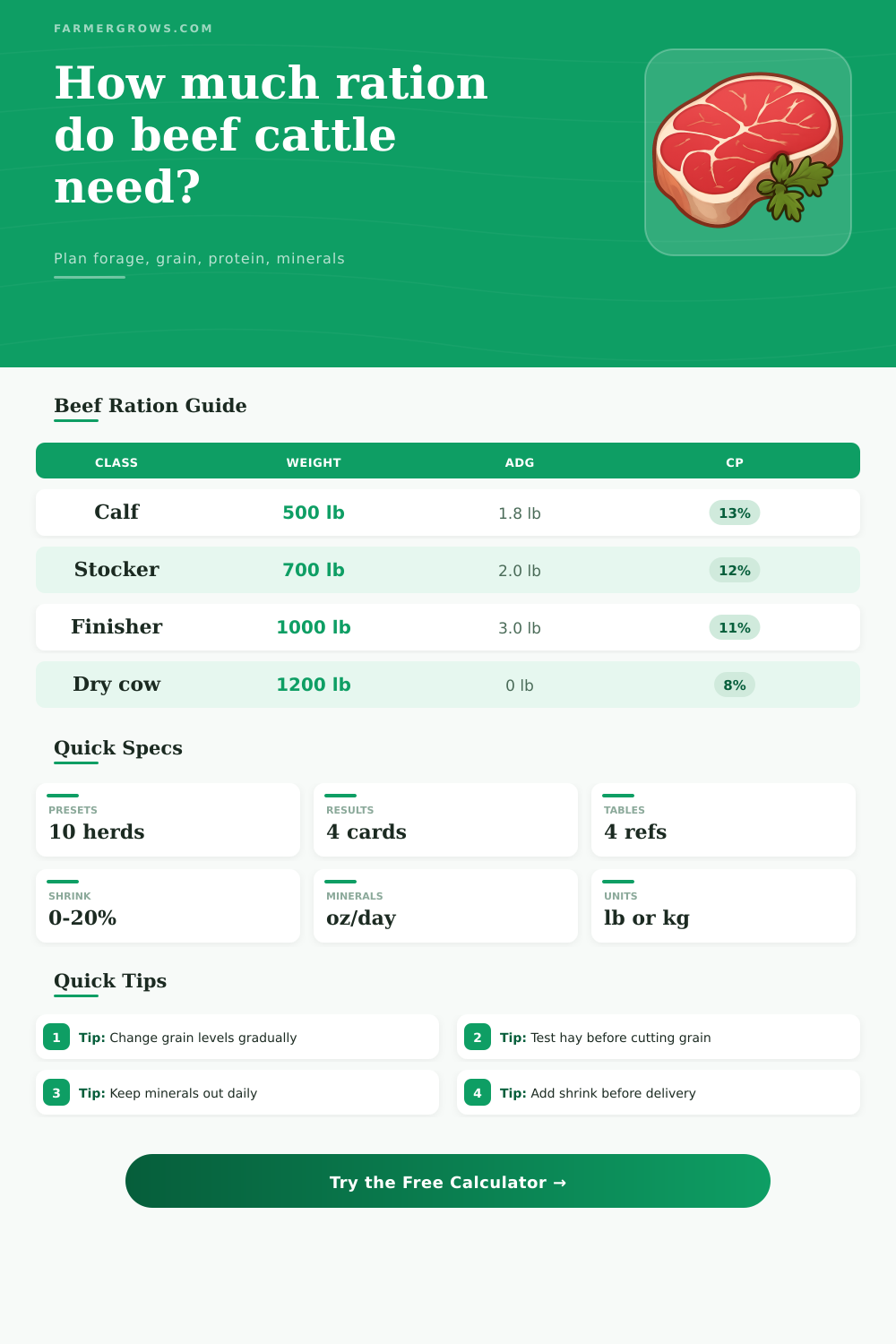
| Weaned calf | 2.5 to 3.0 percent of body weight | 13 to 15 percent CP | Palatable, moderate energy, and enough effective fiber. |
| Stocker or backgrounding steer | 2.3 to 2.8 percent | 11 to 13 percent CP | Steady gain from forage plus controlled concentrate. |
| Finishing steer | 2.0 to 2.4 percent | 10 to 12 percent CP | Higher grain, controlled roughage, and gradual step-up. |
| Replacement heifer | 2.0 to 2.4 percent | 10 to 12 percent CP | Frame growth without overconditioning. |
| Dry pregnant cow | 1.8 to 2.1 percent | 7 to 9 percent CP | Maintain body condition before calving. |
| Lactating cow | 2.2 to 2.6 percent | 10 to 12 percent CP | Support milk, rebreeding, and body condition. |
| Ration style | Grain DM share | Protein supplement | Use case |
|---|---|---|---|
| All-forage cow ration | 0 to 10 percent | 0 to 5 percent | Mature cows on adequate hay or pasture. |
| Backgrounding ration | 15 to 35 percent | 2 to 8 percent | Growing calves needing moderate daily gain. |
| High roughage feedlot | 35 to 55 percent | 2 to 6 percent | Steers stepping up or using silage-heavy diets. |
| Finishing ration | 60 to 85 percent | 0 to 5 percent | Energy dense diets after a careful adaptation period. |
| Poor forage rescue | 10 to 25 percent | 5 to 12 percent | Low protein hay, straw, or winter weather stress. |
| Planning item | Typical adjustment | Calculator field | Why it matters |
|---|---|---|---|
| Normal weather | No stress factor | Weather stress | Use when cattle are dry, sheltered, and eating normally. |
| Cold exposure | 5 percent more feed | Cold exposure | Energy need rises when wind and low temperature persist. |
| Cold and mud | 10 percent more feed | Cold and mud | Mud raises maintenance cost and can reduce bunk behavior. |
| Heat stress | 8 percent less intake | Heat stress | Intake often drops, so nutrient density may need review. |
| Severe storm stress | 15 percent more delivery | Severe storm stress | Use short term and check bunk cleanup closely. |
| Feed shrink | 3 to 12 percent | Shrink and refusal | Wind, storage, mixing, sorting, and refusals all reduce consumed feed. |
Hay, silage, pasture, grain, and minerals only compare cleanly after moisture is removed, so review the dry matter split before changing delivered pounds.
When grain share rises, make several small moves over multiple days and watch manure, cud chewing, intake, and bunk cleanup before making the next change.
This calculator is for feed planning only. Use forage tests, local extension recommendations, veterinary advice, and a qualified nutritionist when balancing minerals, medicated feeds, or high-concentrate finishing diets.
Beef cattle require differents types of feed due to the different types of needs that there beef cattle have according to their age, the weather conditions, and the type of forage ground up by the beef cattle. For instance, a calf just off it’s mother’s milk will require more protein then a bull of the same age. A steer being fed corn will require a different type of ration than a dry cow eating hay of average quality.
Beyond the type of feed that must be provided, the amount of feed consumed by the beef cattle change according to their body weight and the quality of the forage. Beef cattle will eat a specific percentage of their body weight in dry matter. The percentage changes according to the age of the beef cattle, the expected gain of the beef cattle, and the quality of the forage.
How to Plan Feed for Beef Cattle
A calf will eat more dry matter as a percentage of it’s body weight compared to a dry cow. Furthermore, because hay is not 100% dry matter, the farmer will need to adjust the tonnage of hay that is ordered according to the dry matter percentage of the hay, such as hay that are 88% dry matter. The weather conditions will change the amount of feed that is consumed by the beef cattle.
Cold weather will increase the amount of energy needing by the beef cattle for maintenance. Mud will prevent the beef cattle from access the feed bunk. Heat will stress the beef cattle and reduce its appetite.
A ration that is calculated for September may need to change in January. A calculator will allow the beef farmer to set the class of cattle, the weight of the beef cattle, the target gain, the forage types, the grain share, and the weather. Calculation of the amount of protein required in the ration will depend on the amount of protein that is present in the forage.
Forage can contain as little as 4% crude protein in straw yet contain as much as 16% crude protein in a good pasture. If the forage is low in crude protein yet the beef cattle is still growing, a supplement will have to be added to the ration. On the other hand, if the forage already contains high levels of crude protein, supplementing the ration will add to the cost of the ration without benefit to the beef cattle.
A reference table for crude protein in forage will allow the beef farmer to calculate the amount of soybean meal or distillers grain to add to supplement the ration. The amount of grain that is provided in the ration will change according to the stage of the beef cattle. For instance, a ration fed to backgrounded beef cattle may contain 25% to 30% grain yet a ration fed to beef cattle being finish may contain 70% grain or more.
Furthermore, increasing the grain share gradual allows for the microbes in the rumen of the beef cattle to adjust to the increased grain content. Otherwise, the beef cattle may stop eat feed or develop acidosis. A ration calculator will display the percentage of forage, grain, and supplement needed to create the ration.
An often ignored component of the ration is the need to provide minerals to the beef cattle. The amount of minerals fed to beef cattle is relatively small in relation to the total ration. However, the ration should contain at least 4 ounce of minerals per head of beef cattle each day.
Yet, the actual amount of minerals consumed by the beef cattle will change according to the weather and how the minerals are delivered to the beef cattle. If the minerals are not consumed, the remainder of the ration will not be able to compensate for the lack of minerals. Therefore, the farmer should check the mineral feeder every few day to ensure accurate measurement of mineral intake.
Beyond the components of the ration, there are issue regarding the total amount of feed that will be delivered to the beef cattle. For instance, wind may move some of the feed out of the feed bunk. Furthermore, the beef cattle may eat some of the ration, yet some of the ration will be left behind during the feeding process.
Six to eight percent of the total ration can be delivered to account for the shrinkage of the ration. The percentage will change based on how the ration is stored and how the beef cattle are manage within the feed bunk. Furthermore, the shrink percentage can be set in the calculator to account for the percentage of shrinkage in the ration that will be delivered to the beef cattle.
To use the calculator, follow the steps. First, determine the class of the cattle and the total body weight of the beef cattle. Second, determine the target gain that you wish to achieve with the beef cattle and the type of forage in which the beef cattle will be fed.
Third, determine the percentage of grain and protein supplement that will be fed to the beef cattle. Fourth, determine how much mineral each head of beef cattle should consume and how much weather stress the beef cattle will experience daily. Finally, determine the shrink allowance that will be applied to the ration that will be delivered to the beef cattle daily.
After these steps, the calculator will calculate the amount of dry matter that the beef cattle will consume, the amount of forage and concentrate that will be fed to the beef cattle each day, and the amount of crude protein in the ration. The four results will allow the beef farmer to order the feed that is necessary for the beef cattle and to make adjustment in the ration. For instance, if the amount of crude protein in the ration is less than the amount desired, the percentage of protein supplement can be increased or the farmer can test the amount of protein in the forage.
If the amount of forage that is fed is too high, the dry matter percentage of the forage being used can be test. Furthermore, if the total ration that will be delivered is too low to feed the number of beef cattle for the number of days that are enter into the calculator, the shrinkage or weather stress on the beef cattle can be adjusted. The calculator is only as good as the values entered into it.
The calculator is not a forage test. Furthermore, the calculator is not a conversation with an expert in feeding beef cattle. If the quality of the hay changes from the default setting, the values calculate by the calculator will change.
Therefore, feeding the same group of beef cattle through the calculator twice with two different quality of forage will calculate the amount of protein supplement that can be saved by using better quality hay. Use the calculator throughout the different seasons in which the beef cattle are manage. For instance, a ration that is calculated for normal weather can be re-run with the settings for cold weather or mud to determine how much extra ration will be needed.
Furthermore, the farmer can calculate the ration for the replacement heifers by updating the weight of the heifers during the winter month. Furthermore, because the calculator has simple input for the beef farmer, the current ration for the beef farm can be saved and used as a template to which only the ration component that change will be adjusted. By calculating the ration to meet the needs of the beef cattle, the season in which they are to be fed, and the type of forage that will be provided, the feeding program will remain on track.