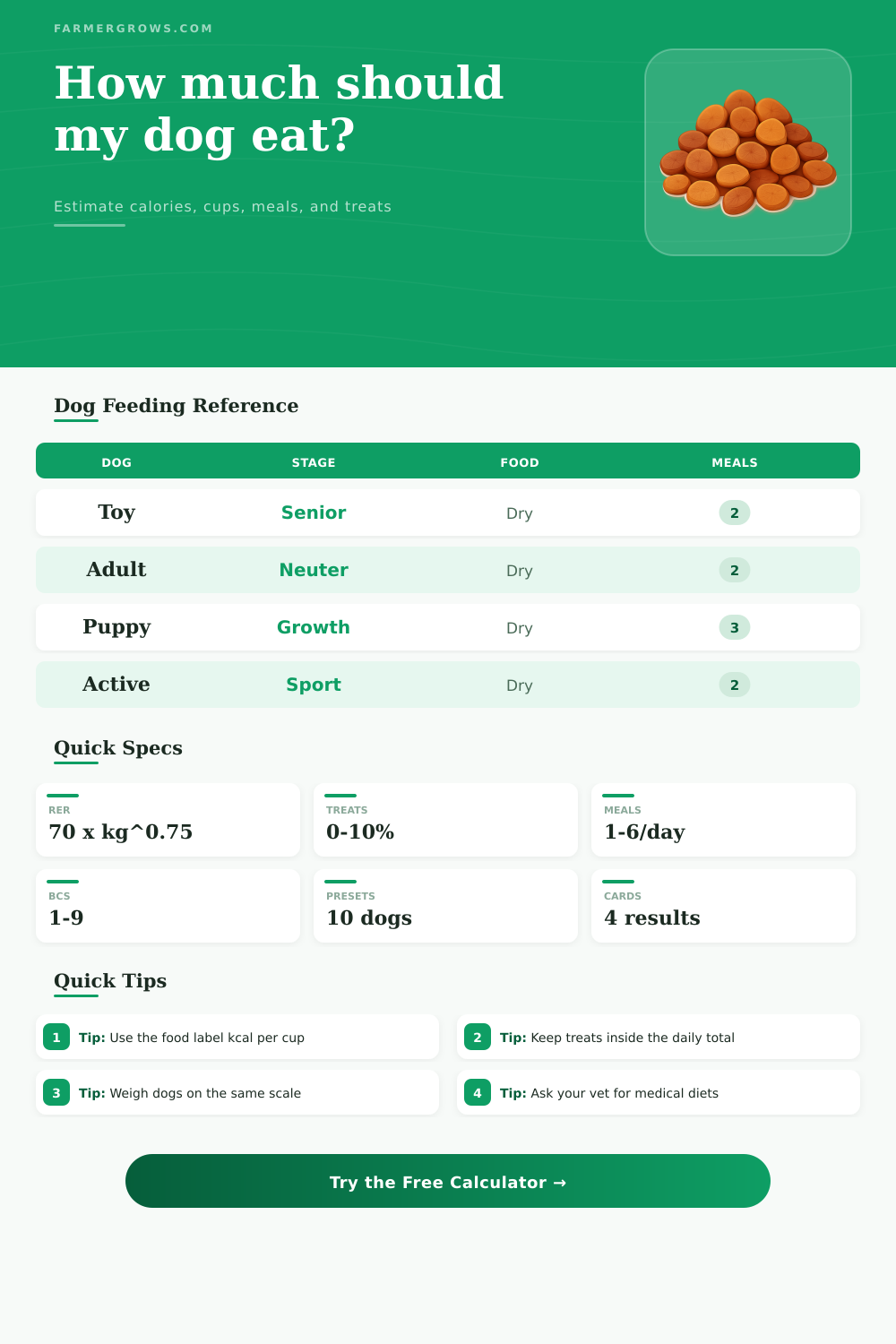
Dog Feed Calculator
Estimate daily dog calories, kibble cups, meal portions, treat allowance, and a practical weight plan from body weight, body condition, life stage, activity, neuter status, and food label calories.
Use this calculator for everyday feeding estimates. Growing puppies, pregnant or nursing dogs, dogs with disease, and dogs using prescription diets should have their feeding plan checked by a veterinarian.
Dog feeding estimate
Enter weight, body condition, and label calories to estimate the feeding plan.
RER = 70 x body weight in kg ^ 0.75
DER = RER x life stage x activity x body condition adjustment
cups = food calories after treats / kcal per cup
| Life stage | Base multiplier | Best use | Feeding note |
|---|---|---|---|
| Puppy under 4 months | About 3.0 x RER | Rapid growth | Use puppy food and recheck weight often. |
| Puppy 4 months to adult size | About 2.0 x RER | Later growth | Large breeds need controlled growth plans. |
| Adult spayed or neutered | About 1.4 to 1.6 x RER | Maintenance | Adjust by body condition and activity. |
| Pregnant or nursing | About 1.8 to 4.0 x RER | Reproduction | Use veterinary guidance for litter size and milk demand. |
| BCS | How it looks | Calculator adjustment | Planning action |
|---|---|---|---|
| 1 to 3 | Thin, ribs easy to see or feel | Adds calories | Plan a gradual gain and check for health causes. |
| 4 to 5 | Ideal waist and easy rib feel | No reduction | Maintain and weigh monthly. |
| 6 to 7 | Ribs harder to feel, waist reduced | Moderate reduction | Use target weight and track weekly. |
| 8 to 9 | Obese, heavy fat cover | Larger reduction | Ask your vet before aggressive restriction. |
| Profile | Typical multiplier effect | What changes | Watch point |
|---|---|---|---|
| Low activity | About 0.85 x activity | Less daily movement | Portions can creep high if treats are not counted. |
| Normal adult | About 1.0 x activity | Walks and regular play | Use body condition to fine tune. |
| Sport or working | About 1.4 to 1.7 x activity | Training, field, farm, or long work | Increase slowly and monitor stool and weight. |
| Spayed or neutered | Lower adult baseline | Energy needs often decrease | Recheck calories after surgery and recovery. |
| Food label density | 600 kcal/day | 900 kcal/day | 1200 kcal/day |
|---|---|---|---|
| 300 kcal per cup | 2.00 cups | 3.00 cups | 4.00 cups |
| 380 kcal per cup | 1.58 cups | 2.37 cups | 3.16 cups |
| 450 kcal per cup | 1.33 cups | 2.00 cups | 2.67 cups |
| 520 kcal per cup | 1.15 cups | 1.73 cups | 2.31 cups |
Measure from the label. Two foods can use the same scoop but deliver very different calories, so change the kcal per cup input any time you switch formulas.
Track the dog, not the bowl. Weigh your dog regularly and adjust portions in small steps when body condition, activity, or treats change.
Determining the correct amount of food for dog is a necessary process to maintain the health of dogs. To determine the amount of food that a dog require, a person must perform some calculations. The calculator help a person to perform these calculations.
Specifically, the calculator uses several different inputs to determine the target amount of calorie that the dog should consume. A person must input the weight of the dog, the body condition of the dog, the life stage of the dog, the activity level of the dog, and the calorie density of the dog food. The calorie density of the dog food is one of the most important of these different input.
How Much to Feed Your Dog
It is possible for two different dog food to appear the same when measured in measuring cup, but the calorie count in each food could be drastically different. In this case, it is always best to use the calorie count that is listed on the food label as the starting point for the calculations. While all dogs require a certain amount of calories for maintenance, there are often adjustments that must be made to that basic calorie requirement.
Many dogs require additional calories because they is growing, recovering from an illness, or they are too heavy for their body size. One formula that a person can use to calculate the baseline calories for a dog is the resting energy requirement. That formula requires that a person multiply the dog’s body weight (in kilograms) by factor that reflect its life stage and its activity level.
Puppies that are under four month of age have a high factor because of the rapid rate at which their bodies are building tissue. Similarly, the resting energy requirement for a senior dog that has been spayed or neutered is lower than dogs of other ages because the metabolism of the dog change with the passing of time. Another factor that can be used is the body condition score for the dog.
This measures the visibility of the dog’s ribs. If the ribs are easily felt, the dog requires additional calories to support its body structure. An older dog’s activity level will impact the amount of calorie that it requires to recover from its physical activities.
For instance, dogs that only get walks and live in yards require fewer calories than dogs that participate in agility or live on a farm. Activity level impact the amount of energy that a dog burns during the day, and the body requires energy to recover from those physical activities. A low activity level to the dog will result in fewer calories being require by the dog each day.
To account for the activity level of a dog, the dog owner can use the activity level dropdown on the calculator to adjust the calorie requirement for the dog. If the activity level of the dog is reduced, the dog owner must also reduce the amount of food that is provided to the dog to avoid providing excess calories to that dog. Treats are another consideration for the calorie requirement of dogs.
A person must ensure that the dog does not consume too many calories from treats. Treats should only account for ten percent of the dogs daily calories. Many people feed treats to their dogs in excess of this percentage.
Common treats, such as cheese, contain a high number of calories. The ten percent of the dog’s calories that is allotted to treats can be seen in the calculator. Should the number of calories from treats come close to reaching the dog’s calorie allowance, the dog should be given fewer high-value treats to adhere to the food portion that is require to provide the dog with complete nutrition.
A dog’s weight goals will take time to achieve, and the changes to the dog’s weight should be gradual. The weight goals for a dog can take place over many week rather than many days. The calculator estimates the number of week that it will take for the dog to reach its weight goal based on the gradual changes to the food that is provided to the dog.
Rapid changes to the weight of the dog are not recommended. The reason for not wanting to make rapid changes to a dog’s weight is that the dog’s joints may be stressed. If the dog needs to lose weight, the feeding plan for the dog will respect the body condition score.
Similarly, if the dog is to gain weight, it should be done on a measured path so as to not drastically change the portion size that is provided to the dog. The life stage of the dog will change the calories that is required of the dog. For instance, pregnant and nursing dogs have increased calorie requirements as the nursing mother’s calories can double if the litter is of a specific size.
A person can adjust the life stage of the dog by using higher multipliers in the calculator. However, a dog owner should seek guidance from a veterinarian as there is great variation of individual dogs. For instance, large-breed puppies have different requirements of food than puppies of other breeds.
The calculator will use a different multiplier for large-breed puppies than for puppies of other breeds. The reason for this is that the older puppies have a lower multiplier for the growth of their bodies than the puppies that are of a younger age. Using the body condition scoring system for dogs, a person can determine the physical condition of the dog.
On a nine-point scale, feeling the dog’s ribs and examining the waist evaluates the physical body condition of the dog. A score of five is the ideal body weight for the dog. A score of six or seven indicate the dog is too heavy for its body size and it needs to consume fewer calories.
A score that is below four indicate the dog needs to consume more calories to establish a healthy body weight. This scoring should be performed every few weeks and the food calculator should be adjusted to account for the body condition of the dog. The format in which the food is provided to the dog can impact the calories that is provided to the dog.
For instance, dry kibble food will have a higher calorie count than canned food of the same brand. Additionally, food that is prepared in the kitchen and gently cooked will have different calories than freeze-dried food. Food that is measured in ounces can have different calories than food that is measured in cups.
The calorie count should be adjusted in the calculator to account for the specific food that will be provided to the dog. Common mistakes in feeding dogs can occur from using an outdated weight for the dog or ignoring the allowance of calories for treats. For instance, dogs that used to be active at two years of age may not have the same activity level at six years of age.
The calculator can be adjusted for these changes. A helpful habit is to weigh the dog on the same scale every two to four weeks. This will allow the dog owner to monitor the dog’s weight and adjust the portion of food that is provided to the dog.
Although the calculator can determine the daily calories and the amount of food in cups that should be provided to a dog each day, the owner should also monitor the dog and adjust the calculator according to how well the dog is tolerate the food portions.