Cat Gestation Period Calculator
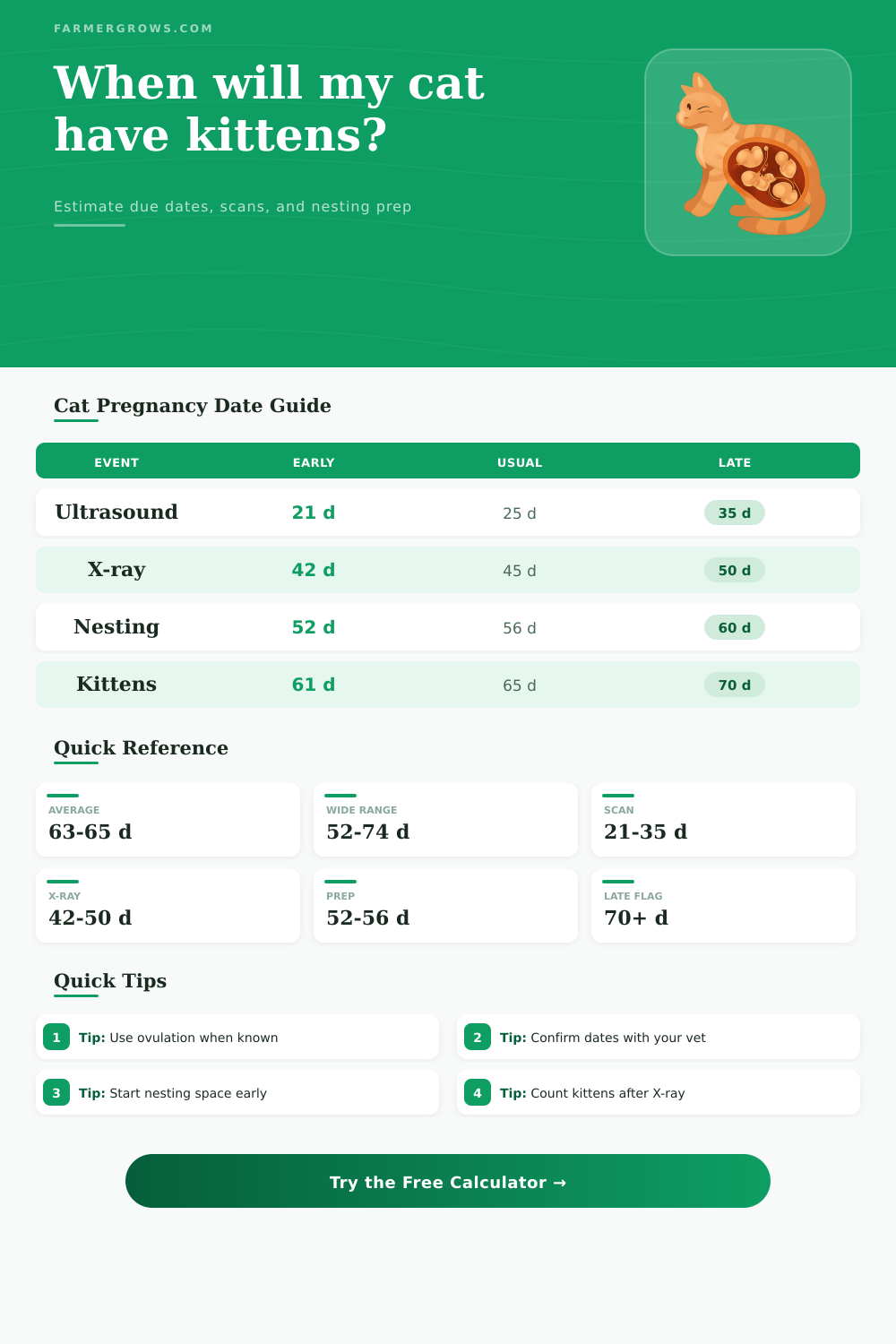
Estimate a queen's kitten due date from mating or ovulation timing, then see the early and late range, ultrasound window, X-ray counting window, nesting prep date, and breed-adjusted notes.
Cats average about 63 to 65 days of pregnancy, but mating-based estimates can be wider because ovulation may not happen on the first mating. Use this as a planning tool and confirm pregnancy timing with a veterinarian.
Cat Pregnancy Estimate
Enter a mating date to estimate the due date range.
| Pregnancy point | Approximate day | What it helps with | Planning note |
|---|---|---|---|
| Breeding or ovulation anchor | Day 0 to 2 | Starts the due date clock | Known ovulation gives a tighter estimate than mating alone. |
| Early ultrasound range | Day 21 to 35 | Pregnancy confirmation and heartbeat check | Counting kittens by ultrasound can be imprecise, especially later. |
| Mid-pregnancy belly changes | Day 30 to 45 | Visible growth, appetite watch, and housing plan | Body shape and coat can hide changes in some queens. |
| Late radiograph range | Day 42 to 50+ | Kitten count after skeletons mineralize | Ask a veterinarian when radiographs fit the queen's case. |
| Nesting and close watch | Day 52 to 60 | Quiet box, supplies, and behavior tracking | Place the nest early so the queen can choose it calmly. |
| Likely birth window | Day 61 to 70 | Highest-attention period for labor signs | Contact a veterinarian for unusual discharge, distress, or long delay. |
| Check | Early window | Best use | Limit to remember |
|---|---|---|---|
| Palpation by veterinarian | About day 17 to 25 | Early pregnancy suspicion in skilled hands | Not a home check, and timing can be easy to miss. |
| Ultrasound confirmation | About day 21 to 35 | Confirms pregnancy and checks viability | It may not give a dependable kitten count. |
| Heartbeat view | About week 3 to 4 | Viability and pregnancy confirmation | Equipment and timing affect what can be seen. |
| X-ray count | About day 42 to 50+ | Counts kittens after skeleton mineralization | It is a later tool, not an early pregnancy test. |
| Factor | Calculator effect | Why it matters | Practical use |
|---|---|---|---|
| Siamese or Oriental type | Adds about 1 day to target | Some lines trend a little longer | Keep the late range visible without waiting too long. |
| Persian or Exotic type | Adds about 0 to 1 day | Body shape can mask visual progress | Use date-based scheduling rather than belly size alone. |
| Large expected litter | Moves early range slightly earlier | Large litters may arrive before the average date | Start nesting and supply prep earlier. |
| Singleton or very small litter | Adds a late watch note | Small litters can be harder to judge by size | Vet confirmation is especially useful near term. |
| Young or senior queen | Widened watch note | Age can raise monitoring needs | Plan a lower threshold for veterinary guidance. |
| Prep item | Start timing | What to set up | Why it helps |
|---|---|---|---|
| Quiet nesting box | Day 52 to 56 | Low-sided box with clean washable bedding | Gives the queen time to accept a calm birth spot. |
| Food and water station | Late month two | Pregnancy or kitten food with easy water access | Energy needs rise as birth and nursing approach. |
| Daily observation log | Day 55 onward | Appetite, behavior, discharge, and temperature notes | Makes changes easier to describe to a veterinarian. |
| Veterinary contact plan | Before due week | Clinic number, after-hours option, and transport carrier | Removes delay if labor appears abnormal. |
Mating alone can be a looser anchor because cats often ovulate after adequate stimulation, so a confirmed ovulation date narrows the target window.
Set the nesting area, food plan, records, and veterinary contact details before the final week so late pregnancy is calmer and easier to monitor.
This calculator is for planning dates only. Seek veterinary care promptly for heavy bleeding, foul discharge, severe weakness, visible distress, or prolonged straining without a kitten.
A cat pregnancy typicaly last for an average of nine weeks. However, the length of the pregnancy can change based on the specific cat and the number of kitten that are to be born. Additionally, tracking the length of pregnancy for a cat can be difficult due to the nature of the cat’s reproductive system.
Because cats is induced ovulators, the mating of two cats does not ensure that the female will release its egg on the same day that the mating occurs. Thus, the start date for the pregnancy can be a day different from when the cat was mated. For these reasons, two cats that were mated on the same date may deliver their kittens one week apart.
Cat Pregnancy: How Long and How to Prepare
Using a pregnancy calculator for cats allow for the owner to account for both the date of mating and the cats ovulation cycle. The pregnancy calculator allows the owner to choose whether the cat ovulated on the same day that they were mated, one day later, or two days later. Choosing this date shifts the pregnancy timeline to account for when the cat may give birth, which is important for knowing when to perform an ultrasound examination of the pregnant cat, or to prepare a nesting box for the kittens that will soon be born.
The breed and the physical condition of the cat can impact the length of the pregnancy. For instance, a Siamese cat may have a longer pregnancy then other breeds of cats, and an underweight cat may have a shorter pregnancy than the average length of pregnancy. Additionally, large litters may give birth to all of their kittens sooner than small litters.
Similarly, a cat that has a single kitten will have that kitten remain in the body of the cat longer than a large litter of kittens. Furthermore, the age of the cat can also influence the length of pregnancy. Cats of any age may experience complications during pregnancy, but the bodies of young and senior cats may reveal any medical issues earlier during pregnancy, or may take longer to recover after the giving of birth.
Using time windows during pregnancy will assist the owner in caring for the pregnant cat. For example, one of the earliest time windows during pregnancy is for an ultrasound examination of the cat to reveal the number of kittens in the litter, and to confirm the pregnancy of the cat. Later in the pregnancy, a veterinarian can take an X-ray of the pregnant cat to reveal the skeletons of the kittens.
By being able to determine the number of kittens in the pregnancy, the owner can be certain that each of the kittens has been born during the labor of the cat. Additionally, the owner should prepare the nesting box for the kittens earlier in the pregnancy of the cat, to allow for the cat to become accustomed to the nesting box. A pregnancy calculator for cats will reveal not only the date when the cat is to give birth, but also a wider watch range for the pregnancy of the cat.
The wider watch range is used to account for the nature of pregnancy, some pregnancies will not conform to the length of pregnancy that the pregnancy calculator calculates. For instance, it is common for individuals to make the mistake of assuming that the first time that the two cats mate is the start date for the pregnancy. However, accounting for the ovulation cycle of the pregnant cat will allow for any adjustment to be made to the pregnancy length.
The size of the pregnant cats belly is not a measurement that can be used to track the pregnancy of the cat. For example, the length of the pregnancy may be reflected in the belly size of the cat, but the size of the belly may not necessarily reflect the true length of pregnancy. For example, a cat with a long coat may hide the belly size from the growth of the kittens.
Thus, only using the belly size to monitor the pregnancy may cause an owner to either miss the window of time in which to perform an ultrasound examination, or to prepare the nesting box for the kittens. As the length of pregnancy nears its end, the pregnancy calculator will assist the owner in making daily decisions regarding the pregnancy. For example, the preparation window for the pregnancy will reveal when to prepare the nesting box, and when to begin to keep a log of the appetite of the pregnant cat.
Additionally, the date range for the X-ray examination will reveal when to take the pregnant cat to a veterinarian to examine the litter of kittens. As the pregnancy reaches its final few days, the pregnant cat may begin to exhibit certain behavior. For instance, the pregnant cat may become restless, it may not eat food, or it may seek spots within the house that are cooler than the rest of the environment.
Additionally, a vocal cat may become quiet, or a quiet cat may begin to vocalize. These behaviors dont necessarily match the days that is calculated by the pregnancy calculator. Thus, the pregnancy calculator includes buffer days for both the start of pregnancy and the end of pregnancy.
These buffer days are provided to account for the fact that pregnancies are not always the same as the average pregnancy length. In planning for the pregnancy of a cat, the owner can prepare for the arrival of the kittens. For instance, if the owner has created a pregnancy calendar and calculated the length of pregnancy for the cat, they will know if more kittens are to be born based on the litter size.
Additionally, the owner will have a record of the behavior of the pregnant cat that can be presented to a veterinarian when examining the cat. Furthermore, because the owner prepared the nesting box prior to the giving of birth, the cat is more likely to use the nesting box for the newborn kittens. Finally, while the pregnancy calculator will not reveal the hour during which the cat will give birth, using such a calculator does provide for the owner a structure in which to respond to the giving of birth to the cat.