Propane Tank Weight Calculator
Estimate the propane weight, cylinder gross weight, safe fill percentage, multi-cylinder load, and transport limit margin from tare weight, water capacity, propane gallons, temperature, and cylinder type.
Use the stamped TW for tare weight and WC for water capacity whenever possible. If the propane gallons field is left at 0, the calculator estimates gallons from the fill percent and water capacity.
Propane Tank Weight Result
Enter the tare, water capacity, gallons, fill percentage, and cylinder count to estimate propane and gross weight.
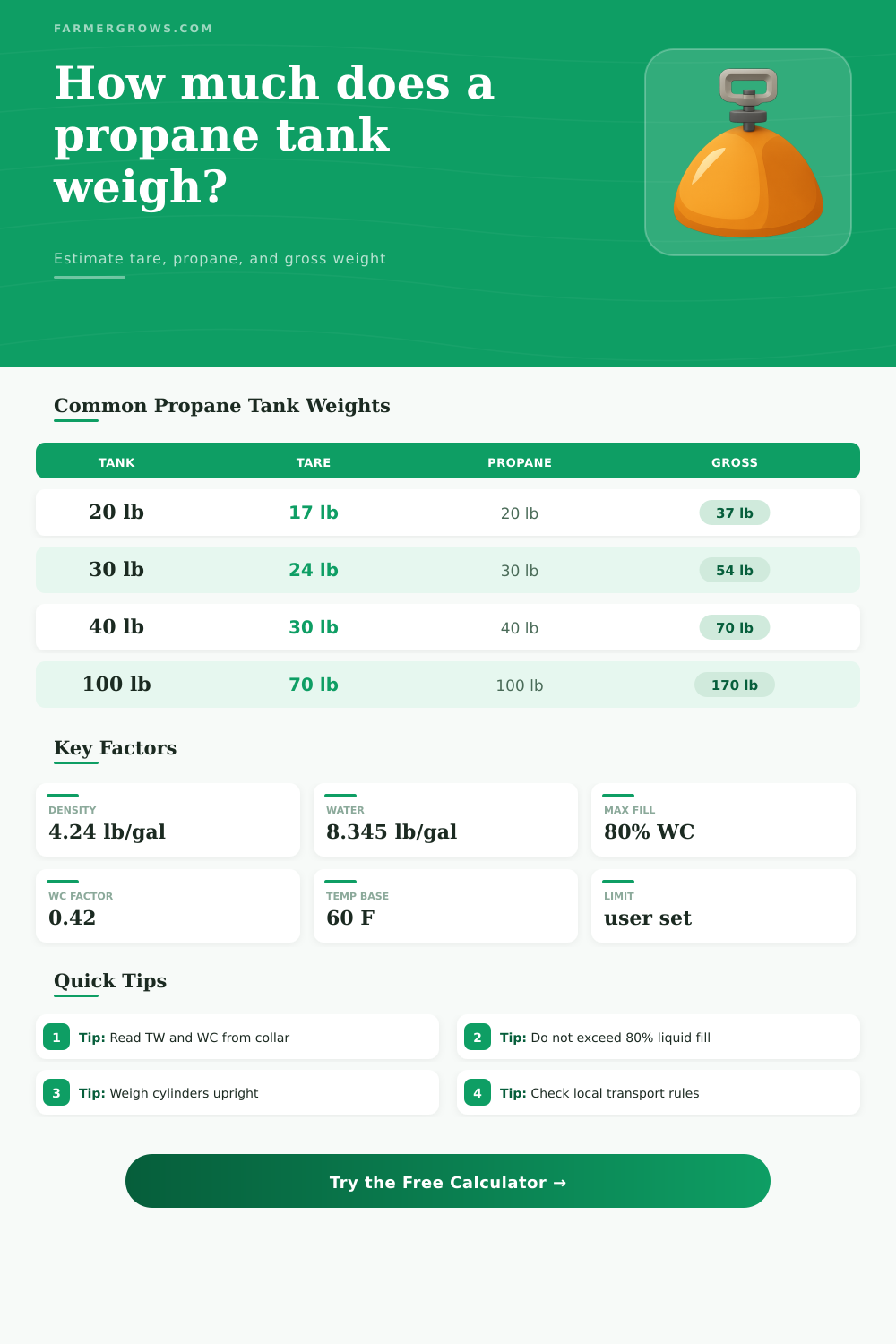
The grid compares common propane cylinders using the selected temperature factor. Gross weights are approximate because real tare weights vary by manufacturer and age.
| Cylinder size | Typical tare weight | Propane capacity | Approximate full gross weight |
|---|---|---|---|
| 1 lb disposable or refillable bottle | 0.8 to 1.1 lb | 1 lb, about 0.24 gal | About 2 lb |
| 5 lb portable cylinder | 7 to 9 lb | 5 lb, about 1.2 gal | About 13 lb |
| 20 lb grill cylinder | 16 to 18 lb | 20 lb, about 4.7 gal | About 36 to 38 lb |
| 30 lb RV cylinder | 23 to 26 lb | 30 lb, about 7.1 gal | About 53 to 56 lb |
| 40 lb tall cylinder | 29 to 32 lb | 40 lb, about 9.4 gal | About 69 to 72 lb |
| 100 lb cylinder | 68 to 76 lb | 100 lb, about 23.6 gal | About 168 to 176 lb |
| Stamped value or formula | What it means | Example | Use in calculator |
|---|---|---|---|
| TW | Tare weight, the empty cylinder weight | TW 17.0 on a grill cylinder | Added to propane weight for gross weight |
| WC | Water capacity in pounds | WC 47.6 for many 20 lb cylinders | Converted to gallons with 8.345 lb per gallon |
| WC x 0.42 | Common propane capacity estimate by weight | 47.6 x 0.42 = 20.0 lb | Used as a rated capacity cross-check |
| WC gal x 0.80 | Common maximum liquid propane gallons | 5.70 water gal x 0.80 = 4.56 gal | Compared with entered propane gallons |
| Condition | Calculator factor | Approximate effect | Field note |
|---|---|---|---|
| Cold, around 20 F | 1.04 | Propane weight per gallon reads higher | Useful for winter cylinder weighing |
| Cool, around 40 F | 1.02 | Slightly denser than 60 F baseline | Good for cool storage sheds |
| Standard, around 60 F | 1.00 | Uses 4.24 lb per gallon | Common reference condition |
| Warm to hot, 80 to 100 F | 0.98 to 0.96 | Propane expands and weighs less per gallon | Leave expansion space and avoid overfill |
| Planning item | Typical check | Why it matters | Calculator output to watch |
|---|---|---|---|
| Single cylinder handling | Gross weight per cylinder | Controls lifting, securing, and rack loading | Gross Cylinder result card |
| Multiple cylinder load | Gross weight x count | Shows the total carried in one trip | Total Load result card |
| Personal transport limit | User-entered gross weight limit | Lets you set a conservative local threshold | Transport margin in breakdown |
| Overfill check | Entered gallons vs 80% water volume | Flags liquid volume above common safe fill space | Fill Status result card |
This calculator is for planning and weight estimation only. Follow cylinder markings, supplier instructions, fire code, DOT or local transport rules, and propane professional guidance for filling, storage, and transport.
The weights of propane tanks is a significant factor for propane tank operation. The weight of propane tanks can changes based on the amount of propane insides the propane tank. In order to safely move propane tanks or to load propane tanks into a vehicle, it is important to understanding the weight of propane tanks.
The weight of propane tanks are determined by the weight of the propane tanks when empty and the weight of the propane inside the propane tank. In order to determine the weight of propane tanks, a person must look at the number stamped on the propane tank collars. The numbers on the propane tank collar will help a person to calculate the weight of the propane tanks.
How to Find the Weight of a Propane Tank
The tare weight indicate the weight of the empty propane tank. The water capacity indicate the amount of water that the tank can hold if it were to be filled with water. Using these two numbers, a person can calculate the weight of the propane that is in the propane tank.
Many people uses the water capacity to calculate how many gallon of propane are in the tank. However, propane tanks should not be filled to more than 80% of the water capacity. The 80% rule is used to allow for the expansion of the propane in the propane tank if the temperature increase.
The temperature of the propane tanks may also impact the weight of the propane inside the tanks. When it is colder outside, the density of the propane will be higher and the propane will weigh more then propane held in a propane tank that is warm. You must account for the temperature of the propane in the tanks because temperature can change the weight of the propane.
If you do not account for the temperature, you may make mistake when calculating the total weight of propane tanks. The type of propane tanks that you use may also affect the propane tanks. For instance, an aluminum propane tank will weigh less then a propane tank that is made of steel.
Additionally, the design of forklift cylinder tanks are different than propane tanks used for grills. Each type of propane tank should be identified before use in order to ensure that the weight of the propane tanks is accurately calculate for the specific situation. In addition to calculating the weight of individual propane tanks, the total weight of all of the propane tanks that are to be transported must also be calculate.
In order to calculate the total weight of all of the propane tanks that are being transported, the tare weight and the weight of the propane inside each of the propane tanks must be calculated and add. If there are five propane tanks to be load into a truck, for instance, the weight of the propane in one tank should be multiplied by five to determine the total weight of the five propane tanks. This total weight will impact the suspension of the transport vehicle and the safety of the transport of the propane tanks.
A weight limit can be set for the vehicle. Using a propane calculator, it is also possible to determine whether or not the total weight of the propane tanks is within the weight limit of the transport vehicle. Common errors include not using the tare weight of the empty propane tanks in the calculations.
People may only calculate the weight of the propane in the tanks, but the weight of the empty propane tanks should also be account for in the total weight of the tanks. Another common error is forgetting that the water capacity number refers to the amount of water that the propane tanks can hold, not the amount of propane that the tanks can hold. A person must use the correct conversion factor to calculate the number of gallons of propane from the water capacity.
If a person remembers the information on the propane tank collars correctly, they will not make these common error and will have more better control over the total weight of there propane tanks.