Barn Size Calculator
Estimate a practical barn footprint from livestock type and count, stall dimensions, aisle width, hay and feed storage, tack or equipment space, ceiling height, ventilation rate, and future growth buffer.
Use the presets as starting points, then adjust the inputs for your herd, access needs, storage habits, and local building rules. The output is a planning estimate, not a stamped building plan.
Your Barn Sizing Estimate
Enter your livestock and storage details, then calculate.
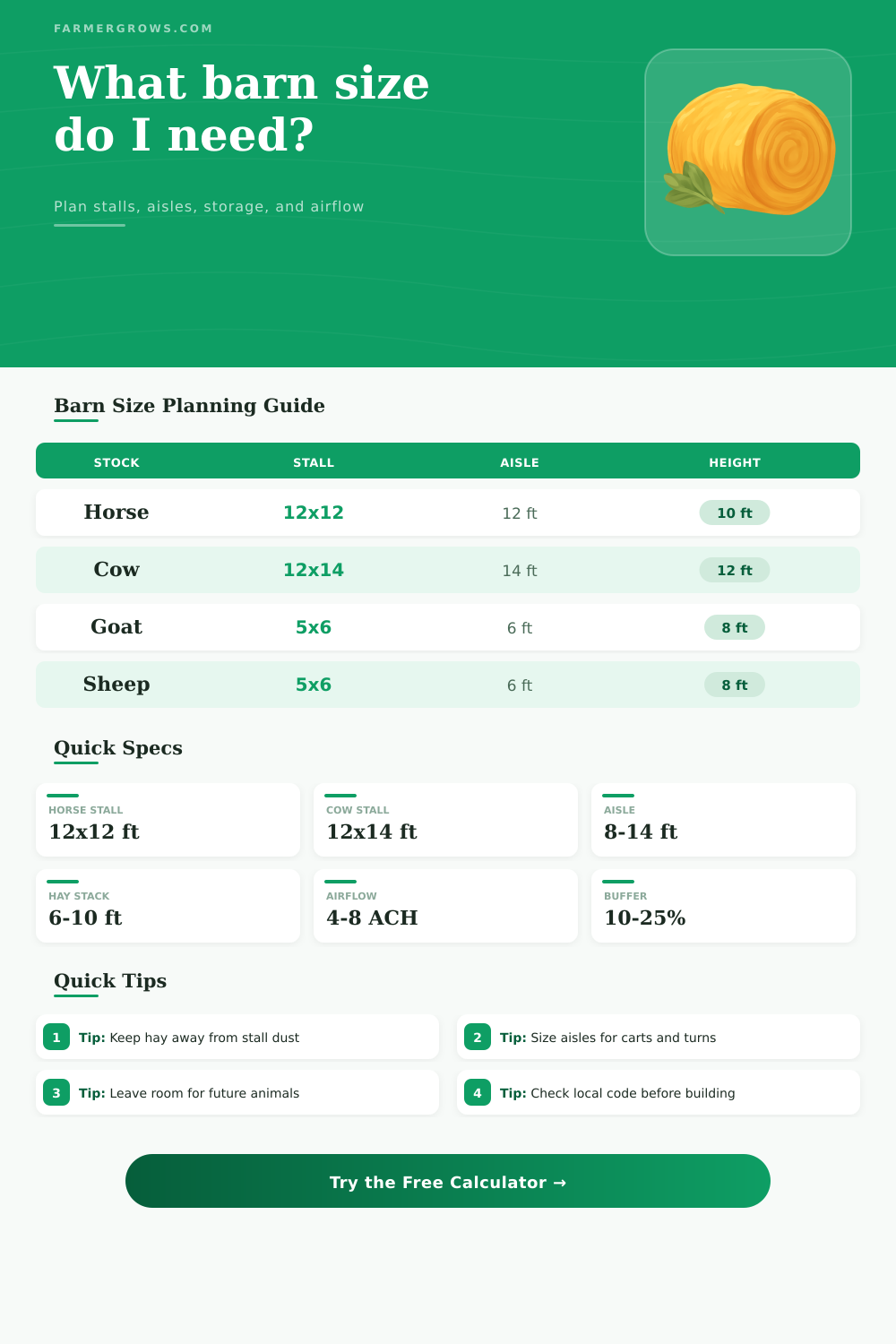
| Livestock type | Starting stall or bay | Suggested aisle | Ceiling planning note |
|---|---|---|---|
| Horse | 12 ft × 12 ft per animal | 10 to 14 ft | 10 to 12 ft helps riders, forks, fans, and warmer air rise. |
| Cow / dairy | 12 ft × 14 ft or larger box stall | 12 to 14 ft | 12 ft or higher helps moisture, manure gases, and equipment clearance. |
| Goat | 5 ft × 6 ft pen bay or grouped pen | 5 to 8 ft | 8 ft is usually workable, with protected hay and climb-safe partitions. |
| Sheep | 5 ft × 6 ft bay or group lambing space | 5 to 8 ft | 8 ft works for small barns; add lambing jugs as seasonal space. |
| Pig | 6 ft × 8 ft pen bay or larger farrowing pen | 6 to 10 ft | 8 to 10 ft improves fan placement and heat control. |
| Poultry | Grouped floor area, not individual stalls | 4 to 6 ft service aisle | 7 to 9 ft supports litter management and ridge ventilation. |
| Storage item | Planning assumption | Floor area method | Practical note |
|---|---|---|---|
| Small square hay bales | About 5.25 cu ft each | Bales × volume / stack height, then add access space | Do not stack tight to damp walls; leave inspection and fire separation room. |
| Round bales | Often stored outside or in a separate bay | Use custom feed area when planning indoor round-bale storage | Loader access usually controls the building opening more than bale diameter. |
| Grain and supplements | Bins, barrels, scoops, and mixing room | Enter direct feed storage area in the calculator | Keep feed secure from livestock, moisture, rodents, and spilled water. |
| Tack and medicine | Shelves, saddle racks, halters, tools, and lockable cabinet | Enter tack, tools, and equipment area separately | Dry, dust-reduced storage protects leather, labels, and electrical equipment. |
| Condition | ACH planning range | Ceiling height | Airflow detail |
|---|---|---|---|
| Cool, dry livestock barn | 4 to 6 ACH | 8 to 10 ft | Use continuous side inlets, ridge outlet, and low-draft animal zones. |
| Horse or dairy barn | 6 to 8 ACH | 10 to 12 ft | Moisture and bedding dust make cross-ventilation and high outlets important. |
| Warm poultry or pig room | 8 to 12 ACH | 8 to 10 ft | Fans may be needed for heat, humidity, litter, and manure gas control. |
| Open-sided shelter | Natural airflow | 8 ft or higher | Protect from prevailing weather while leaving broad, clear air paths. |
| Example barn | Likely layout | Typical footprint | What drives the size |
|---|---|---|---|
| 2 horse hobby barn | Single row or compact center aisle | About 24 ft × 36 ft | Two 12 ft stalls, hay corner, tack area, and a workable aisle. |
| 4 horse center aisle | Two stalls per side | About 36 ft × 48 ft | 12 ft stalls, 12 ft aisle, wash bay, tack, feed, and storage length. |
| Small goat dairy | Open pens plus milk area | About 24 ft × 40 ft | Group pen space, milking lane, hay rack access, and kidding flexibility. |
| Mixed homestead barn | Storage wing with flexible pens | About 36 ft × 60 ft | Multiple species, equipment, feed storage, quarantine, and future buffer. |
Hay, feed, tack, and medicine last longer when they are protected from stall humidity, spilled water, bedding dust, and animal traffic.
Size the aisle for the hardest turn: a nervous animal, loaded wheelbarrow, feed cart, small tractor, or emergency access path.
Always confirm setbacks, snow load, wind bracing, manure handling, electrical rules, fire separation, and animal welfare requirements with local professionals before construction.
When you are planning a barn, you have to consider more than the animals you will keep in the barn. Beyond the stalls for the animals, you also need space to store the equipment for the animals, as well as to allow for proper ventilation in the barn to prevent moldy hay and stalls. While many focus on the stalls that must be included for the animals, you must also consider the aisles for the wheelbarrow, the storage area for the hay to stay dry, and the ventilation in the barn to prevent mold.
Thus, planning for a barn considers more than how many animal you have; it also considers how much building space is required for the animals and there equipment. The dimensions of the barn will depend upon the type of livestock that you have. For instance, horses will require different stall dimension from dairy cows.
What to Plan for Your Barn
Additionally, the aisle width required for the goats may not be sufficient for moving the feed cart and animals. The number of areas for which hay must be stored will change with the seasons and the number of animals to be housed. Each of these variable can be entered into a barn calculator to determine the total building footprint that the barn will require to efficiently house the animals and provide for their needs.
Each of the variables will impact the total required footprint for the barn. For instance, the width and depth of the stalls will impact the area dedicated to the animals to be housed within the barn. The aisle width will impact the total footprint required for the barn to allow for both cart and animal movement.
The number of days that hay will be stored and the number of bales of hay per animal will impact the total area dedicated to hay storage. The height of the barn ceiling will impact the area for air movement in the barn, as well as impact how high the hay can be stacked. Finally, a growth percentage will be added to each of the other variables so as to provide additional space within the barn for any additional animals that may be added to the farm.
Each type of livestock will require different dimensions to its barn. For instance, horses will require certain dimensions within the stalls to allow for the animals to turn and lie down, but aisles may be required only for grooming of the animals. Dairy cows will require higher ceilings and increased ventilation rate due to the additional moisture that these animals produce.
Goats and sheep may be required to have smaller pens to house the animals, but still need hay racks and space for lambing or kidding. Pigs and poultry will require different planning considerations for the building of the barn, as pigs require specific temperature control for their environment and litter to be managed, as do the poultry in the barn. The layout of the barn is also as important as the dimensions of the barn.
For instance, a center aisle layout will require stalls on both sides of the barn, but will require more depth for the stalls to provide heating for the animals. A single row layout will cover less ground, and require the barn to be built against a wall. Open pen designs allow for the animals to live in larger pens rather than individual stalls, but require more floor area for each animal.
Finally, a storage wing will separate the hay and tack areas away from the stalls, which is a more effective way of managing the barn areas. Ventilation is also important in the barn planning process. The target air changes per hour will help to remove moisture from the barn areas while avoiding drafts upon the animals.
Ridge and sidewall vents will work well in many regions of the country. However, in areas that are hotter during the summer months, a monitor roof or a fan system may be required to provide adequate ventilation within the barn. Finally, the height of the ceiling will impact the total ventilation calculations for the barn; the higher the ceiling, the more air that can move within the barn.
Often, real barns will be different than those planned before construction. For instance, the location of the posts will impact the size of the barn; they take up space. Additionally, the doors may open in only one direction, which will impact the layout of the barn.
Finally, local codes will require certain distances between barn and property lines, barns within a farm, and manure areas, which will also affect the construction of the barn. While the barn calculator will produce a number for the total size of the barn, this number will require adjustments to the barn site during construction to account for these factors. It is also important to separate the areas within the barn for storage from the areas for the animals.
Separating the areas for storage from the animals allows for hay to remain drier within the storage area rather than within the barn stalls. Finally, the tack and medicine for the animals will last longer if they are stored in separate areas from the animals. Finally, it is also important to plan for the growth of the farm.
For instance, if there will be a need to add animals to the farm in the future, providing an extra percentage of the total area calculated will allow the farmer to avoid the need to build a lean-to barn addition to the existing barn. Overall, the goal in the construction of the barn is to build a structure that is sized for the actual work that will be performed within it. Thus, the barn should include stalls for the animals, aisles for the cart and movement of the animals, hay should remain dry within the barn for the winter months, and the ventilation within the barn should be efficient so that the barn does not have an unpleasant smell due to poor ventilation.
You should of considered alot of things when you start this proyect. It isnt easy to get the dimensions right and you’ll need to make sure the barn is comfortabley sized for the animals.