Acre to Square Feet Converter
Convert decimal acres, fractional acres, and measured farm dimensions into square feet, usable growing area, buffered planning area, and practical row or bed counts.
Choose whether the calculator should use acreage, dimensions, or both. Fractional acres are added to the decimal acre field, so 2 acres plus 1/4 acre equals 2.25 acres.
Converted Land Area
| Acre Amount | Square Feet | Square Yards | Square Meters |
|---|---|---|---|
| 1/16 acre | 2,722.5 sq ft | 302.5 sq yd | 252.93 m² |
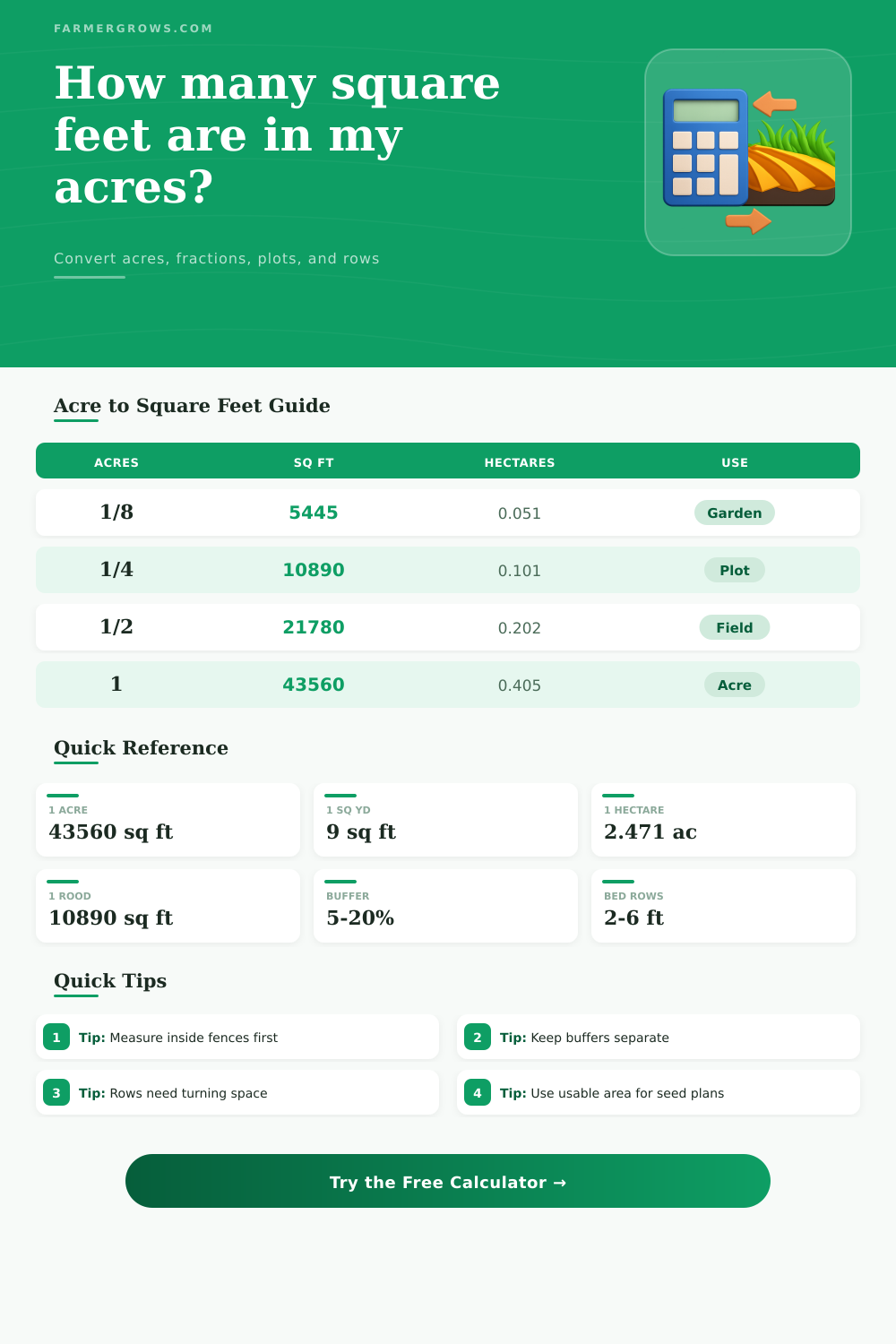
| 1/8 acre | 5,445 sq ft | 605 sq yd | 505.86 m² |
| 1/4 acre | 10,890 sq ft | 1,210 sq yd | 1,011.71 m² |
| 1/2 acre | 21,780 sq ft | 2,420 sq yd | 2,023.43 m² |
| 1 acre | 43,560 sq ft | 4,840 sq yd | 4,046.86 m² |
| 5 acres | 217,800 sq ft | 24,200 sq yd | 20,234.28 m² |
| Common Fraction | Decimal Acres | Square Feet | Typical Farm Use |
|---|---|---|---|
| 1/32 acre | 0.03125 | 1,361.25 | Hoop house or nursery pad |
| 1/16 acre | 0.0625 | 2,722.5 | Starter bed block |
| 1/8 acre | 0.125 | 5,445 | Home production garden |
| 1/4 acre | 0.25 | 10,890 | Market garden section |
| 1/3 acre | 0.3333 | 14,520 | Small orchard or berry plot |
| 3/4 acre | 0.75 | 32,670 | Expanded field block |
| Plot Dimensions | Area | Acres | Notes |
|---|---|---|---|
| 50 ft x 100 ft | 5,000 sq ft | 0.115 ac | Urban farm plot |
| 100 ft x 100 ft | 10,000 sq ft | 0.230 ac | Near quarter acre |
| 165 ft x 264 ft | 43,560 sq ft | 1.000 ac | Exact one-acre rectangle |
| 208.71 ft x 208.71 ft | 43,560 sq ft | 1.000 ac | Square acre side length |
| 330 ft x 660 ft | 217,800 sq ft | 5.000 ac | Five-acre rectangle |
| 660 ft x 660 ft | 435,600 sq ft | 10.000 ac | Ten-acre square |
| Row or Bed Layout | Module Width | 100 ft Rows per Acre | Approx. Bed Area |
|---|---|---|---|
| 30 in bed + 18 in path | 4 ft | 108 rows | 27,225 sq ft planted |
| 36 in bed + 18 in path | 4.5 ft | 96 rows | 29,040 sq ft planted |
| 48 in bed + 24 in path | 6 ft | 72 rows | 29,040 sq ft planted |
| Single crop row 3 ft spacing | 3 ft | 145 rows | Varies by crop |
| Orchard row 20 ft spacing | 20 ft | 21 rows | Tree count depends on in-row spacing |
| Pasture lane 40 ft strip | 40 ft | 10 strips | Useful for rotation checks |
Conversion factors used: 1 acre = 43,560 square feet, 1 square foot = 0.09290304 square meters, and 1 acre = 0.404685642 hectares.
When planning a farm or a garden, it is important to understand the difference between total acreage and usable square footage. While the tax records of that plot or the deed of that land can readily provide the total acreage, the usable square footage is the actual amount of that land that can be utilized for farming activity. Many people makes mistakes with calculating the amount of supplies that is required for farming that land due to the use of total acreage rather than usable square footage; total acreage do not account for the amount of land that is taken up by paths, fences, or ditches used to drain the land.
Using the total acreage for planning a farm can lead to purchasing too much of one supply or too little of another, as well as to not having enough space to actualy create the number of garden bed that are needed for the intended crops. The calculator included on this website can help to convert total acreage to usable square footage. You can enter total acreage directly into the calculator, as well as the length and width of the land plot.
Total Acreage and Usable Square Footage
Additionally, the percentage of the land plot that is usable can be accounted for; many plots is not rectangular in shape, as, for instance, sheds, fencing areas, or ditches can occupy part of that land plot. Additionally, by using this calculator, the user can convert a legal number (total acreage) to a working number (usable square footage) which can then be used to determine the number of rows of crop that can be planted on that land, as well as the amount of compost that should be ordered to prepare the land. Many plots are fractional acre in size; the calculator accounts for fractional acres directly.
It is common for plots to be of sizes of only quarter-acres or eighth-acres, and it is important for these fractional acres to be accounted for in the calculations rather than requiring the individual owner of the land to calculate the square footage of those fractions themselves. As with determining the total area of land that will be used for farming activities, it is also important to use the usable area input to account for land plots that include items such as sheds, farm lane, and other areas that are not usable for farming activities. By making these calculations prior to the beginning of the farming season, the farm owner can avoid the mistakes that may otherwise happen if the land is only planned for farming based on the total acreage of that farm.
In addition to being able to determine the total area that is usable for farming activities, it is also possible to use the calculator to determine the number of rows that can be established on that land. Different type of garden beds of a specific width can be established on the land, as well as aisles of specific width between those garden beds. By dividing the total usable square footage by the size of each module (each row of garden beds of a specific width and aisles of a specific width), the user can determine the number of rows that can be established on that land.
While the calculations are not exact, and the actual number of rows that is established on the land may be less than the number calculate by this tool, the calculation is still an accurate estimation of the number of rows that can be established. Additionally, as is common in the planning of farms, a buffer percentage can be applied to the total usable square footage; this buffer percentage provides a small amount of extra usable square footage that is included in the total calculations for the land to account for any potential error in the measurements of that land plot. The tool is also helpful in that it allows for the comparison of different sizes of land plots.
For instance, while a half-acre of land may sound like a significant amount of land for farming activities, that same half-acre of land may be smaller in size once you subtract the space requirement of the farm lanes. Similarly, five acres of land may seem large for farming, but it may include land plots that are used for pastures or orchards, each of which require there own fencing plots. These reference tables help to provide an understanding of the relationship between land plots of different sizes without having to memorize these measurements.
An additional common mistake that farm owners can make is to confuse the total acreage with usable acreage. For instance, 160 acres of land may sound like a significant amount of land, but if that land is to be used for farming activities, the usable area for those activities may be much more smaller than 160 acres. The dimensions of the land that can actually be used for farming should be entered into the calculator, as well as that percentage of the total area that will actually be usable for farming activities.
Using such measurement will ensure that the amount of seed that is ordered for that plot of land is the appropriate amount. Additionally, the acreage calculator also features the ability to perform metric calculations. For instance, many people are familiar with the imperial system of measurements for land, but other country use the metric system of measurements.
Square meters and hectares are units of area that are used in these different countries. By choosing either the “feet” or “meters” in the calculator, the measurements in either the imperial system or the metric system will automatically be converted into the other system, allowing the comparison of the size of different pastures or land plots. Finally, it is important for the reader to become familiar with the difference between the buffered and usable square footage.
Buffered square footage is the total area that is calculated for farming activities with the inclusion of a buffer percentage. This number should be used when ordering supplies for those farm, as errors in preparation of the land will lead to errors in the amount of materials that are ordered. Usable square footage is the total area that is calculated for farming activities, but without the inclusion of the buffer percentage.
This number can be used to prepare the farm plots for the planting of crop. By using this tool and remembering the difference between these two measurements, farm owners will not run out of the materials that are required to prepare the plots for the planting of crops. Additionally, by thinking in terms of square footage, farm owners will have a more accurate understanding of the amount of land that they own, as well as an understanding of how to compare the size of their different plots of land.