Propane Tank Size Calculator
Estimate the propane gallons, nominal tank size, usable BTU storage, and refill interval for home heat, farm shops, water heaters, generators, dryers, cooktops, and mixed rural loads.
●Home and farm propane presets
Start with a common propane setup, then adjust the BTU loads, run hours, reserve days, fill percent, climate factor, delivery interval, and safety buffer.
●Propane load inputs
Use this for ranges, dryers, space heaters, pool heaters, or combined smaller appliances.
Use burner-on equivalent hours, not thermostat hours. Cold houses may need 8 to 14.
A standby generator can use a lot of propane during outages, even when heating load is modest.
The calculator sizes for whichever is larger: reserve days or the delivery interval.
Many stationary propane tanks are filled to about 80% liquid capacity to leave vapor expansion space.
The recommended tank may be larger than this comparison tank.
Calculation breakdown
●Propane planning numbers
●Common propane tank reference table
| Nominal tank | Usable gallons at 80% | Usable BTU | Common planning use |
|---|---|---|---|
| 20 lb cylinder | About 3.8 gal | About 344,000 BTU | Grills, small heaters, short emergency use. |
| 100 lb cylinder | About 18.9 gal | About 1.73 million BTU | Shop heaters, fireplaces, temporary appliance service. |
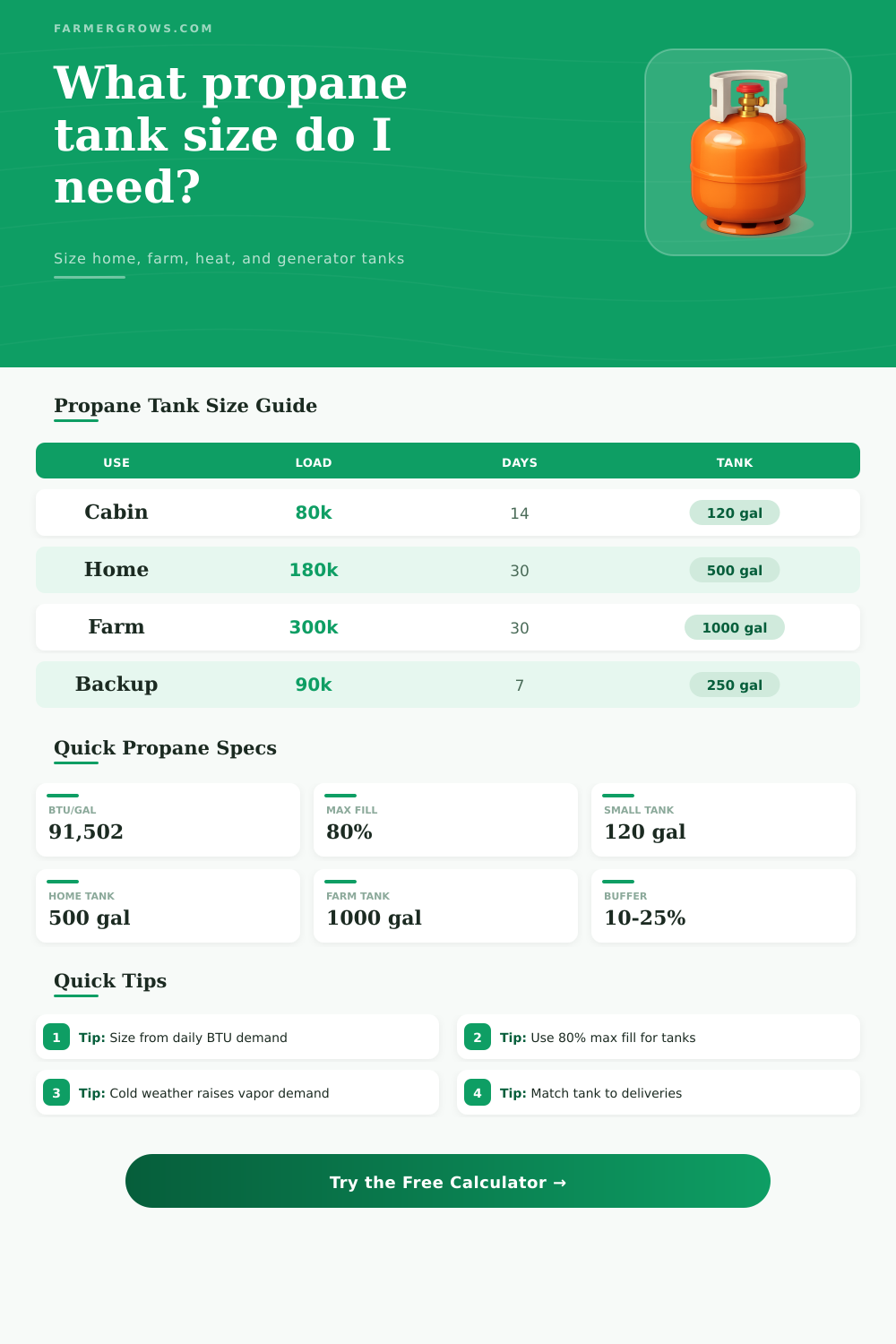
| 120 gal tank | 96 gal | About 8.78 million BTU | Cabins, cooking, water heat, modest seasonal use. |
| 250 gal tank | 200 gal | About 18.30 million BTU | Small homes, generators, and mixed light loads. |
| 500 gal tank | 400 gal | About 36.60 million BTU | Many full-time homes with furnace and water heater. |
| 1000 gal tank | 800 gal | About 73.20 million BTU | Large homes, farms, shops, dryers, or long delivery windows. |
●Appliance BTU reference table
| Propane load | Typical BTU/hr range | Run-hour note | Calculator input tip |
|---|---|---|---|
| Forced-air furnace | 60,000 to 120,000 | Cycles with weather and insulation. | Use equivalent burner-on hours per day. |
| Boiler or hydronic heat | 80,000 to 199,000 | Can run long during cold snaps. | Enter the rated input and realistic daily firing hours. |
| Tank water heater | 30,000 to 50,000 | Short draws add up over the day. | Use 1 to 3 hours/day for many households. |
| Standby generator | 60,000 to 300,000 | Depends heavily on electrical load. | Use manufacturer fuel data when available. |
| Range, dryer, or fireplace | 20,000 to 80,000 | Often intermittent. | Group smaller loads in other appliance BTU/hr. |
| Grain dryer or greenhouse | 200,000 to 1,000,000+ | Large seasonal draw. | Size from actual burner rating and run schedule. |
●Climate and reserve factor table
| Condition | Factor | What it represents | When to use it |
|---|---|---|---|
| Mild season | 0.75 | Lower heating runtime and lighter appliance use. | Coastal, southern, or shoulder-season sizing. |
| Shoulder season | 0.90 | Moderate heat demand with some cold nights. | Spring and fall planning or well-insulated homes. |
| Normal winter | 1.00 | Baseline daily BTU demand from entered hours. | Use when the run hours already match your winter average. |
| Cold climate | 1.20 | Longer cycles, more standby generator load, colder vapor conditions. | Northern homes, exposed farmsteads, older buildings. |
| Severe cold | 1.40 | Cold snaps, wind exposure, and reserve for delayed deliveries. | Remote farms or sites where refill access is uncertain. |
●Delivery interval planning table
| Delivery pattern | Typical days | Tank sizing effect | Planning note |
|---|---|---|---|
| Will-call emergency refill | 7 to 14 | Can work with small tanks if monitoring is strict. | Keep a larger buffer because scheduling can slip. |
| Monthly route | 25 to 35 | Often points to 250 or 500 gal for homes. | Good match for average winter deliveries. |
| Six-week route | 40 to 50 | Raises tank size when furnace load is high. | Useful for rural route timing and snow access. |
| Seasonal top-off | 90 to 180 | Requires larger storage or lower daily loads. | Common where a farm wants fewer truck visits. |
| Remote site reserve | 180+ | Often needs 1000 gal or manifolded tanks. | Check vaporization capacity and local code before installing. |
●Tank type comparison grid
Portable cylinders
Good for small burners, temporary heat, grills, and backup appliances, but refill interval is short under furnace or generator loads.
20 to 100 lbVertical tanks
Useful where pad space is tight. Common around cabins, shops, small homes, and individual appliances.
120 to 420 galHorizontal tanks
Common for full-home service because the capacity handles furnace, water heater, cooking, dryer, and generator mixes.
250 to 1000 galManifolded tanks
Multiple tanks can expand storage or vapor capacity for farms, dryers, greenhouses, and larger backup generator setups.
farm service●Propane sizing tips
Choosing a propane tank require you to understand your fuel needs, and choosing a propane tank require you to understand your delivery schedule. You need to determine how much propane you need to keep your system running. You also need to determine how long your systems will run before you need to refill your propane tank.
The amount of propane you need is dependent on a few different factor. For example, you could look at the BTU rating of your furnace to determine the size of the propane tank you need. However, the BTU rating of your furnace isnt the same as the amount of fuel your furnace will use.
How to Choose the Right Propane Tank Size
Your furnace may have a high BTU rating but will cycle on and off to provide heat to your home. You should use the run hours of your furnace to determine the size of your propane tank. Using the peak BTU rating of your heating system will lead to purchasing an oversized propane tank.
Furthermore, you will have to account for your daily fuel use but also your fuel reserve and delivery interval for your propane. A fuel reserve is the extra propane you will keep in your tank to ensure that you dont run out of fuel. Your propane delivery interval is the time between propane deliveries to your home.
For example, if your propane supplier only delivers propane every six week, your propane tank must provide enough propane to last you six weeks. You should choose a propane tank size that will last you your longest delivery interval. Another factor to consider is the effect that the climate will have on your propane tank.
For example, cold weather may cause your propane tank to vaporize at a slow rate. This slow vaporization will reduce the amount of propane available for your propane powered appliances. The same is true of the wind; it may reduce the propane output of your tank.
You must account for these factor when determining the size of your propane tank. Another additional consideration for the amount of propane you will need to store is the safety buffer. A safety buffer will provide enough propane to help you through another cold snap in the winter.
A safety buffer will also ensure that you have propane for delivery if your propane delivery truck is delayed due to bad weather. Many people will use a fifteen percent safety buffer for their propane tanks. However, if people cant afford to lose power or heat to their homes, they may use a larger safety buffer.
You will add this safety buffer after accounting on the climate in your area. These calculations will provide you with four specific piece of information. First, the calculations will provide the total gallons of propane that you will need for your area.
Second, the calculations will provide the propane tank size to you. This is the standard size of a propane tank. Third, you will recieve the usable BTU storage of your propane tank.
Suppliers may not fill your propane tank to 100% capacity; they may only fill it to 80%. Finally, the calculations will show you the estimated number of day that your propane tank will last based on the number of BTUs that you use daily. These calculations will allow you to compare different size of propane tanks for your home.
For example, a small cabin that only uses heat for four hour a day may only require a 120-gallon propane tank. However, a home that lives in the cabin for ten hour a day and also requires a generator to run during power outages will require a 500-gallon propane tank. You can use this information to weigh the different requirement for propane tanks to decide on the size of the propane tank for your needs.
There are a few other factor that will affect your installation of the propane tank that cannot be accounted for in these calculations. For example, the vaporization rate of your propane tank will depend on the size of your tank and the size of the regulator on your propane tank. You may have to run several propane operated appliances at the same time.
Another factor will be the codes in your area for where you may place your propane tank. A propane supplier will discuss these installation factor and will be able to provide this information to you. Lastly, even if you own a propane tank, you can use these calculations to determine whether or not your propane tank is the correct size for your area.
By entering the size of your current tank, you can calculate the number of days that your propane tank will last. If the number of days that your propane tank will last is less than the number of days that you require as a reserve or delivery interval, then you will need to purchase a larger propane tank. By planning your propane tank according to your patterns of use, you can ensure that you have enough propane to power your appliances as needed.