Liquid Soap Lye Calculator
Calculate KOH from oil weights and KOH SAP values, correct for KOH purity, size paste water from lye concentration, then estimate glycerin, dilution water, and final soap solids.
Load a practical liquid soap profile, then edit oil weights, KOH SAP values, superfat, purity, paste water concentration, glycerin, and dilution ratio.
SAP KOH values are grams of pure KOH needed per gram of oil at zero superfat. Edit the default values if your supplier gives a specific range.
Liquid Soap Batch Results
After calculating, this grid ranks the active oils by weight share and shows how much pure KOH each oil contributes before superfat and purity correction.
| Oil or fat | KOH SAP | Liquid soap role | Typical use range |
|---|---|---|---|
| Olive oil | 0.190 | Mild base, slower lather | 40% to 100% |
| Coconut oil, 76 deg | 0.257 | Cleansing, quick bubbles | 10% to 35% |
| Castor oil | 0.180 | Lather support and body | 3% to 15% |
| Sunflower, high oleic | 0.189 | Mildness and fluid feel | 10% to 50% |
| Avocado oil | 0.186 | Conditioning blend oil | 5% to 25% |
| Shea butter | 0.179 | Creamier paste, more opacity | 3% to 15% |
| Palm oil | 0.199 | Body and firm paste | 5% to 25% |
| Rice bran oil | 0.181 | Conditioning utility oil | 5% to 30% |
| Soybean oil | 0.192 | Soft economical liquid base | 5% to 35% |
| Cocoa butter | 0.194 | Thicker paste, creamy feel | 2% to 10% |
| KOH solution concentration | Water multiplier | Formula | Batch behavior |
|---|---|---|---|
| 25% | 3.000 x KOH | KOH x ((100 / 25) - 1) | Looser, slower cook, more water to evaporate |
| 28% | 2.571 x KOH | KOH x ((100 / 28) - 1) | Gentle paste water for many small batches |
| 30% | 2.333 x KOH | KOH x ((100 / 30) - 1) | Balanced default for hot process paste |
| 33% | 2.030 x KOH | KOH x ((100 / 33) - 1) | Thicker paste, less initial water |
| 35% | 1.857 x KOH | KOH x ((100 / 35) - 1) | Concentrated solution, harder to stir |
| Water:paste ratio | Dilution water formula | Expected texture | Solids direction |
|---|---|---|---|
| 0.50:1 | Paste x 0.50 | Concentrated gel or refill base | Higher solids |
| 0.75:1 | Paste x 0.75 | Thick soap once fully dissolved | Medium-high solids |
| 1.00:1 | Paste x 1.00 | Balanced pump soap test point | Medium solids |
| 1.50:1 | Paste x 1.50 | Fluid hand soap or foamer base | Lower solids |
| 2.00:1 | Paste x 2.00 | Thin soap, often needs thickening | Lower solids |
| Preset | Oil profile | Superfat | Dilution starting point |
|---|---|---|---|
| Clear Castile Liquid Soap | 90% olive, 10% castor | 1% | 0.8:1 water to paste |
| Olive Coconut Hand Soap | 60% olive, 25% coconut, 10% castor | 2% | 1.2:1 water to paste |
| Farm Kitchen Degreaser | 45% olive, 35% coconut, 10% castor | 1% | 1.0:1 water to paste |
| Coconut Laundry Paste | 80% coconut, 20% soybean | 0% | 0.7:1 water to paste |
| Shea Cream Liquid Base | 55% olive, 15% shea, 15% coconut | 3% | 1.4:1 water to paste |
KOH and fresh liquid soap paste are caustic. Wear appropriate protection, weigh ingredients accurately, and confirm supplier SAP and purity values before making a full batch.
To make liquid soap, one must understand that potassium hydroxide will turn the oil into soap. Potassium hydroxide is also known as KOH. The amount of potassium hydroxide that are required will depend on the oils that is selected for the liquid soap.
Each type of oil has a saponification value that will indicate the amount of potassium hydroxide that will be required to turn that specific oil into soap. For instance, olive oil has a more lower saponification value than coconut oil, meaning that it will require more potassium hydroxide to create soap. If a recipe use more than one type of oil, then an individual must calculate the amount of potassium hydroxide required for each of those oils so that the total amount of potassium hydroxide that is required for the entire recipe is accounted for.
How to measure ingredients for making liquid soap
Using the provided calculator will allow an individual to input the weights of the oils and the saponification values of those oils to calculate the amount of potassium hydroxide that should be used in the liquid soap. In addition to the amount of potassium hydroxide that is required, the purity of the potassium hydroxide must also be considered. Most potassium hydroxide that are commercially purchased is not 100% pure.
Therefore, an individual must take into account the purity percentage of the potassium hydroxide when weighing the amount of potassium hydroxide that will be used in the recipe. If the purity is not accounted for, it is possible that there will not be enough actual potassium hydroxide (alkali) added to the mixture. If there is not enough actual alkali in the liquid soap, then there will be excess oil in the liquid soap.
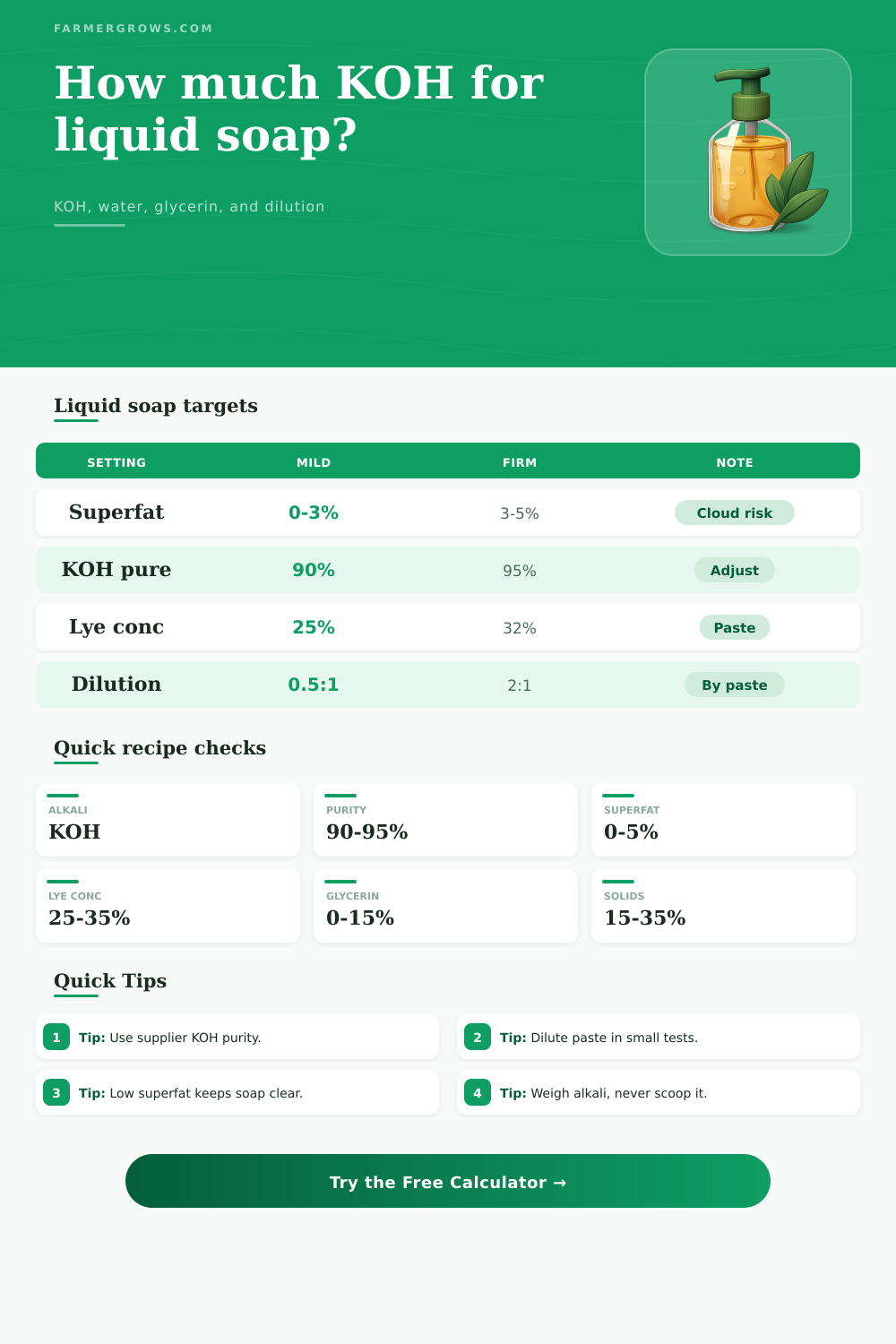
Another factor to consider is the superfat percentage of the liquid soap. The superfat percentage is the percentage of oil that will remain unreacted with the potassium hydroxide. The percentage can be small to allow for some oil to remain unreacted with the potassium hydroxide so that the liquid soap will feel more conditioningly to the skin.
However, if the superfat percentage is too high, then the liquid soap could become cloudy or separate. To avoid these issues, most individuals will use a low superfat percentage when preparing their recipe. Another factor to consider when preparing the liquid soap is the concentration of the lye solution that will be used.
The concentration will determine the amount of water that will be added to the potassium hydroxide and oil mixture. If the concentration is low, more water will be added to the lye solution. More water will make the paste that is created during the mixing process more loosely.
If the paste is too loose, it will take longer to cook the paste to create the liquid soap. If the concentration is high, then less water will be added to the potassium hydroxide and oil. Less water will create a stiff paste.
This paste may be more difficult to stir when making the liquid soap. However, both types of pastes can be used in the recipe and the provided calculator will calculate the amount of water. Another ingredient in the liquid soap is glycerin.
Glycerin is naturaly occurring in the liquid soap as a byproduct of the saponification reaction. However, individuals can also add glycerin to the liquid soap to enhance its properties. Adding extra glycerin to the liquid soap will increase the clarity of the liquid soap.
Additionally, extra glycerin will allow for the liquid soap to dissolve more easy. However, if too much glycerin is added to the paste, the liquid soap can develop a sticky texture when it is poured into a container. Once the paste has been cooked, another factor to consider is the dilution ratio for the liquid soap.
The dilution ratio will indicate the amount of water that should be added to the cooked paste to create the liquid soap. If a high amount of water is added to the paste, the resulting liquid soap will be thin. If less water is used, the liquid soap will be thicker.
There are many variable that can impact the quality of the liquid soap. For instance, as the paste is cooked, the evaporation of the water will change the weight of the paste. Additionally, the humidity in the workspace will impact the amount of water that the liquid soap absorbs.
Lastly, if the liquid soap is stored at different temperatures over time, it may lead to cloudy liquid soap. Creating and testing a small batch of the liquid soap prior to adding it to large batches of liquid soap can mitigate all of these variables. In addition to the variables of the ingredients for the liquid soap, another consideration is the way in which the potassium hydroxide should be handled.
Potassium hydroxide will absorb the moisture in the air. This will change the purity of the potassium hydroxide. To avoid this change in purity, it is important to store the potassium hydroxide in a tightly sealed container and to weigh the potassium hydroxide as quicklyly as possible.
The calculator assumes that the purity level of the potassium hydroxide is accurate. Therefore, care must be taken to ensure that the amount of potassium hydroxide that is measured is accurate. Finally, another use of the calculator is to determine the solids percentage of the liquid soap.
The solids percentage will determine the amount of soap solids that are in the liquid soap as compared to the water content of the liquid soap. If the percentage of solids is low, the liquid soap will be thin and contain more water than soap solids. Higher percentages will create liquid soap with a thicker texture.
However, the solids percentage will not indicate if the liquid soap is stable. Stability can also be impacted by the mineral content of the water that is used and the age of the oils. The provided calculator will help the individual to calculate the mathematics behind the recipe so that they can focus on the other aspects of creating a batch of liquid soap.